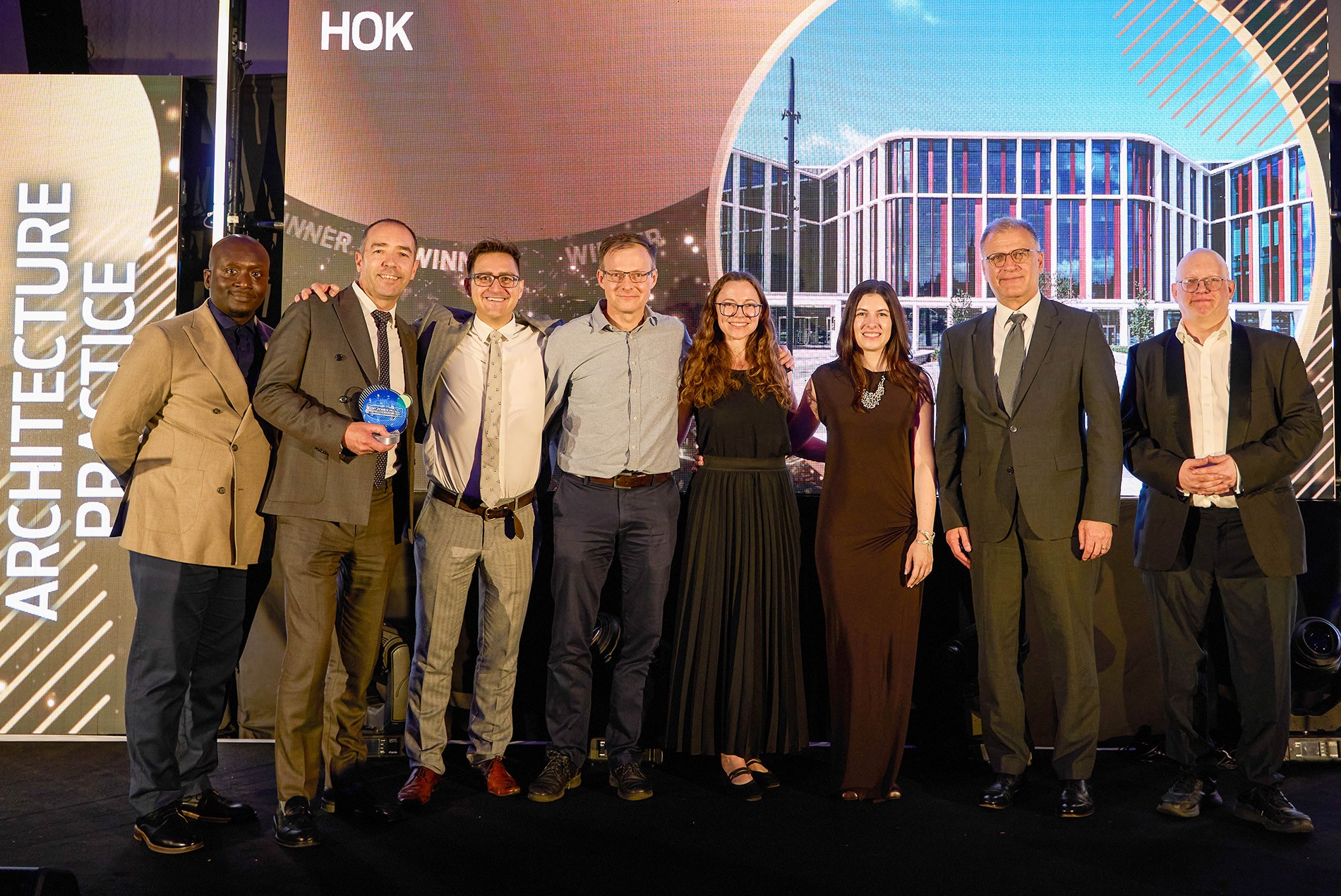
Judges recognized HOK for its evidence-based design methodology, the scale of its UK life sciences delivery and its leadership in neuroinclusive laboratory design.
HOK has been named Best Architecture Practice at the 2026 Construction News & Property Week Life Sciences, Tech & Research Clusters Awards, presented on June 23 at a gala ceremony at the Hilton Bankside in London.
Now in its third year, the awards drew more than 90 entries across 18 categories and were judged by a panel of over 25 industry experts. More than 250 senior figures from across the UK life sciences, technology and research sectors attended the ceremony.
HOK was selected from a shortlist that also included Arup Architecture, Bond Bryan, Corstorphine & Wright, David Miller Architects, Niazi Roden and Oberlanders Architects.
In their citation, the judges recognized HOK for “its delivery of major, technically complex life sciences projects combined with a strong focus on user-centred design and research-led innovation.” They particularly valued HOK’s work in advancing neuroinclusive design and its application of workplace phenotyping “to better understand how laboratory environments are used in practice,” noting that these approaches “demonstrate a forward-thinking commitment to creating spaces that enhance user wellbeing and scientific performance.” The judges concluded that “the strength of HOK’s evidence-based design methodology, scale of delivery and continued exploration of how space supports people and science set it apart as a leader in the sector.”
The practice’s work spans several of the UK’s most significant research projects. For DEFRA, HOK and WSP are transforming the £1 billion National Biosecurity Centre in Weybridge into a modern diagnostics and research campus capable of responding to animal and zoonotic disease. In Scotland, HOK designed the University of Glasgow’s Advanced Research Centre and is now designing the £300 million Keystone Building, a 27,000-square-meter teaching and research facility targeting BREEAM Excellent and on track to become one of the UK’s largest net-zero-carbon university buildings. In Cambridge, Merlin Place—a flexible new lab and office building for Kadans Science Partner—opened this year at the Cambridge North Science & Business Cluster. HOK was also lead designer of the Francis Crick Institute, whose researchers have published nearly 2,000 papers, including work that contributed to mapping the COVID-19 spike protein and advancing gamma delta T-cell therapies. Named R&D Magazine’s Lab of the Year and rated BREEAM Excellent, the Crick marks its 10th anniversary this year.
Alongside its project work, HOK’s London Science + Technology practice runs an active research program into how scientific workplaces affect the people who use them. Building on the Glasgow ARC, the team conducted a phenotyping study of more than 500 laboratory rooms and developed a Workforce Phenotyping approach now used across the sector to match headcount to the lab space researchers actually need. A 2024 study with Advanced Research Clusters and the University of the West of Scotland found that nearly half of lab workers surveyed identify as neurodivergent, more than double the general population average. The findings have informed a neuroinclusive design blueprint now embedded in HOK’s major UK life sciences projects, including ARC and Keystone.
Across the portfolio, projects target BREEAM Excellent or Outstanding and pursue net-zero-carbon outcomes.
See the full list of 2026 winners on the Construction News & Property Week Life Sciences, Tech & Research Clusters Awards site.