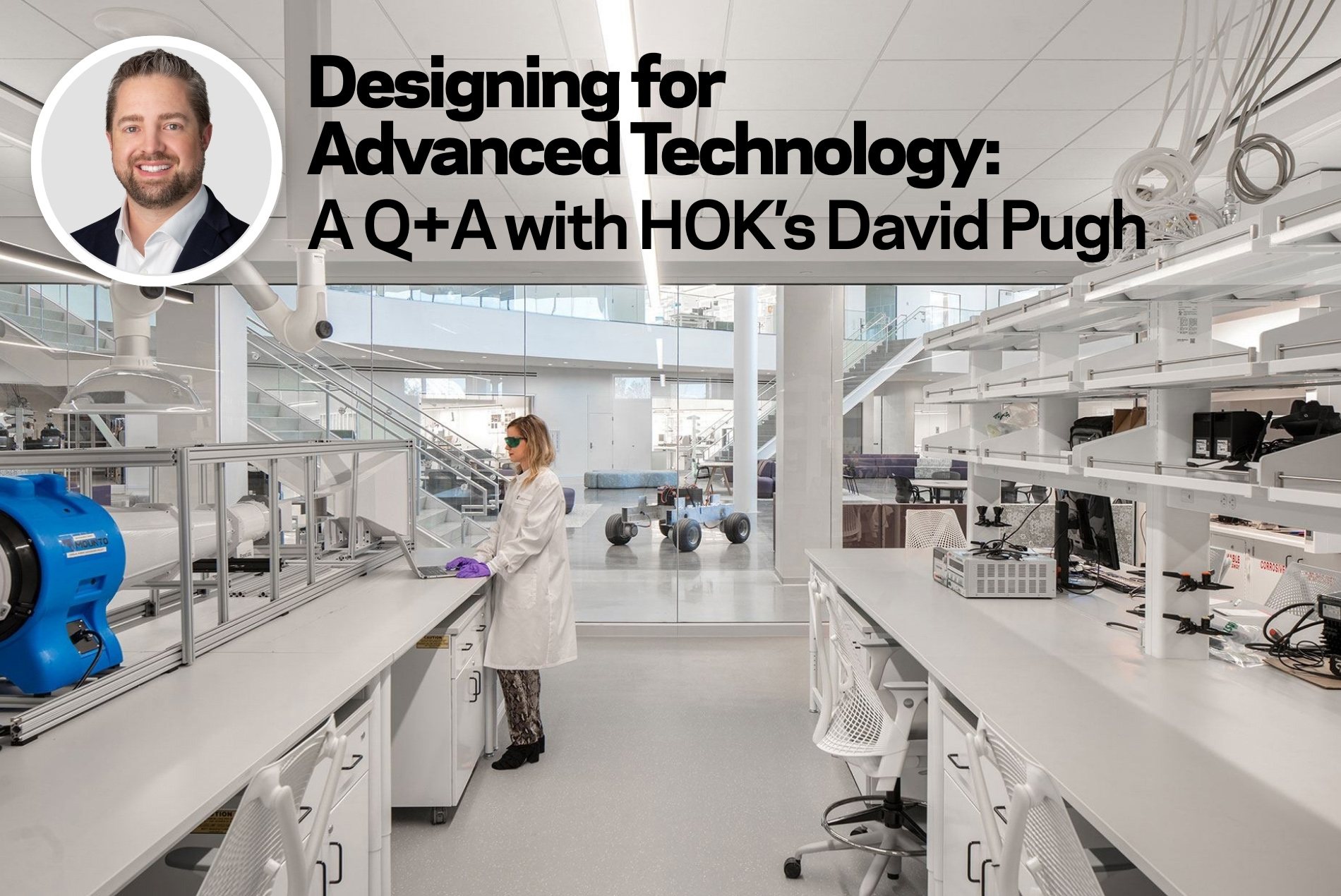
David Pugh discusses HOK’s expanding focus on emerging technology sectors and the “fun” of solving complex problems.
David Pugh, AIA, LEED AP BD+C, recently joined HOK as a principal and the firm’s Advanced Technology sector practice leader. Based in San Francisco, he is helping expand HOK’s Science + Technology work in emerging and advanced technology sectors including robotics, quantum sciences, corporate technology and semiconductors.
In this conversation, David shares his perspective on the evolving landscape of advanced technology facilities and why he loves the complicated side of architecture.
What does advanced technology mean at HOK, and which sectors are you focused on?
David: Tech can mean so many things to different people. HOK works on everything from office spaces to engineering labs, R&D facilities and everything in between. We already have an incredible team focused on delivering exceptional office spaces for our technology clients. I’m here to help our Science + Technology team tackle those highly complex programs where HOK’s expertise really shines.
This includes everything from semiconductors and quantum—both computing and measurement—to automotive R&D and aerospace. We focus a lot of our attention on robotics, advanced manufacturing and medical devices, and have expertise in the future of mobility, from EVs to autonomous vehicles.
Our work isn’t always standalone buildings. You might not see a building that is purely a robotics facility. These component parts exist within a larger ecosystem within the building to serve a bigger purpose. So, whether it’s a clean room, a secure facility or a quantum lab, we’re looking at these as specialized components and how they contribute to the needs of a variety of clients and project types.
One challenge in this space is that NDAs are extremely common. We need to respect our clients’ confidentiality while still showing the industry what we’re capable of. Sometimes that means creative storytelling and only being able to show diagrams or renderings.
What drew you to this role and to HOK?
I’ve been practicing architecture for nearly 23 years. Early in my career, I started gravitating toward the technical aspects of the work, which led me down a path of taking on more and more complicated projects. For me, this meant I found projects with technically complex spaces and requirements even more exciting and rewarding.
When my kids ask me what I do for a living, I tell them that I enjoy solving really complicated problems. I love that within this role, I can help clients when they say, “I have this situation and I don’t really know what to do with it.”
I was specifically drawn to HOK to be a part of this incredible team of experts. This firm has the technical chops and high design standards that I respect, without the black-cape culture of design you see in some other firms. There isn’t that level of ego here. We want to do incredible work, but we also really want to be partners with our clients.
 What are the biggest challenges your clients are facing now?
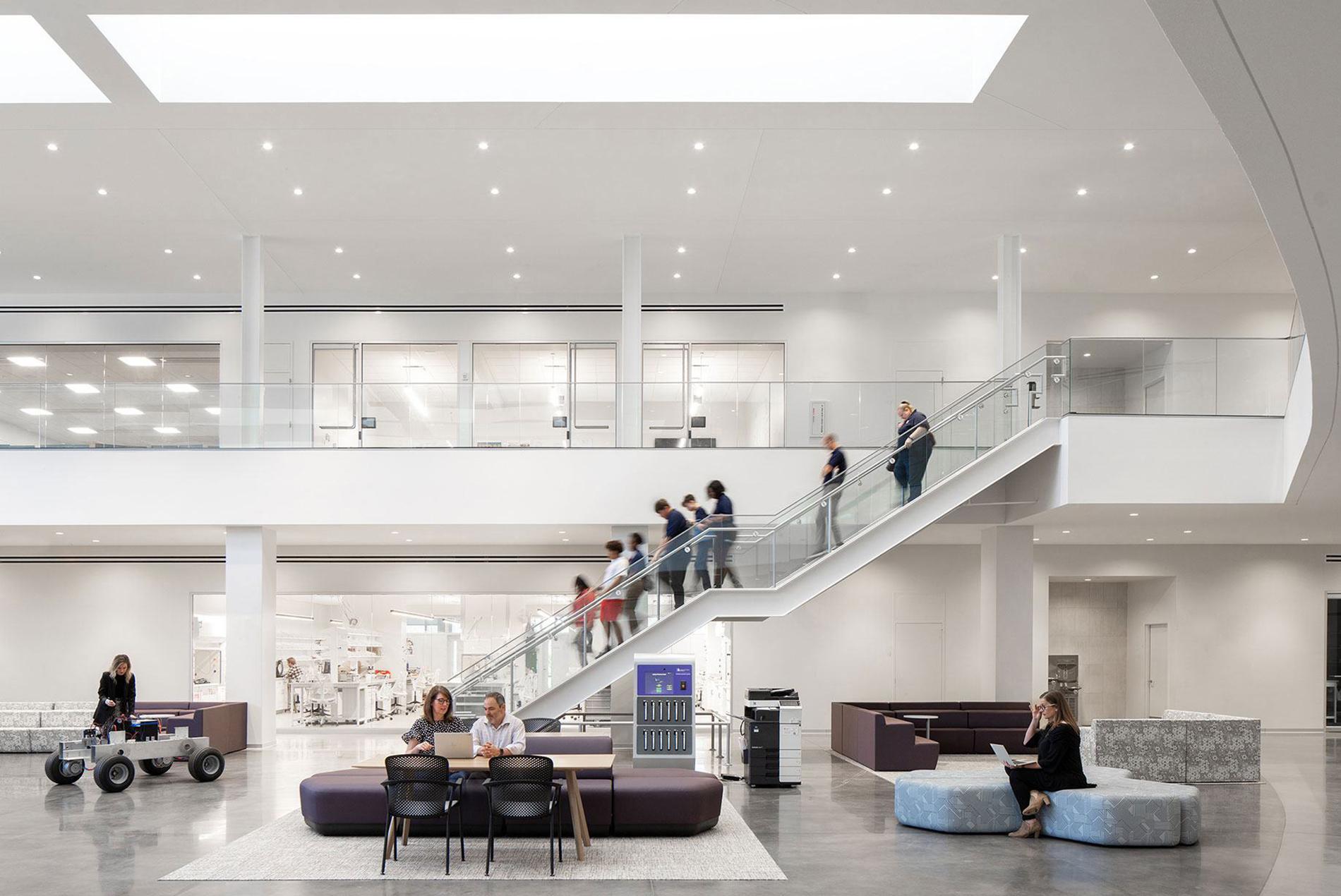
The biggest one is flexibility. Funding sources change, politics change and technology evolves so fast. Advanced technology is blending into life sciences and office spaces more and more each day. Our clients need spaces that can adapt to an ever-changing landscape.
I spoke with a contractor about several recently completed buildings that are struggling because they were designed to focus on a single tenant or a specific type of science. If you design a highly specialized building with expensive infrastructure and that tenant leaves, you can be stuck with a liability.
We try to help clients see a building’s second life. But I’ll be honest: Anyone who says they have “future-proofed” a building is lying. There’s only so much anyone can do. We love helping our clients think holistically about what a building could be if things change, or helping them thoughtfully convert from one focus to another, rather than just having to knock it down and start from scratch.
You mentioned that project types are blending. What does that look like?
I don’t think there are many parts of the industry that sit separate from everything else anymore. It doesn’t work that way in this day and age.
A traditional life sciences client might now need server farms, robotics and automated 24/7 facilities. We’re seeing early use cases where life science and pharma teams are looking to model outcomes digitally before ever doing any clinical research. This type of integrated science and technology increases computing needs and requires very low latency.
This brings up new challenges, especially regarding power. As more equipment is added to a facility or chips evolve and get even faster, our clients need more power. So we aren’t just designing a lab. We’re helping clients plan facilities responsibly in light of that energy demand. It requires a mix of architecture, engineering and sustainability that you can’t really silo. We need to bring all parties to the table at the very outset of a project to ensure that the site can actually support the proposed functions.
What can HOK’s integrated approach offer clients in this space?
We want to be the trusted advisor who gets the first phone call. Even if a client just says, “I was asked for something I have never heard of before and I don’t even know what that means yet,” we can help them figure it out.
Because we have architecture, engineering, interiors, planning and consulting all under one roof—and can integrate specialist partners whenever needed—we can offer a level of expertise and coordination that is hard to get elsewhere. Other firms might have to piece that team together with consultants or other outside groups that they haven’t worked with before.
There is no “easy button” in the advanced technology sector. This type of work is inherently complex. However, having such a deep bench of experts and the opportunity to build an integrated, in-house team makes the process with HOK much smoother for the client.
You’ve identified Customer Experience Centers as a key emerging opportunity. Why are these becoming so critical for your clients right now?
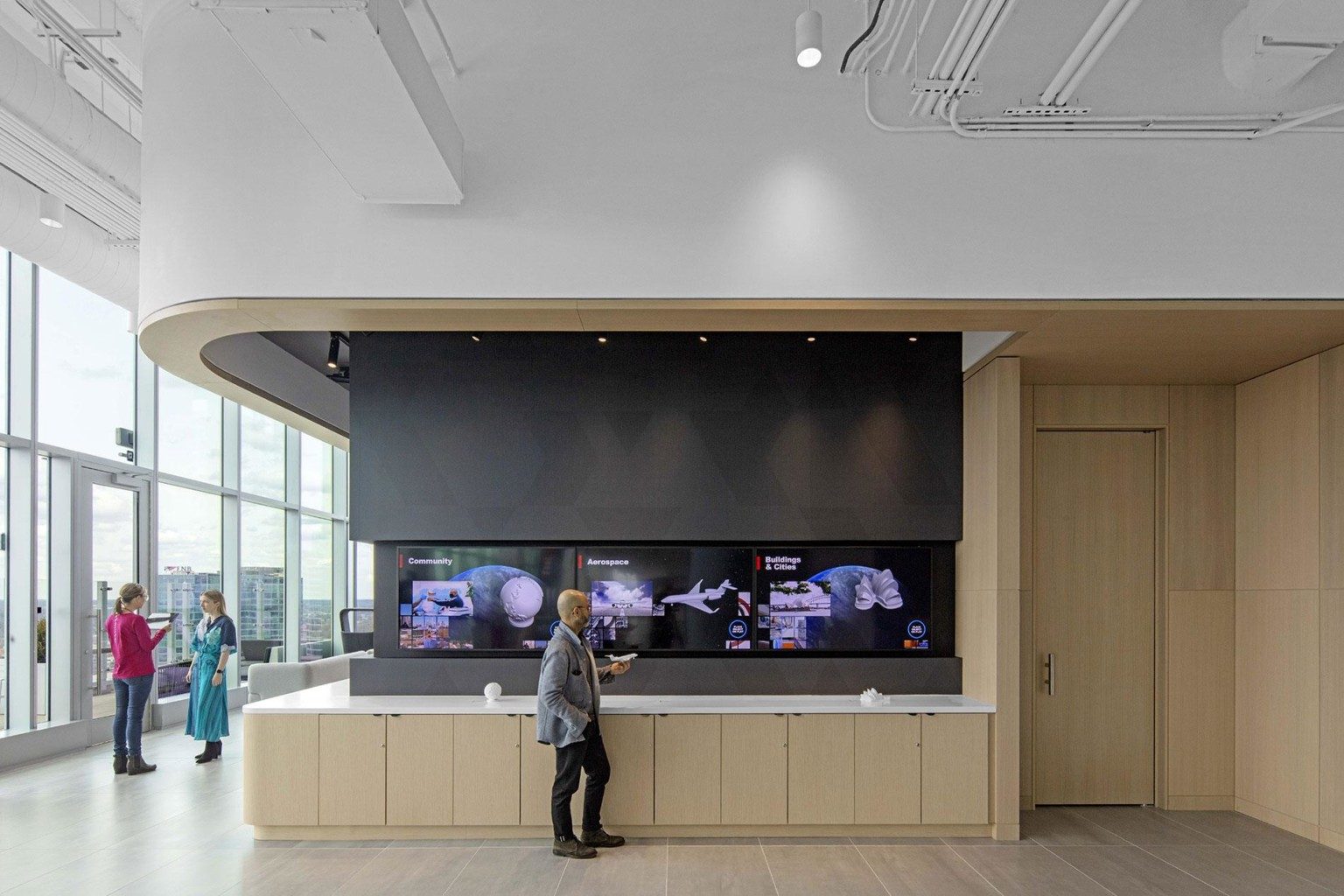
Honeywell Customer Experience Center in Charlotte, North Carolina
These are fun ones where we’re able to engage experts across our firm, from experience design to interiors and hospitality design, to create one-of-a-kind spaces for our clients.
As competition heats up—whether you are a quantum company or a vertical takeoff startup—you need a place to bring investors and customers to show them what you can do and why they should partner with you.
These spaces can range from a tech-enabled boardroom to fully immersive exhibition areas with AR, VR and live product demos. I worked on one in Ottawa that included multiple pavilions, each showcasing different technologies. In the end, it’s about differentiation. If you’re competing for the next round of funding or the next big contract, how you physically present your technology matters.
How does workplace design factor into advanced technology facilities?
Anyone who ignores the human side of the scientific workplace is putting their head in the sand.
There’s an outdated notion that scientists and engineers only need to work in sterile, high-tech boxes where all spaces are exactly the same, but that’s just not true. We know from our research on neuroinclusion that very often, the people drawn to life sciences and advanced technology work differently. That difference is part of why they are so successful, and we need to support all aspects of their work.
Our projects can’t just be about having the latest and greatest lab. That’s a huge part of our work, of course, but we have to focus on the other types of work being done in the facilities we design. We need to create spaces that support the incredible people who work there and their needs throughout the day.
If companies want to maintain the workforce they spend so much time building, they have to address more of their teams’ needs. All of this is amplified by the fact that, as advanced technology labs and other spaces make their way into more industries, everyone will be competing for the same incredibly talented individuals.
Let’s Connect
Considering an advanced technology project? David Pugh and HOK’s Advanced Technology practice bring decades of experience designing complex research and technology facilities for corporate, institutional and government clients worldwide. Contact david.pugh@hok.com to begin the conversation.