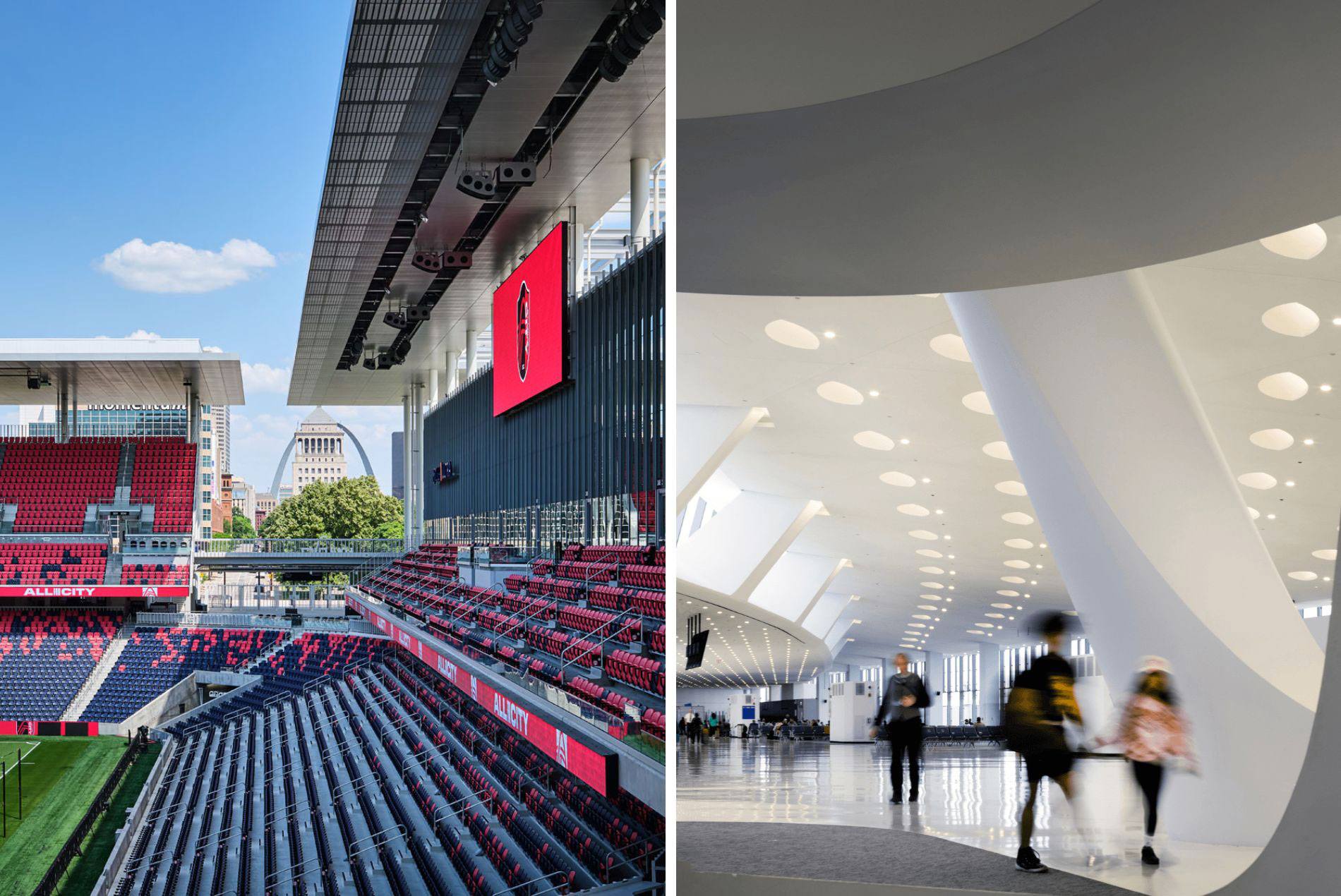
Energizer Park and Chicago O’Hare International Airport Terminal 5 Expansion are finalists in the 2025 Structural Engineering Excellence (SEE) Awards.
For the sixth time in eight years, HOK’s Engineering practice has achieved one of the profession’s top honors—earning recognition in the National Council of Structural Engineers Associations’ 2025 SEE Awards.
Energizer Park, home of Major League Soccer’s St. Louis City SC, was named a finalist in SEE’s Social Impact category. Chicago O’Hare International Airport Terminal 5 Expansion was named a finalist in SEE’s Bridge and Transportation category.
“The NCSEA Awards recognize the best work in our industry and are incredibly competitive,” said Matt Breidenthal, director of HOK’s Engineering practice. “HOK is proud to have been recognized twice this year, continuing the trend of having our work singled out for exceptional structural engineering.”
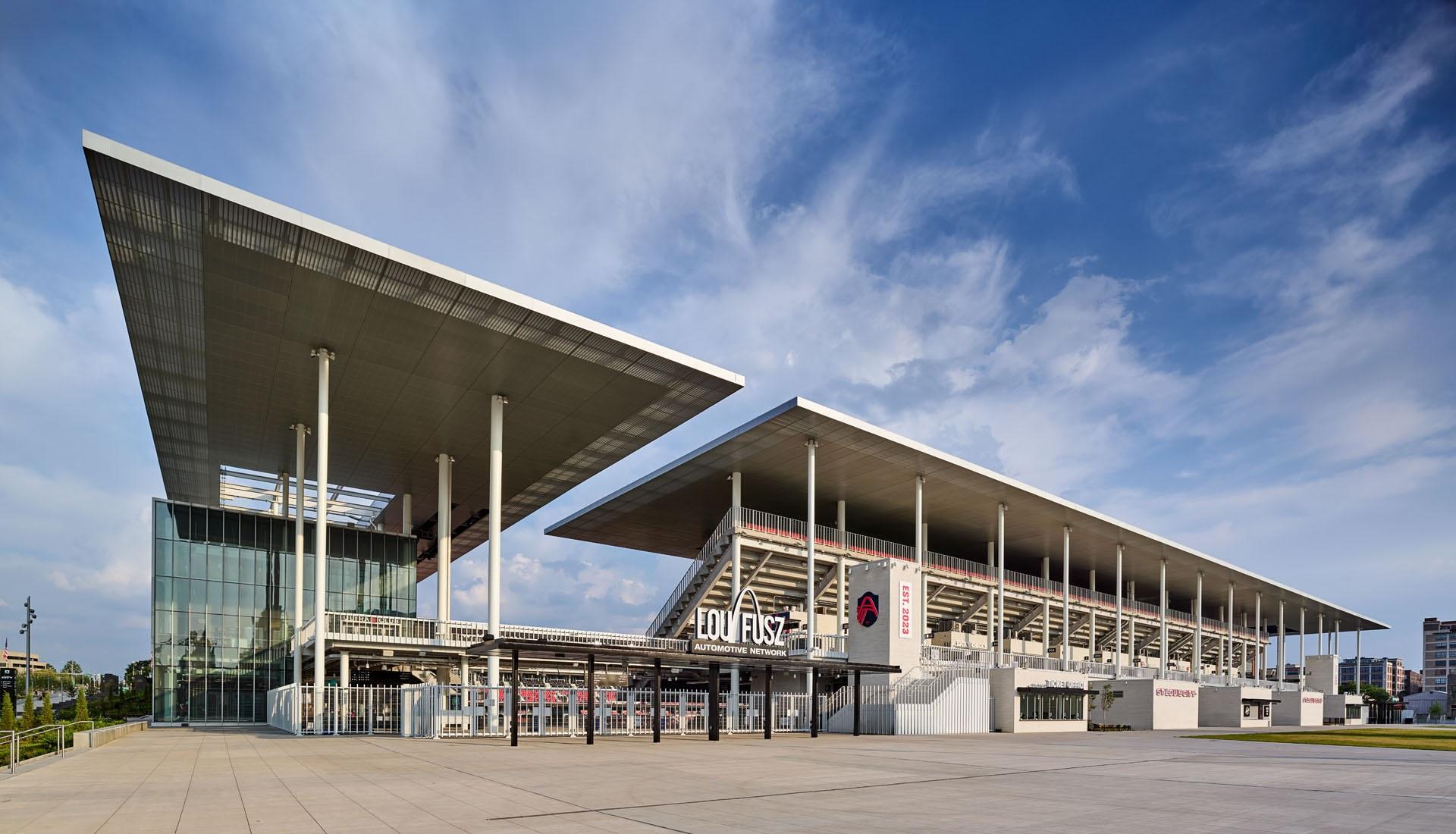
Energizer Park in St. Louis is known for its expansive roofline, slender support columns, and open sightlines into and out of the stadium.
About Energizer Park
Designed as more than a stadium, the 22,500-seat Energizer Park serves as the centerpiece of a vibrant new sports-anchored district in downtown St. Louis. The project’s innovative structural engineering includes:
- Slender steel columns and concealed lateral framing offer spectators unimpeded views of the pitch and allow passersby to see into the stadium.
- A thin canopy roof supported by hidden steel trusses and tapered girders. The roof’s engineering allows it to cantilever far over the seating bowl, reflecting sound back onto the pitch and protecting fans from the elements.
- A subterranean loading dock and tunnel allows all four sides of the stadium to be active and accessible. The underground bay is wide enough for a tractor trailer to turn around and is supported by a 150-foot-long concrete girder with parallel steel stusses. A street-level plaza above the bay serves as a fan gathering place.
“We created a transparent structure, where the lateral system disappears from the view, emphasizing the stadium’s openness and its connection to the surrounding neighborhood,” said Francesca Meola, HOK’s lead engineer on the project. “The amphitheater-like layout allowed us to create a unique and intimate experience for the fans inside the stadium.”
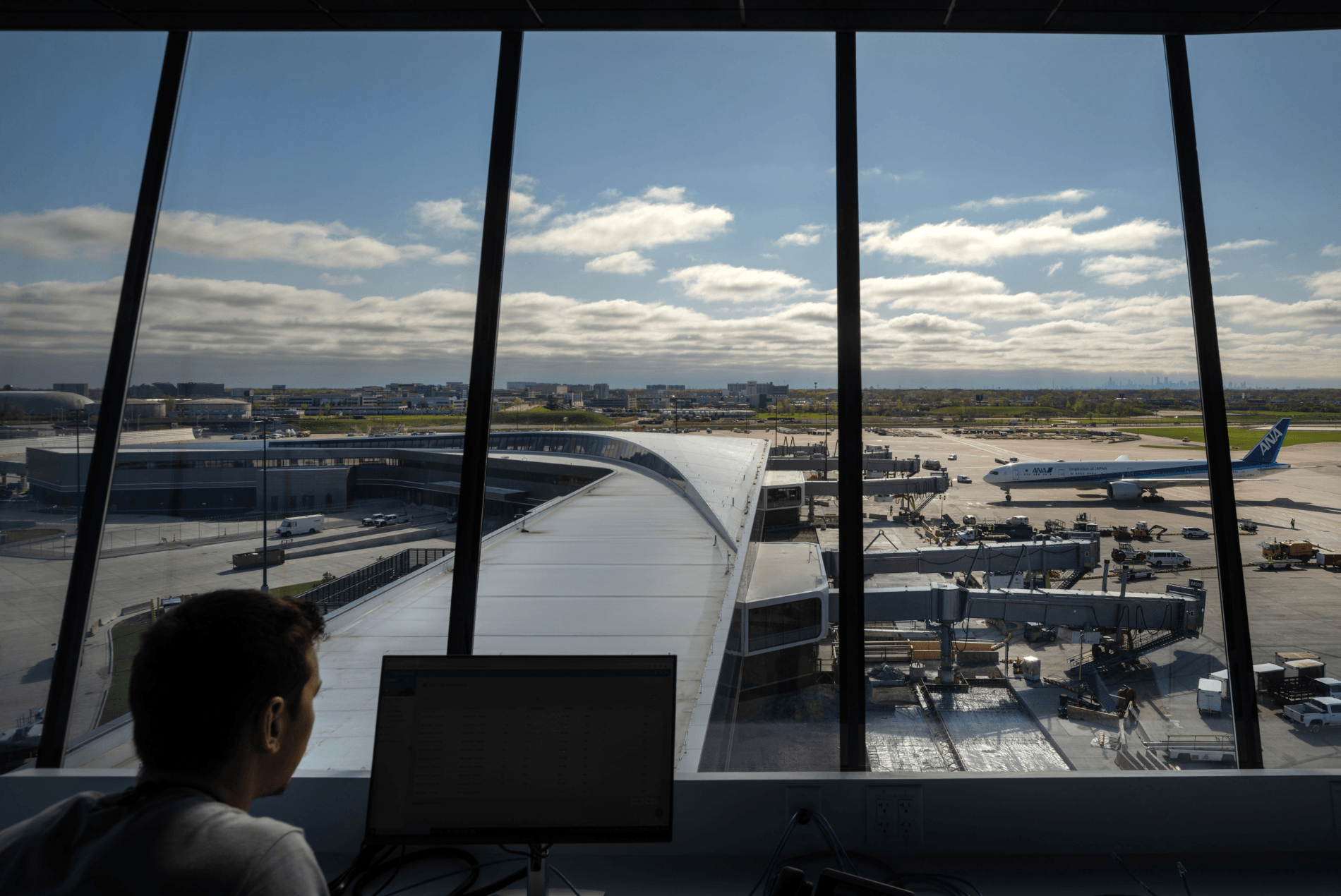
A view of the L-shaped extension of Chicago O’Hare Terminal 5 as seen from the terminal’s control tower.
About O’Hare Terminal 5 Expansion
The expansion of Terminal 5 at O’Hare International Airport added 300,000-sq.-ft. to the building’s existing east concourse. Originally conceived as a linear extension, the design team ultimately bent the concourse into an L shape to optimize airfield real estate and create an expansive town square at the building’s “elbow.” The project’s unique structural engineering includes:
- An 800-foot-long parabolic clerestory supported by bent steel girders that span the entire 67-foot width of the concourse.
- A column arrangement that minimizes the number of interior columns and allowed the complex roof framing to be structured entirely out of readily available rolled shapes without built-up trusses.
- To vet the concourse’s complex roof geometry and communicate that geometry in structural drawings, HOK’s engineers developed a parametric script that defined a series of intersecting planes and two singly curved tilted barrel vaults that create the appearance of a curving roof structure.
“One of the biggest challenges was proving the roof structure could be built using standard shapes without excessive fabrication complexity,” said Mark Hendel, HOK’s lead engineer on the project. “By running the design through our parametric script and working with the architecture team, we demonstrated that the roof was really just a series of intersecting planes. Once we showed that to the contractor, they responded, ‘OK. Let’s do this.’ That was a great moment.”