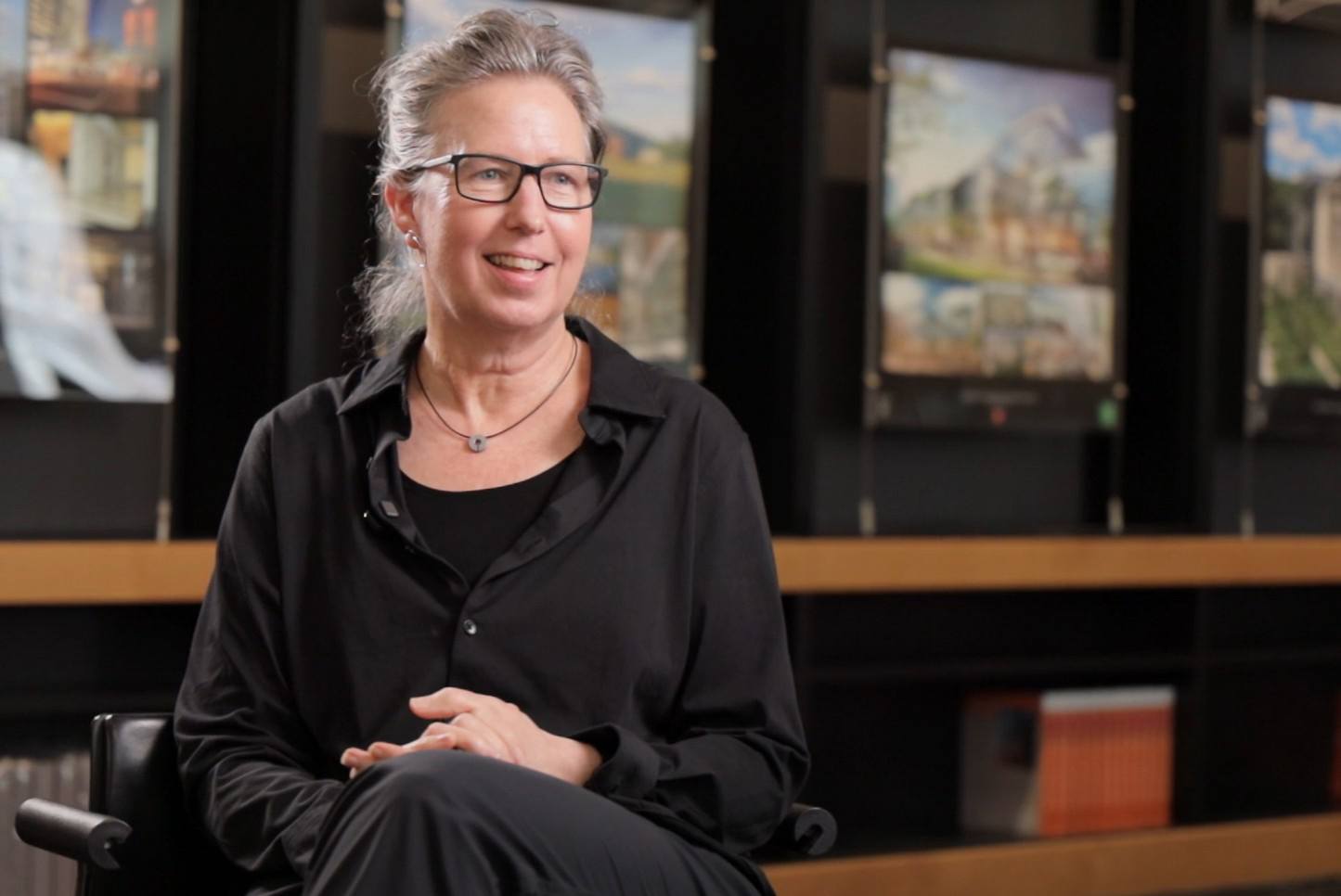
HOK’s sustainable design leader for resiliency discusses why resilience begins with curiosity, how forward-looking data is changing design and why, in her words, “nobody wants disruption.”
Ann Kosmal has spent much of her career helping organizations prepare for observed and expected changes in climate. Before joining HOK as sustainable design leader for resiliency, she guided climate risk management and adaptation efforts for the U.S. General Services Administration’s federal real estate portfolio and contributed to climate adaptation and resilience initiatives across the federal government.
Today, she helps clients understand how extreme weather and long-term climatic changes can affect their buildings, operations and investments—and what they can do about it. She also contributes to industry standards, national climate assessments and professional guidance that shape how the built environment responds to these changes.
As she discusses below, much of Kosmal’s work comes down to helping clients answer a simple question: What happens if a building can no longer do what it was designed to do?
Watch an in-depth discussion with Kosmal below or jump down to highlights from the conversation.
Note: The answers below have been edited for length and clarity.
How do you help clients and their projects?
It starts with genuine curiosity. Working in climate resilience and adaptation requires a deep understanding of the client. What are they doing in this place that they can’t do someplace else? And what are their sensitivities to interruption, relocation or replication?
Once you know that, you can start to answer other questions. What do we have to be resilient to? For how long, for what purpose and for whom?
Then it becomes about understanding how forward-looking data can help clients understand their vulnerability. Are they willing to accept some interruption or, if interruption is unacceptable, what design measures do they need to take? That’s the biggest way I help, and it needs to begin early in the design process.
Why did you choose to focus on resilience?
It chose me.
Early in my federal career, I was working on a net zero energy project. I was learning a lot. Then, at some point, I realized the project would never actually achieve net zero energy as designed over its expected service life. That was gut-wrenching for me.
It wasn’t about being wrong. It was that I had never been taught to think about design this way. So much of architectural education is based on historical information. Adaptation and resilience require looking at forward-looking information so that what we’re designing is truly fit for purpose over time.
That realization pushed me to spend more time with climate scientists. It forced me to understand what they were talking about, learn how to ask better questions and figure out how to use that information to inform design decisions for the built environment.
How has the definition and approach to resilience changed over the years?
There are aspects that have changed, particularly when it comes to the use of terms and what they mean to different people and different groups.
But I take it back to the core response to climate change: How does it affect a building owner’s ability—or a client’s ability—to perform their business?
Resilience is not a guarantee or even necessarily a desired outcome. In some situations, climate adaptation is required, prompting relocation or changing course. There’s no resilience in relocation. That’s why it’s important to be clear and accurate about vulnerabilities, outcomes and expectations so there’s no misunderstanding.
How do you navigate differing perspectives on climate risk while advancing readiness?
It requires distilling and simplifying the message.
At the GSA, that simplification was all about safeguarding assets and maintaining mission continuity. In my work now, it’s not mission continuity, but business continuity.
How does a building owner avoid interruption, relocation or replication? Because nobody wants disruption. Nobody.
Once you focus on that, the conversation becomes much simpler. The question isn’t about debating risk. It’s about understanding what people need a building or asset to do and how they can keep doing it over time.
Beyond your design work, you also shape adaptation and resilience codes, standards and best practices. How does that benefit your clients?
It provides a front-row seat into actionable science and the methods being used or developed for that science.
This is an arena where people are not operating as activists. They are looking at what is practical and what will help owners protect real property and investments.
It’s about using science to help clients make decisions that align with their risk management objectives. Some resilience measures are relatively simple. Others can be expensive. The key is understanding which strategies align with a client’s investment goals, long-term plans and tolerance for risk.
Whether it’s with the American Society of Civil Engineers, ASHRAE, the American Institute of Architects or my work with the National Climate Assessment, it all provides a view into how science can help us make more informed decisions for clients and the public.
What’s one thing a property owner can do to determine the resilience of their investment?
Start with a property resilience assessment led by an architect or engineer.
Understanding not just what a property is exposed to, but where it is truly vulnerable, is a huge step forward. A building can be exposed to a hazard without necessarily being sensitive to it. Understanding that distinction helps owners focus their resources where they can have the greatest impact.
There are standards available today, including ASTM E 3429, that can guide these assessments. Online tools can be useful for understanding high-level exposure, but they can’t tell you how a site drains, how a building has been maintained or how its assemblies actually perform.
Ultimately, resilience starts with understanding both the property and what the owner needs it to do. I also encourage owners to focus first on the things that cost the most, last the longest and are most consequential to business continuity—often the building enclosure and site development. If a site floods and people can’t get there, the building can’t do its job.