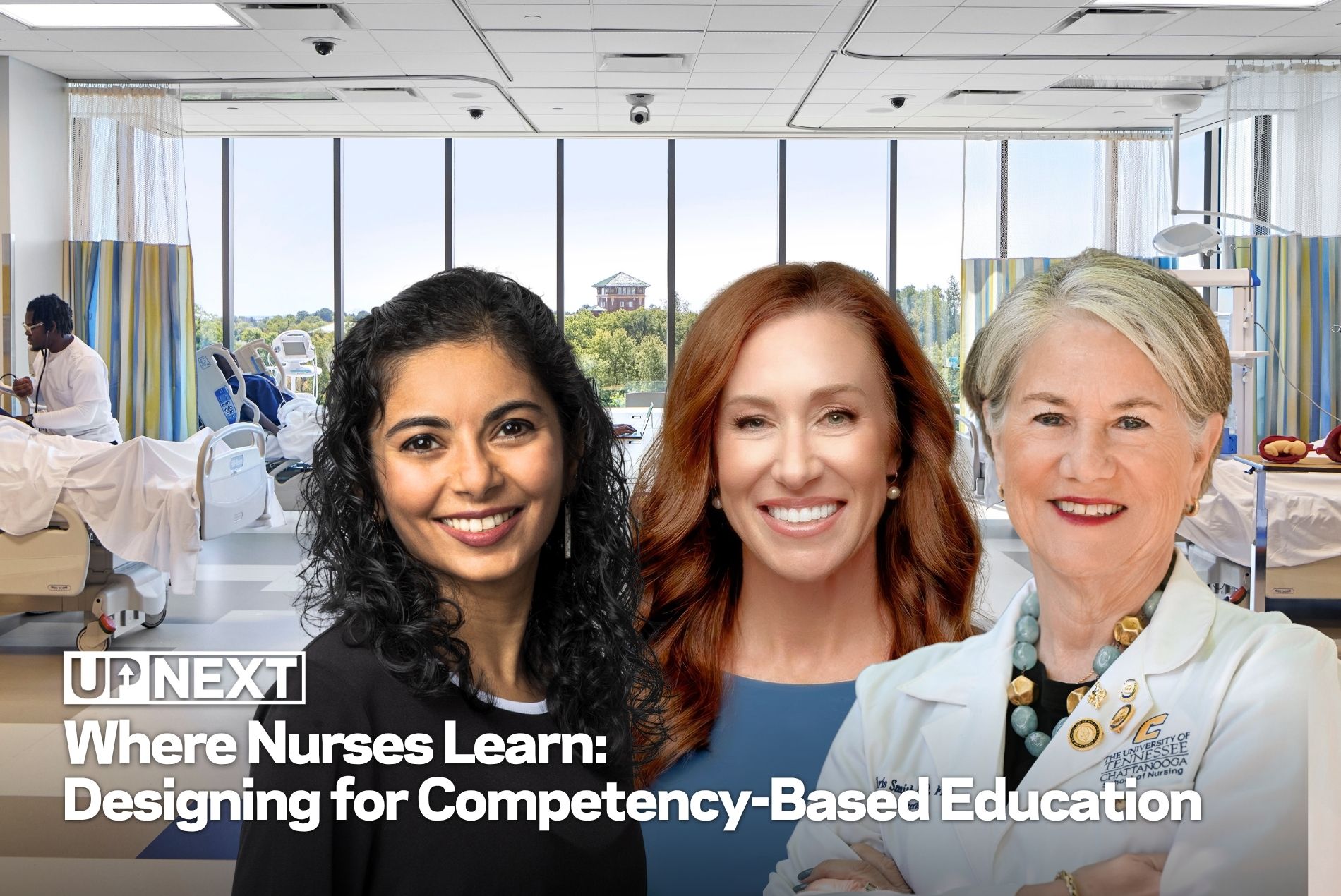
A recent HOK Up Next panel joined experts in nursing, education and design to discuss how a fundamental shift in nursing pedagogy is reshaping the buildings where the next generation of nurses trains.
Nursing education is undergoing its most significant transformation in decades. The American Association of Colleges of Nursing’s (AACN) new competency-based education (CBE) framework means nursing students must prove not just what they know, but what they can do.
This shift from time in the lecture hall to skill demonstration is changing how curricula are structured, how technology is deployed and how learning facilities are designed. Those themes anchored the HOK Up Next conversation featuring three experts:
- Ami Shah, health education practice leader at HOK
- Sarah Holton, senior healthcare consultant at HOK and registered nurse
- Chris Smith, dean of the College of Nursing at the University of Tennessee at Chattanooga, nurse and nurse practitioner
Watch the full panel discussion and read the key takeaways below.
Beyond the Lecture Hall
One of the main changes brought on by CBE requirements, said Dr. Smith, is that academic institutions are now combining didactic and clinical experience rather than introducing them as separate, sequential steps.
“We focus on what students can do in practice rather than how many hours they spend in a class or skills lab,” she said. “It emphasizes observable performance and allows the person who is hiring that student to actually understand how competent the individual is.”
Simulation at the Center
If CBE is the pedagogical shift, simulation is its vehicle. State boards of nursing now allow up to 50% of clinical hours to be completed through simulation, and the design implications are significant. Shah shared that HOK’s design of UTC’s new College of Nursing building centers on the belief that simulation is essential rather than supplemental.
“We want to make sure that you, as an educator, are able to sit with the learner during their assessment and debriefs and give them the chance to reflect and improve on their skills,” Shah said. “As designers, we have to make sure there are no physical limitations, so you can really teach and have competent nurses at the end of the day.”
To support this, 40% of the space at UTC College of Nursing was designed for simulation. Classrooms house fewer traditional seats and instead offer space to wheel in a stretcher or mannequin for practicing procedural skills. The program is flexible to accommodate changes in technology over time.
Designing for How Students Learn
In addition to better preparing nursing students for clinical practice, CBE better responds to how today’s students prefer to learn.
“With the explosion of technology, our students are expecting more exciting ways to learn,” Dr. Smith said. “I can’t just read off a presentation. Students want hands-on, immersive learning.”
“We’re acknowledging that adult learner who wants to interact with the material,” Dr. Holton said. “From a design perspective, we want these learning spaces to mimic the real-life experience. It allows the student to immerse themselves in the lived experience of a licensed professional.” A simulated environment such as a patient bedroom, operating theater or infusion chair helps students experience what it’s like to be a professional nurse and prepare for specific challenges they might face with a patient, she explained.
UTC nursing classrooms can record student simulations, and students can watch and learn from the video in conference-style debrief rooms designed to promote discussion. “The debrief is equally, if not of greater importance than the simulation itself,” Shah said. “That’s where the real learning happens. That’s why UTC has a 1-to-1 ratio of debrief rooms for every simulation space.”
Artificial intelligence makes certain simulations more robust, Dr. Smith said, allowing students to practice interactions with patients’ families following a difficult decision or procedure, for example.
Closing the Nursing Gap
Nursing faces a well-documented workforce shortage. Educational facilities designed to support CBE can help attract the next generation of nurses and prepare them to stay in the profession.
For example, nurses with a sense of professional efficacy are less likely to experience burnout, Dr. Holton said, and CBE allows students to validate their own abilities before they even enter clinical practice. Dr. Smith also noted that prospective students evaluate programs on the quality of their learning environments, thus making design excellence a recruitment strategy.
Competency-based education is not simply a curriculum update. It reaffirms what nursing school is for and changes what learning facilities need. The spaces where nurses learn must be flexible enough to evolve, immersive enough to build genuine confidence and compelling enough to draw the next generation in.
Shah said: “If a student walks in and feels that this is where they belong, this is how they’re going to make an impact—then we have achieved the goals for the building.”