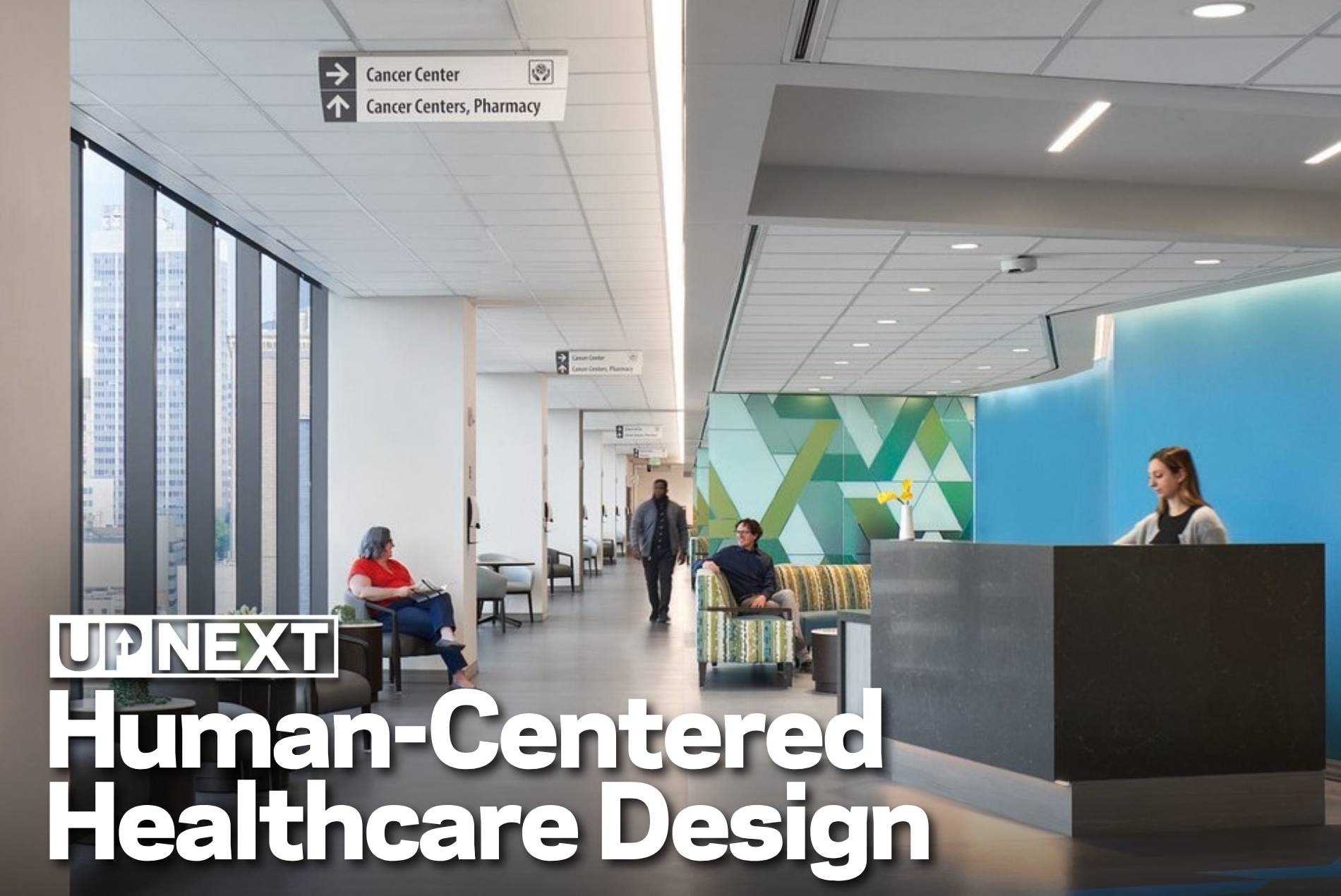
HOK’s Mark Banholzer and Sarah Holton share five human-centered strategies to elevate healthcare design, strengthen communities, and support patients, caregivers and staff.
Today’s healthcare environments are more than places of treatment. They are civic assets that bring together patients, families, caregivers, researchers and entire neighborhoods. As healthcare systems expand their mission, design strategies must adapt—elevating empathy, encouraging collaboration and strengthening a sense of belonging.
In a recent HOK Up Next hosted on LinkedIn, HOK healthcare design experts explored how hospitals and medical spaces are evolving to reflect a broader role. The discussion with HOK’s Mark Banholzer and Sarah Holton shared ideas and strategies for creating healthcare spaces that are as inclusive and intuitive as they are clinically effective.
Check out the full conversation in the video below and continue on for five big takeaways from the discussion.
1. Supporting All Users
For decades, healthcare design has focused almost exclusively on “patient-centered care.” But successful healthcare environments must consider more than that.
“Today’s healthcare buildings are ecosystems for patients, families, providers, staff and researchers,” said Holton, a registered nurse and senior healthcare consultant at HOK. “If we limit the conversation to just one type of user, we’re missing how complex the environment really is.”
By considering every user, design can support positive outcomes across the care continuum. “It’s about designing spaces that foster communication, be it caregiver to caregiver, caregiver to patient or patient to family,” said Banholzer, an HOK senior project designer. “Whether it’s caregiver to caregiver, caregiver to patient, or patient to family.”

Rediscovered murals—commissioned during the 1930s Work Progress Administration—adorn the exterior of Harlem Hospital. | HOK
2. Creating Community
Hospitals are evolving into town squares—civic destinations where people connect with services, culture and each other.
“Hospitals are the new town centers,” said Banholzer. “Healthcare systems are really about engaging their community.”
This civic purpose shows up in thoughtful design elements—from flexible community rooms that host wellness classes to public art installations that reflect the community.
Banholzer highlighted an HOK healthcare project for an indigenous population in Alaska that incorporated graphics of native medicinal plants as a design motif. “It gave patients, families and caregivers a sense of connection to their history,” he noted.
The group also talked about HOK’s modernization of Harlem Hospital, clad with historic murals discovered during the renovation that reflect the local community.
Beyond the walls, outdoor gathering areas can also help welcome the public. Banholzer cited an example from Eskenazi Hospital in Indianapolis, which includes an outdoor space that can host farmers markets and other community events.

A rooftop gathering space at UPMC Mercy Pavilion in Pittsburgh allows clinicians from lower levels to interact with researchers on upper floors. | HOK
3. Designing for Collaboration
Some of the most important medical insights come from unexpected hallway conversations and cross-discipline teamwork. Healthcare environments can encourage these connections by breaking down silos.
At the Morris Cancer Hospital, it was very important to the administration that the clinical labs were inside the building, for example. Researchers and clinicians could see each other in the hallway and have further dialog about specific patients.
Banholzer offered a related example from The Ohio State University Comprehensive Cancer Center. “They actually took the wet lab and put it on the patient unit and put it on display,” he said. “It was all about making sure research was integral to the care team—and letting patients and families see that.”
Mock-ups and stakeholder feedback are essential for testing these collaborative ideas before construction. Mock-ups can help check if project teams are communicating well and improving on previous designs.
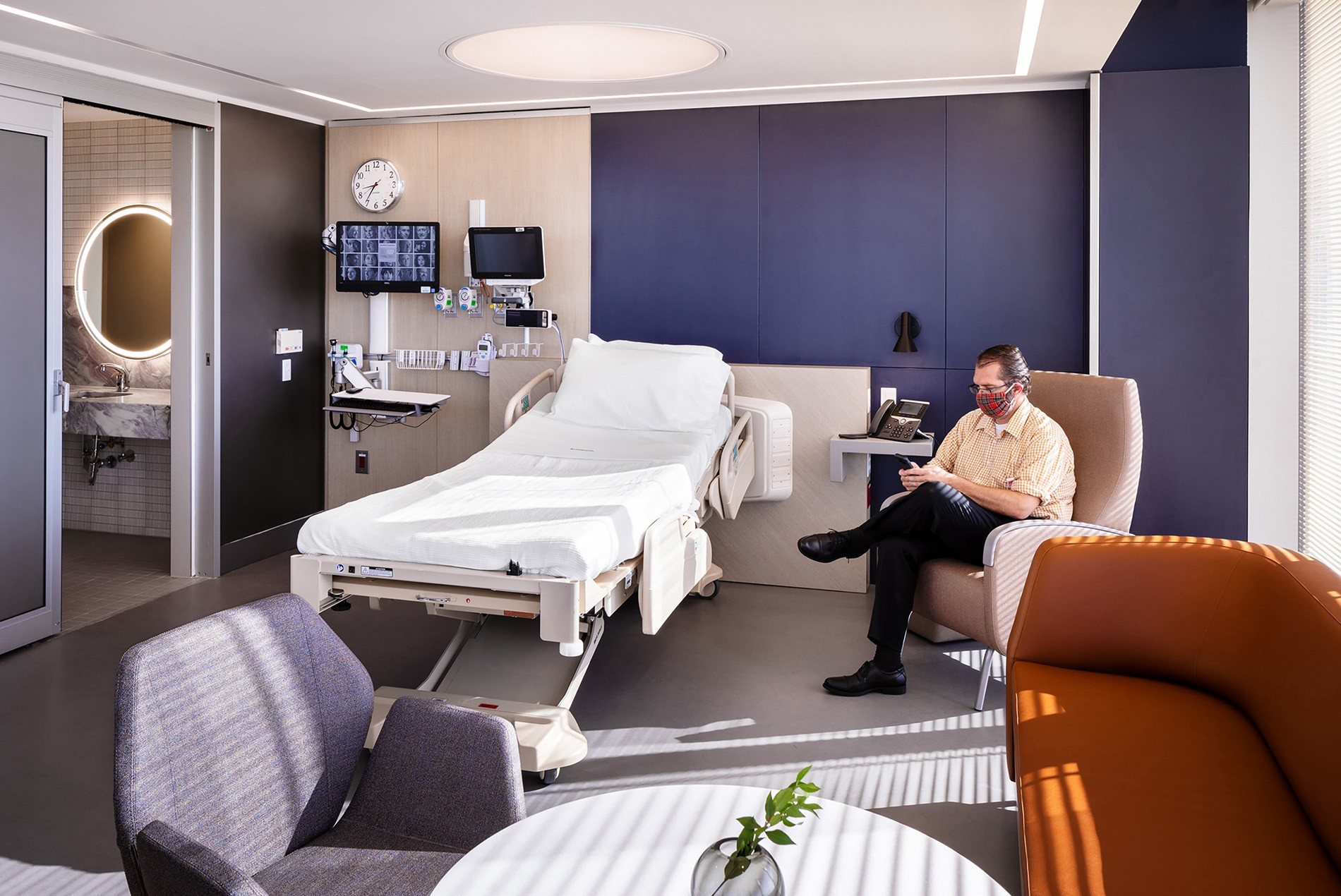
A patient room at NewYork-Presbyterian’s Alexandra Cohen Hospital for Women and Newborns includes family gathering space, natural daylight and an ensuite bathroom. | HOK
4. Balancing Clinical Needs with Empathy
The best healthcare spaces blend operational precision with emotional comfort. Striking that balance takes open dialogue and shared priorities.
Our teams work to create an experience that feels curated to a client’s needs and less clinical within these very clinical environments. It comes down to prioritization and finding solutions in the middle, with open conversation.
Banholzer recalled one project that reframed designers’ assumptions about privacy. “At Ohio State, we talked to patients about the head of the bed,” he explained. “We thought patients would want to be hidden from the hallway, but they told us, ‘We want our faces near the door so if we need help, people can see us.’ That was a real ‘aha’ moment.”

A central atrium at the Jack & Sheryl Morris Cancer Center in New Jersey features embedded technology and intuitive wayfinding. | HOK
5. Humanizing Technology
Technology is transforming every aspect of healthcare, but it can’t come at the cost of human connection.
People’s experience with a hospital or medical office often begins at home via their phone or other technology. How can we make the experience feel more personal—both inside and outside the hospital?
Banholzer urged designers to think of buildings themselves as empathetic hosts. “How can technology know me when I walk in, adjust the lighting, play music, respond to my preferences?” he asked. “Technology should take over the mundane so it frees up the space for human interaction.”
When thoughtfully integrated, technology can complement rather than replace relationships—supporting trust and personal connection along every step of the healthcare journey.
A Path Forward
By designing with empathy, co-creation and a sense of community at its core, healthcare environments can deliver not only clinical excellence, but also authentic human experience.
As Holton concluded, “When patients truly partner with the healthcare organization, they tend to have better outcomes, not just for one illness but across their whole health journey.”