Health systems are expanding their ambulatory footprints to increase systemwide capacity and relieve strain on hospitals. But the effectiveness of a care network is not determined by sheer size. Adding new sites and square footage helps only when each expansion strengthens the whole.
Where, when and with whom a health system builds a new ambulatory facility are as important as whether it builds. These five questions can help provide the right care in the right place.
1. How will the new ambulatory site support the whole health system?

Closing the gap between patient demand and available capacity begins with identifying patients’ and providers’ needs. For many health systems, a pressing priority is relieving hospitals whose inpatient beds are full and whose staff are stretched thin.
“The hospital is becoming a truly high-acuity facility, while appropriate cases shift to outpatient centers, ambulatory surgery centers, diagnostics and imaging facilities,” says Kathleen Schwarz, director of Healthcare Consulting in HOK’s New York studio. “Ambulatory settings offer lower cost per encounter and less overhead, and patient satisfaction can be better when the operation works well.”
Each new site must fit into a coordinated network strategy that improves access, efficiency and consistency across the outpatient portfolio. Communicating the patient’s health history and treatment path to selected providers, regardless of location or operating model, maintains continuity of care.
HOK’s design for the Grady Health System Correll Pavilion (image above) in Atlanta demonstrates this systemwide approach. The Correll Pavilion allowed Grady Health to move outpatient clinical services across the street from the main hospital, expanding systemwide clinical capacity by 45% and allowing the hospital to add 200 beds in spaces once devoted to outpatient care. Its standardized clinic modules also support multiple specialties and changing needs, creating a more adaptable care network overall.
2. How can ambulatory care support patient and staff retention?

Timely access to care is both a patient-outcome issue and a competitive differentiator.
“For a patient with a rapidly progressing condition such as ALS, a long delay is significant,” says Karen S. Freeman, HOK’s firmwide director of Healthcare and Children’s Health practice leader. “Faster access to care can improve quality of life.”
When a hospital has to refer patients elsewhere, it risks losing the patient relationship and the reimbursement tied to that care. Other health systems are not the only competitors.
Ambulatory care models can help health systems compete with convenient alternatives such as retail health services and AI health tools while retaining the trust patients place in an established organization or physician.
Provider and patient retention go hand in hand. Physician referrals influence where patients receive diagnostics, specialty care and surgery. Health systems can involve providers early when planning a new ambulatory site to improve operations, prevent burnout and reduce future recruitment and training costs.
“Clinicians face stress and burnout from patient care, email, telehealth and increasing demands that are not always matched by available time or compensation,” says Belinda Young, Northwest regional leader of Healthcare in HOK’s San Francisco studio. “Leveraging AI to facilitate charting or expedite tasks will allow physicians and care teams to spend more meaningful and in-person time with patients. Providing areas of respite and amenity spaces within ambulatory care settings can make their demanding work more convenient and desirable.”
3. How will our technology strategy support ambulatory operations?
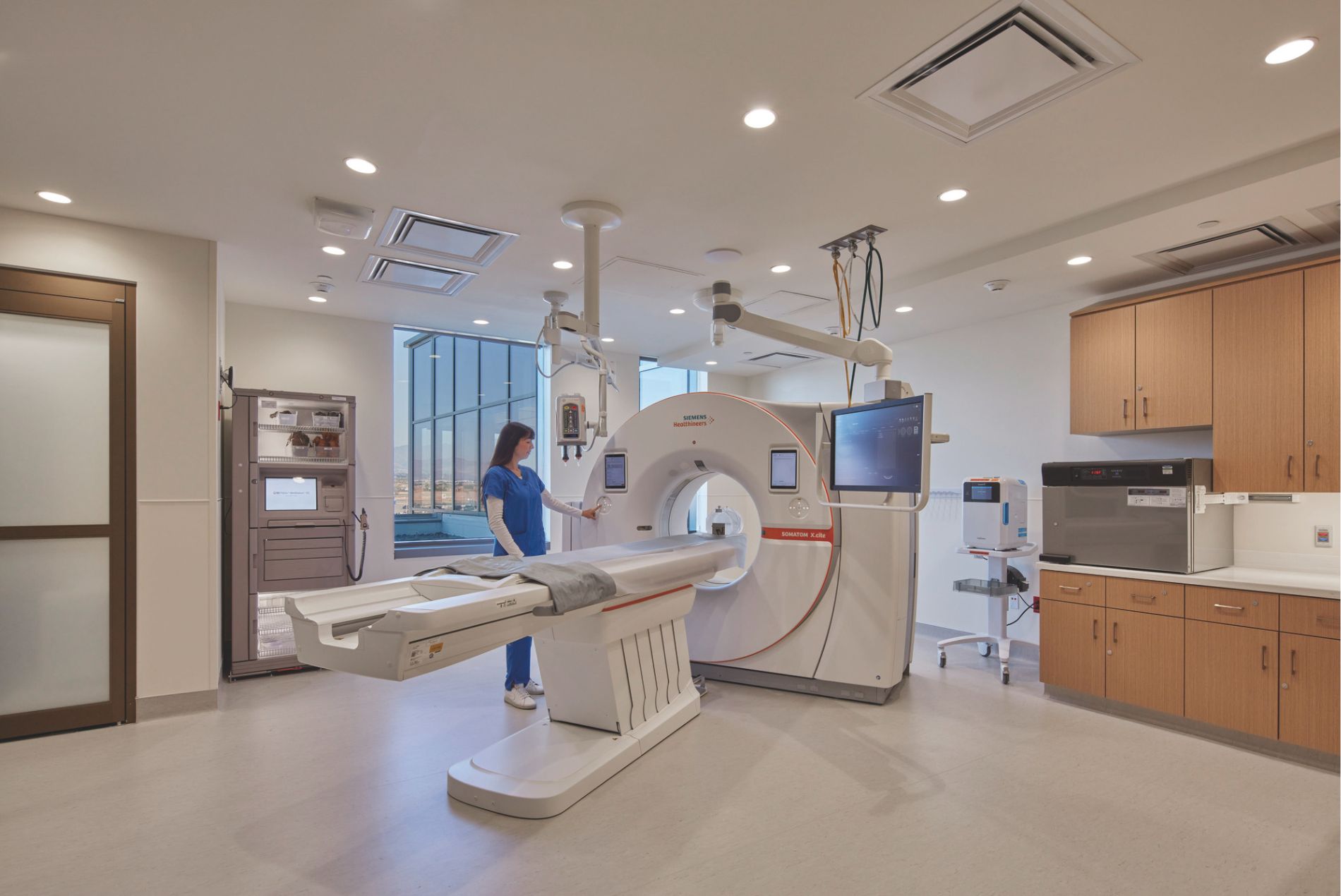
Technology can make ambulatory care more accessible, predictable and connected. AI can support documentation, scheduling and post-visit instructions while telehealth and remote monitoring can extend care beyond the facility through nurse check-ins, medication management, pain monitoring and vital-sign tracking.
Health systems also need to consider how patients use consumer-facing AI before they enter the care network. Online tools can help people find information, but they can also cause misinformation and delayed treatment.
The opportunity is to pair the convenience of digital care with the trust and continuity of an established health system. Clear pathways from online screening or telehealth to in-person care can give patients convenient access without asking them to navigate the system alone.
4. How do we build to adapt?

By the time a new facility opens, the landscape of care, technology and policy may already have changed. Long-term value therefore depends less on predicting the future than on designing a facility that can respond to it.
Standardized rooms and clinic modules can accommodate different specialties, equipment and workflows over time. Designing around the patient journey rather than a single department, physician or process can identify common needs across services and reduce costly customization. Operational flexibility matters too. Cross-training staff can help teams move between specialties as demand changes.
Technology infrastructure should be similarly adaptable. Flexible low-voltage pathways and digital capacity can support telehealth, remote monitoring, connected devices and future tools without committing the building to one platform. Physical growth should also be planned early: Where will the next chair, room or expansion zone go? Can the facility grow on the same site, or will future demand require another location?
5. How do we prepare for changes in reimbursement?

Hospitals generally have higher overhead than ambulatory settings and might receive different reimbursement for the same service depending on where care is delivered. Site-neutral payment and the continued movement of procedures from inpatient to outpatient care could change which services are financially viable in each setting.
Health systems should model several service and reimbursement scenarios rather than assume that today’s rules will hold. Depending on the care provided, adaptability could include flexible operating rooms, portable equipment, spaces that can support different services, or extended-care zones for patients who need longer recovery but not inpatient admission.
“Designers need to help teams create facilities that succeed under multiple scenarios,” Freeman says. “It is less about predicting the future and more about being flexible enough for whatever it becomes.”
From expansion to a stronger care network
A successful ambulatory center does more than add capacity. It expands access, supports caregivers, preserves continuity and gives the health system room to change. When every new site is planned as part of a coordinated network, ambulatory growth can strengthen the entire system.
Continue the conversation
Want to know more? Reach out to our experts:
Kathleen Schwarz, Director of Healthcare Consulting, New York
Karen S. Freeman, Firmwide Director of Healthcare and Children’s Health Practice Leader, Atlanta
Belinda Young, Northwest Regional Leader of Healthcare, San Francisco