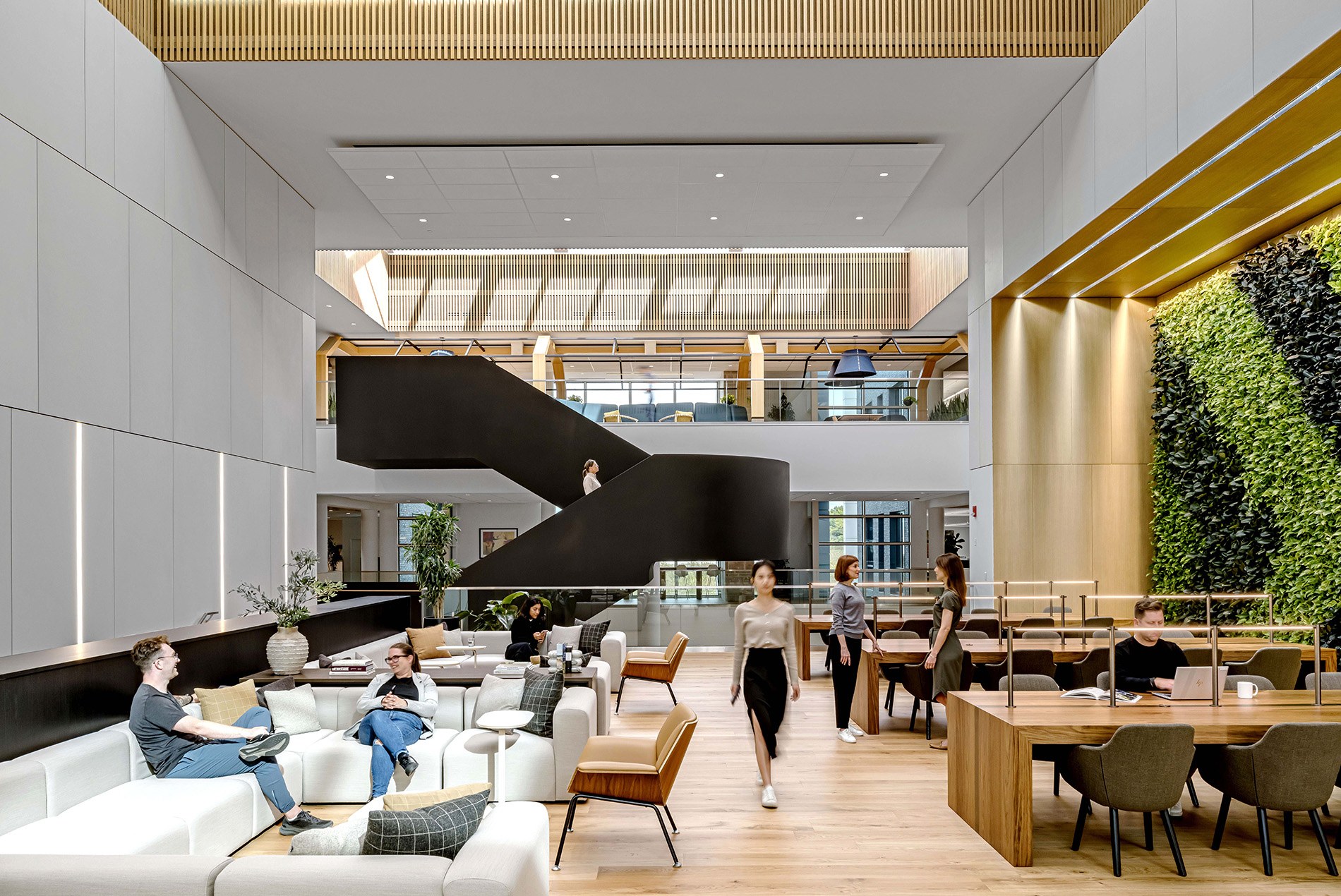
HOK experts discuss how neuroaesthetics helps designers create spaces that better support well-being, performance and human experience.
Interior designers have long understood that spaces influence how people feel. A room can calm, energize, focus or overwhelm us before we consciously understand why.
Neuroaesthetics helps explain those reactions. The field studies how the brain and body respond to art, beauty and the built environment, giving designers new tools to create spaces that support human well-being and performance.
A recent HOK Up Next discussion explored the growing role of neuroaesthetics in interior design. Moderated by Stephanie Miller, HOK’s director of public relations, the conversation featured Kay Sargent, director of thought leadership for interiors; Candon Murphy, HOK’s firmwide material resource manager; and Kristina Kamenar, director of design, interiors in HOK’s Toronto studio. The discussion built on themes explored in this year’s HOK Forward publication.
Below: Watch the full conversation and read key takeaways.
Neuroaesthetics gives designers a framework for understanding experience
The discussion began with a simple question: What is neuroaesthetics?
“Neuroaesthetics is the study of how our brains respond to art and beauty in the built environment,” said Sargent. She contrasted it with neuroinclusive design, which focuses on creating environments that allow people with different types of brain wiring to participate and thrive.
For designers, that distinction matters because it reinforces a central idea: spaces are never passive.
“No design decision is neutral. Our bodies read a space instantly,” said Kamenar. “We’re able to now explain why certain environments help us feel calm, focused, overwhelmed.”
Research is helping move design from intuition to intention
The panelists agreed that designers have long relied on instinct and experience to create compelling environments. Neuroaesthetics provides scientific evidence that helps explain why those instincts often work.
Murphy described the immediate “gut feeling” people experience when they enter a space and how neuroscience can help decode those reactions.
“Neuroscience really helps to break down the hows and whys you might be feeling that way,” she said. “By understanding those hows and whys, we can start to really create emotional responses in the environments we design.”
The conversation highlighted research from Dr. Anjan Chatterjee and the Penn Center for Neuroaesthetics, including the neuroarchitecture triad: coherence, fascination and hominess. Together, those principles offer a framework for understanding how people experience and respond to their surroundings.
Material choices influence far more than appearance
Materiality emerged as one of the clearest examples of neuroaesthetics in practice.
Murphy noted how texture, color, pattern, translucency and reflectivity all contribute to how people perceive a space. Material selections can support restoration, comfort and focus or create energy, excitement and stimulation depending on the intended experience.
She also pointed to growing research around natural materials, particularly wood.
“It actually drops your cortisol and heart rate when you’re in the presence of natural wood,” Murphy said. “Even though you can’t smell it, your brain can smell it.”
The insight resonated throughout the conversation and underscored a recurring theme: people often respond to environmental cues at a biological level long before they consciously recognize them.
Neuroaesthetics should be considered from the earliest stages of design
Kamenar emphasized that neuroaesthetic principles should not be treated as a finishing layer added late in a project. Instead, they should inform planning, programming and design decisions from the beginning.
She described how HOK is applying these ideas to the Toronto Tempo Performance Centre, a project for Canada’s first WNBA team. The design balances restorative environments for recovery, meditation and hydrotherapy with more energetic, high-performance training spaces.
“We’re not just designing space,” Kamenar said. “It’s really about thinking about these concepts in order to think about it in terms of designing for a feeling.”
The goal is to intentionally shape emotional and physiological responses through planning, materiality, lighting, acoustics and biophilic design.
Human well-being starts with sensory experience
The panelists repeatedly connected neuroaesthetics to broader conversations around wellness, inclusion and human-centered design.
“Every single decision that we’re making really is a sensory decision,” Sargent said. Understanding those sensory impacts allows designers to create environments that better support people’s neurological, emotional and physical needs.
The conversation also highlighted the importance of psychological safety, choice, prospect and refuge, daylight and biophilic design. Panelists emphasized that these elements can help people feel more comfortable, oriented and in control of their environment.
For Sargent, the implications extend far beyond aesthetics alone.
“This isn’t a trend. This is a shift from intuition to a practice that is rooted in science, in empathy and has a huge social impact.”
As organizations seek ways to support well-being, reduce stress and improve performance, neuroaesthetics offers designers a growing body of research to guide decision-making. The result is a more intentional approach to creating spaces that help people not only function, but flourish.