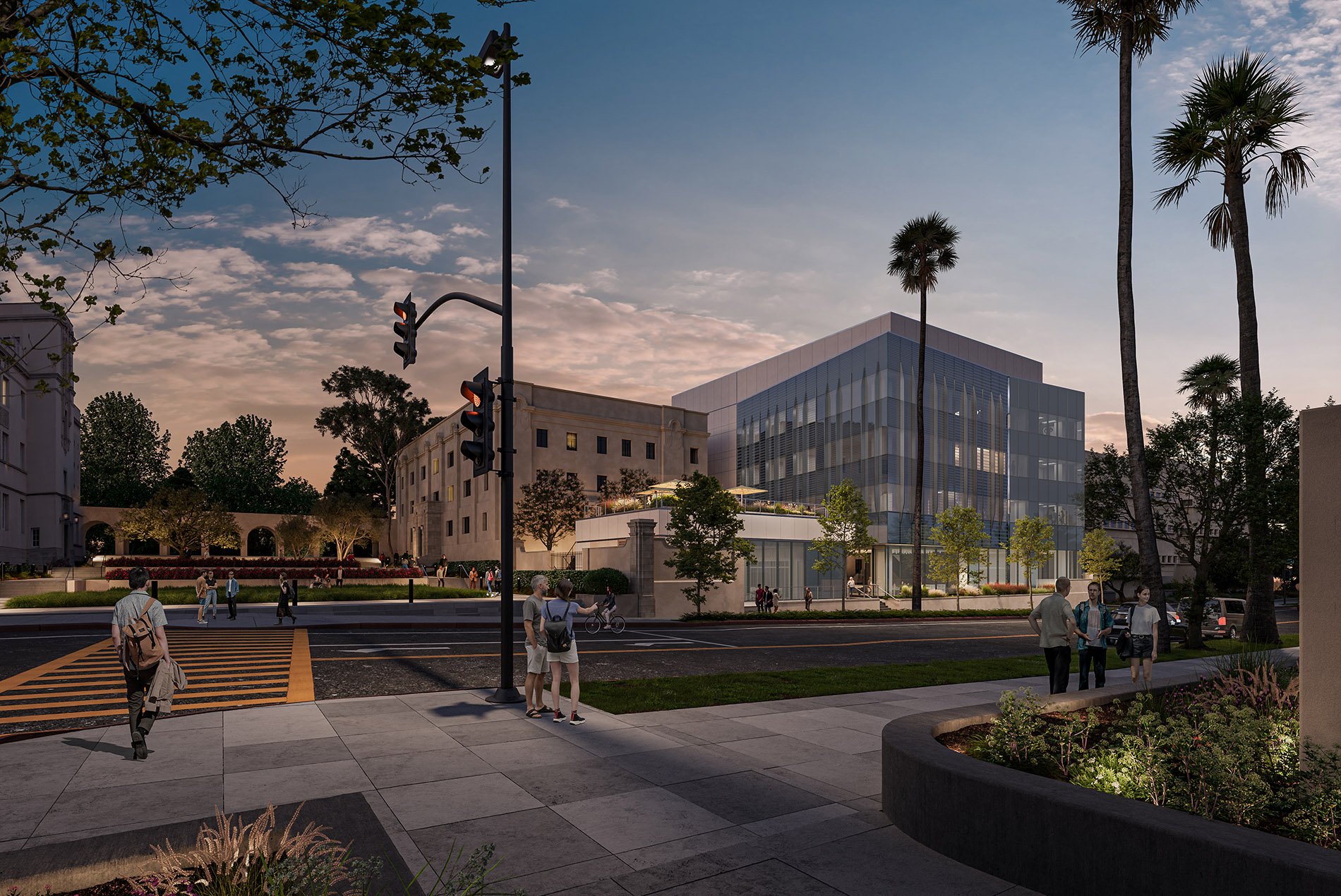
The California Institute of Technology (Caltech) has dedicated the Dr. Allen and Charlotte Ginsburg Center for Quantum Precision Measurement, a new interdisciplinary research facility designed by HOK to support next-generation discoveries in quantum science.
Leaders from academia, industry and government joined Caltech faculty, students, donors and the design team on June 17 to mark the dedication of the 70,000-sq.-ft. center, which will serve as a hub for advances in quantum precision science, quantum information science and gravitational-wave detection.
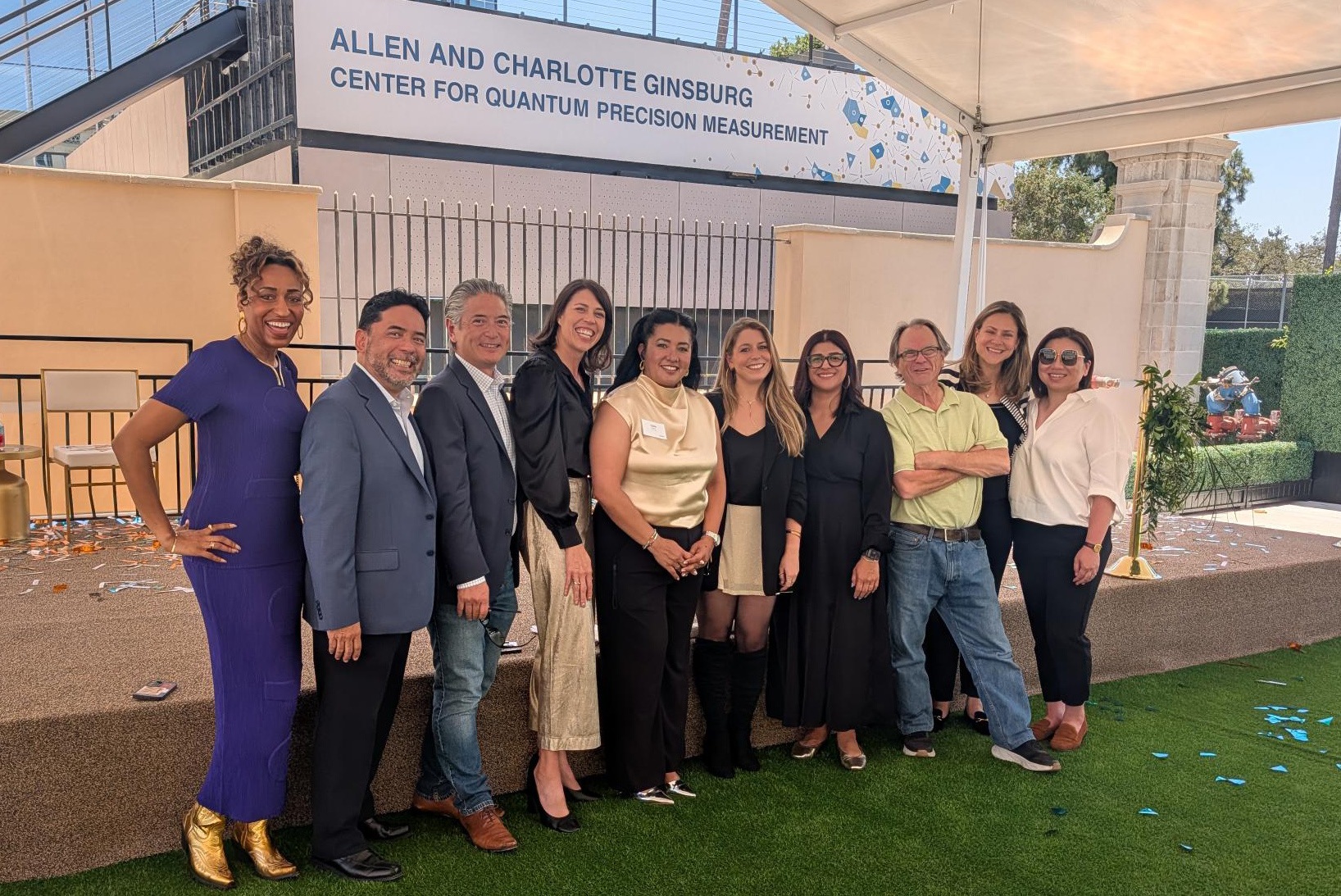
HOK’s team at the dedication
Located on the south side of campus, the four-story building sits atop a basement level that houses the most sensitive research environments, positioned 28 feet below grade. Above ground, the building integrates offices, interaction spaces and laboratories.
These subterranean laboratories are engineered to minimize vibration, electromagnetic interference and temperature fluctuation, creating the conditions essential for highly precise quantum measurements.
The facility brings together researchers from across disciplines, including physics, engineering, chemistry, biology and computer science, to address complex scientific challenges that require both theoretical and experimental collaboration. “The notion of a place where you can bring together people who think about important problems from very different directions is very Caltech,” said Caltech President Thomas F. Rosenbaum during the dedication ceremony, highlighting the building’s role in advancing cross-disciplinary innovation.
Designed to meet the demanding requirements of quantum research, the center incorporates specialized environmental controls that allow scientists to detect extremely faint signals without interference. Anchored to a 3-foot contiguous concrete slab beneath the entire lab area, the building neutralizes surface vibrations from nearby California Boulevard. Each lab also has its own dedicated air-handling system and is wrapped in electromagnetic shielding to block ambient radio waves from disrupting sensitive quantum states.
“A project of this complexity required us to design both for extreme precision and for collaboration,” said Adaeze Cadet, design principal in HOK’s Los Angeles studio. “By placing highly controlled laboratories below grade, we created the stability researchers need, while the above-ground spaces are intentionally open and connected to encourage interaction across disciplines.”
To further encourage chance encounters across fields, the center features a bridge between its top floors and the adjacent Downs-Lauritsen building, home to the Walter Burke Institute for Theoretical Physics, as well as an underground tunnel connecting the two facilities.
Design elements throughout the building reflect the science within. A transparent facade is inflected inward on its south and west sides to suggest a prism or the bending of space-time, while fins on the glass curtain wall form a pattern that subtly references the famous double-slit experiment. Some windows are adorned with tiny dots representing quantum particles, and paving patterns in the plaza are arranged to mimic quantum circuits. The center is targeting LEED Gold certification.
Made possible through philanthropic support from Broadcom, the Duan Family, Dr. Allen and Charlotte Ginsburg and the Sherman Fairchild Foundation, among other donors, the center represents a significant investment in the future of scientific discovery.
By uniting researchers across disciplines within a highly controlled research environment, the Ginsburg Center positions Caltech at the forefront of quantum science—advancing knowledge that could transform technology and deepen understanding of the universe.