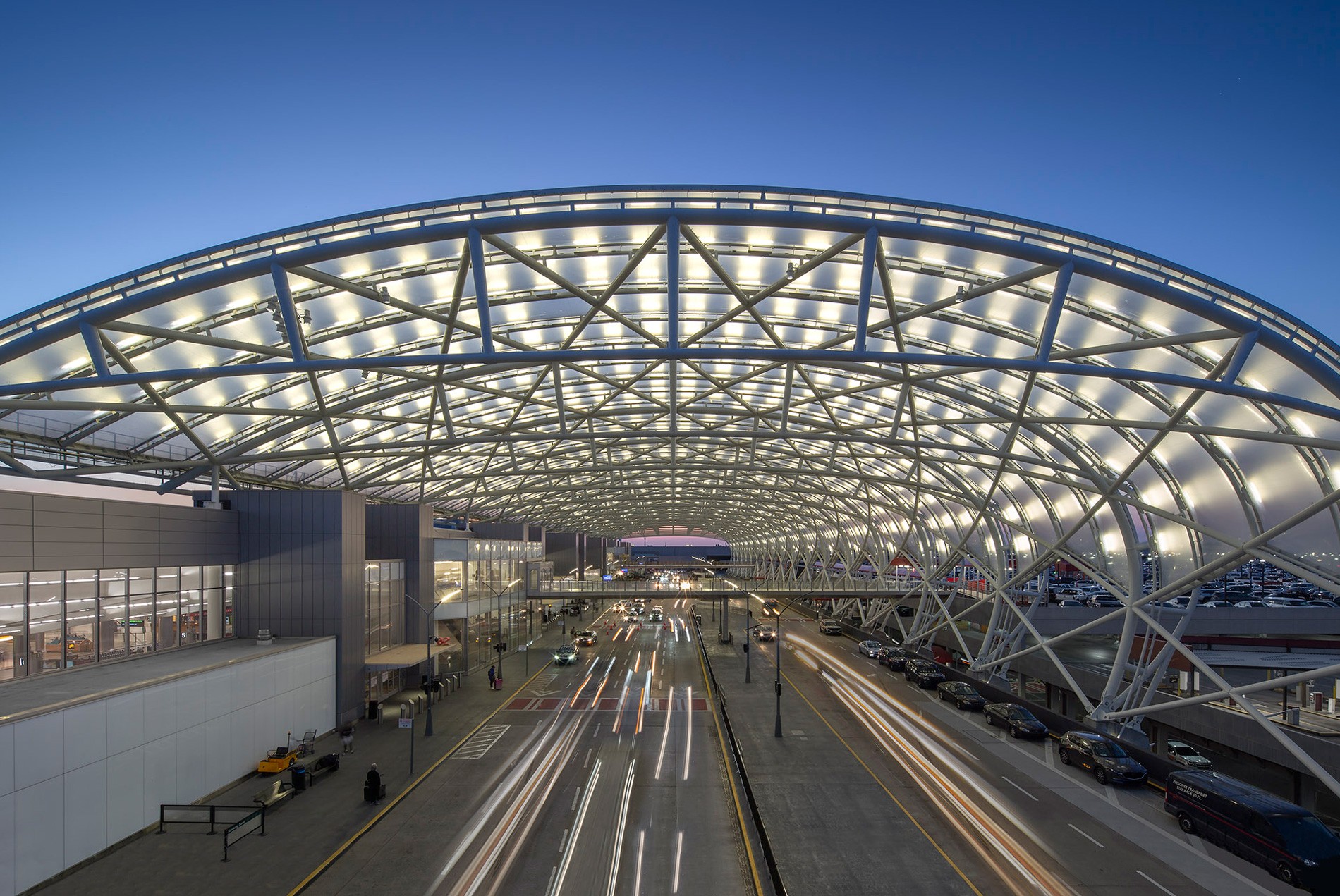
As Hartsfield-Jackson Atlanta International Airport (ATL) marked the fifth anniversary of its terminal modernization and curbside canopies last year, key members of the HJ+P joint venture team of HOK, CHASM Architecture and Stanley, Love-Stanley, P.C. reflect on the project and look ahead to the next five to 10 years of airport design.
Matt Breidenthal, director of engineering at HOK; David Camp, senior project manager at HOK; and Nathaniel Clark, managing partner at CHASM Architecture, share insights on design, collaboration and construction of ATL’s iconic canopies.
1. Looking back five years after completion, what aspects of the ATL canopy and modernization have delivered the most value?
Breidenthal: The most valuable thing is what we didn’t do. The original concept would have been far more disruptive to the airport and passengers. Our design prioritized maintaining operations, keeping traffic moving by spanning the roadway from the terminal roof to the opposite side. The result is both functional and visually strong. It created a clear front door for the world’s busiest airport.
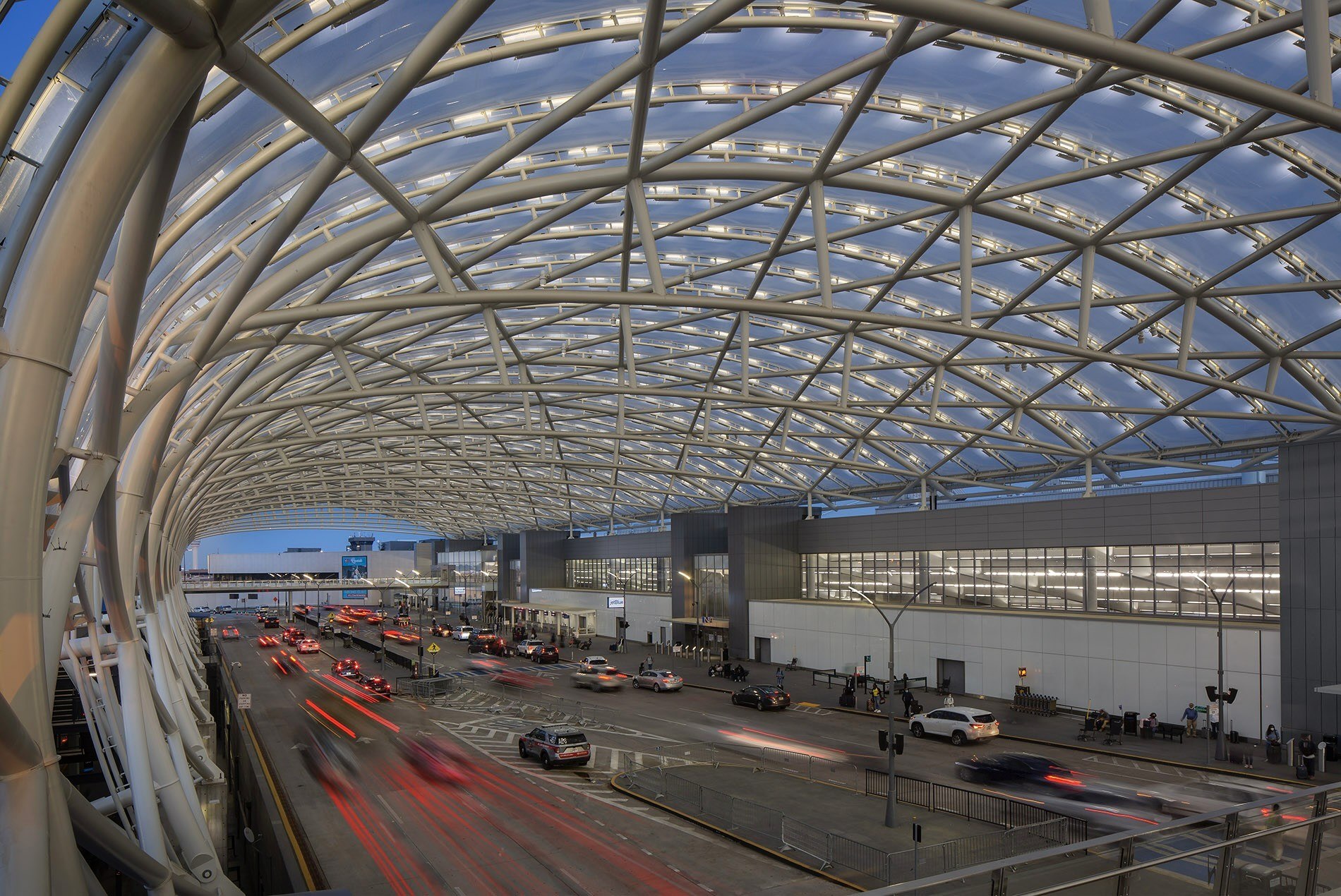
Clark: For passengers, the canopies make the experience from the garage to terminal seamless and simple without thinking about the weather. This helps reduce stress and just as importantly creates a comfortable threshold for human moments that happen at the curbside.
The pedestrian bridges underneath the canopies have also become more than circulation space. Over the past five years, I’ve noticed many travelers stop in the middle to take a selfie and celebrate their arrival in Atlanta. Airport staff also use the bridge on breaks. It has become a third space that didn’t exist before.
Camp: Operationally, the canopies remove friction. Passengers aren’t unloading cars and saying goodbye in the pouring rain or boiling sun. Having that protected space takes so much stress out of the experience.
2. This project required close coordination between architecture, design and structural engineering. What specifically made the team’s collaboration effective, and how did that improve the final outcome?
Clark: From a collaboration and coordination perspective, CHASM Architecture was an unknown entity to HOK at the beginning. The biggest thing that was earned during that time was trust. We built credibility by delivering and contributing at a high level, especially during the design phases. We worked alongside experienced aviation designers and grew into that role quickly.
Breidenthal: We took advantage of a ‘big room’ approach to conceptualize the project. Teams worked side by side, sketching and developing ideas in real time. That process built respect and trust among team members. There’s no substitute for it.
We paired that approach with advanced design technology to move quickly and understand the terminal’s layout and what we could improve. That combination of in-person collaboration, technology and field insight supported the outcome.
Camp: Our team had a wide range of voices and backgrounds all contributing to the modernization’s success. The project had a goal of 35% participation from small, local firms, and we surpassed that with 38% participation. This helped us win the Maynard Jackson SOAR award for our outreach and economic impact with small, local firms in Atlanta.
3. How did trust with the client shape the project?
Clark: The airport’s Department of Aviation had a very strong and capable project team. They were collaborative partners throughout the entire process with a willingness to push the envelope.
Breidenthal: They trusted us to challenge the initial concept and explore new options. That required a leap of faith, especially given the pace and complexity.
Clark: That trust allowed us to quickly develop and present multiple viable design options, giving the Department of Aviation confidence to move forward.
4. The canopies turned a functional curbside into a civic landmark. What were the key design and engineering decisions that allowed you to balance performance, cost and identity at that scale?
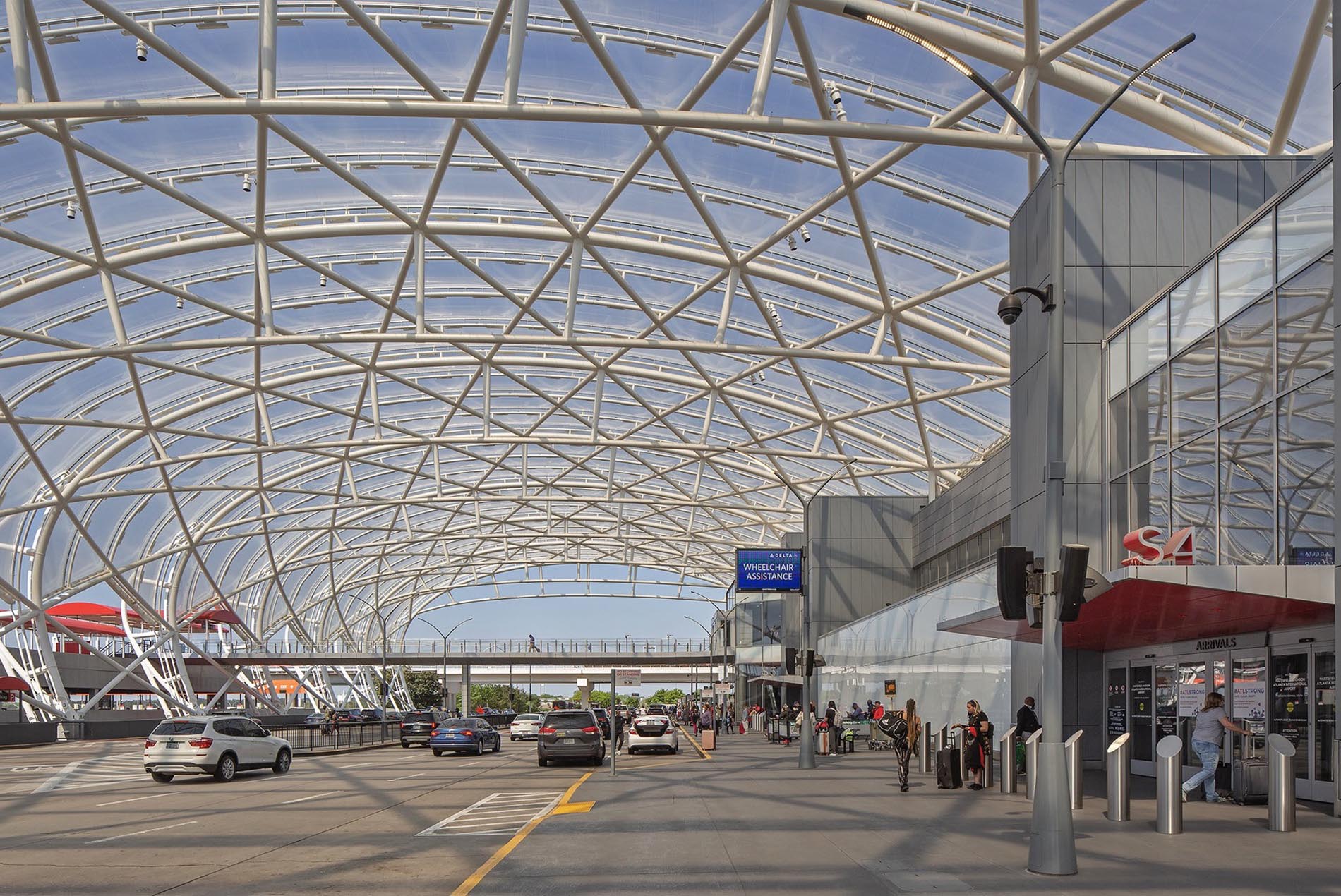
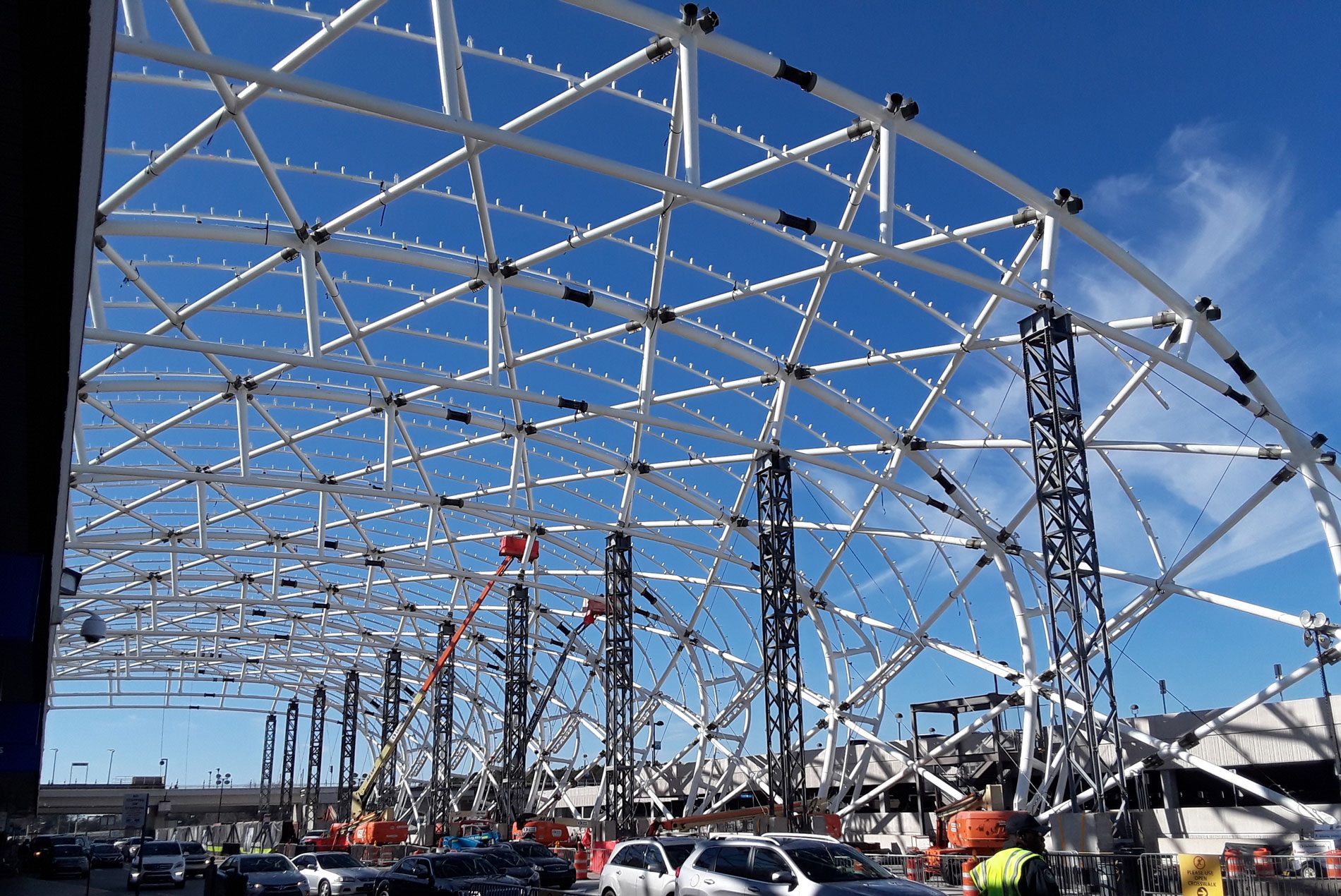
Breidenthal: I think the canopy design is beautiful because its form is fully driven by function. Every element is there to support structural alignment, load transfer and performance.
Camp: The canopy is also a clear span. The whole roadway has no obstructions in it, other than what it’s required to hold.
Breidenthal: Yes, keeping columns off the sidewalk and anchoring the canopy to the terminal significantly improved the curbside experience for passengers. It creates a brand new facade.
Because the canopy is laid on top of the building, it also had to be very light. Using ETFE instead of glass reduced the weight by roughly half compared with a typical canopy.
5. How did community perception and civic pride influence the design?
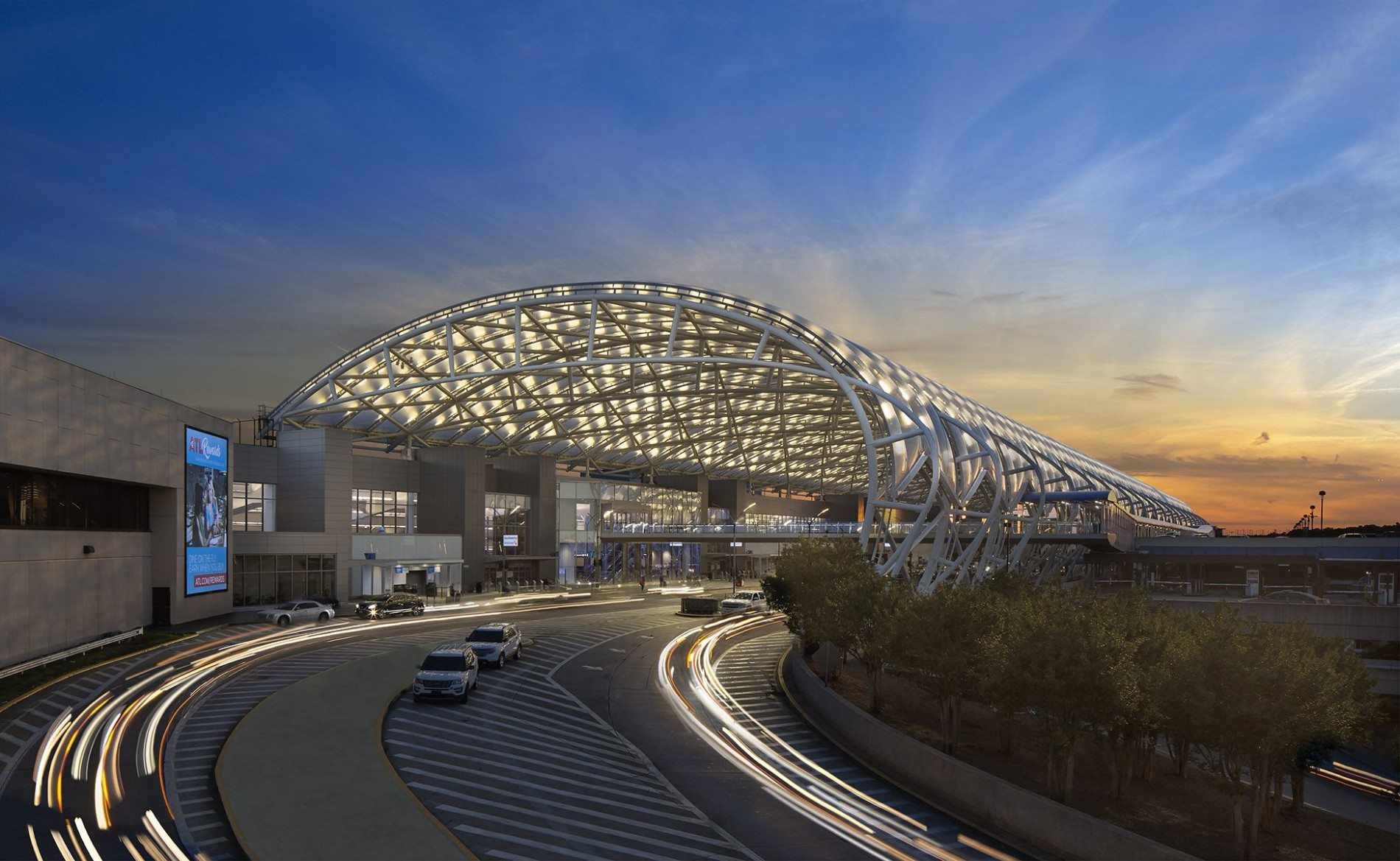
Clark: The canopies became a centerpiece during the airport’s 100-year anniversary last year, which speaks to how visible the project has become in the airport’s history.
Breidenthal: The design had to be beautiful to match its prominence. Atlanta now has a way to very visibly welcome anybody to the city, from the FIFA World Cup to the Super Bowl.
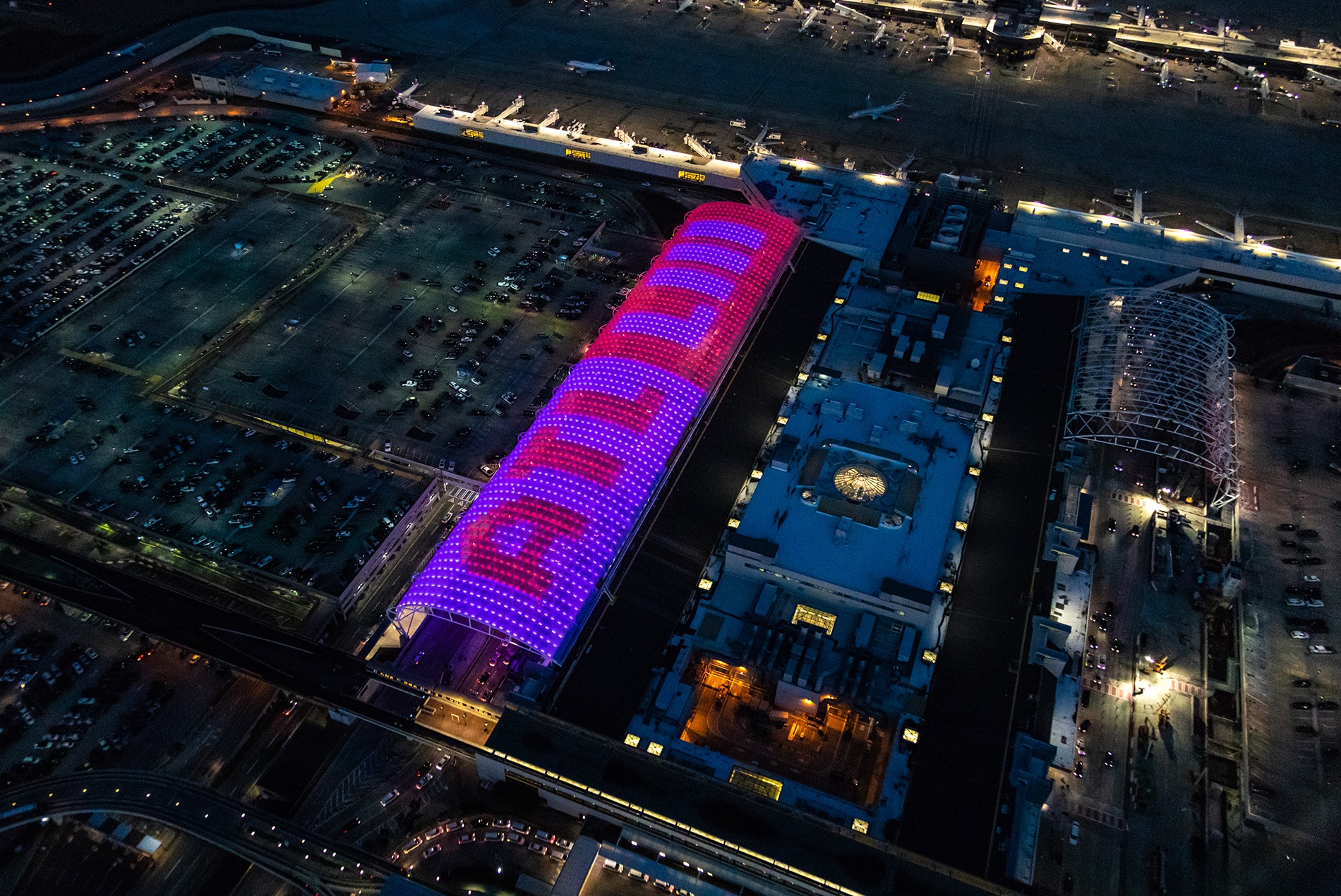
Camp: Yes, the canopies’ programmable lighting can connect to the community through major events and holidays. When Atlanta hosted Super Bowl LIII, canopy lighting celebrated the big game and was seen by viewers watching at home.
6. Delivering this project at the world’s busiest airport required maintaining operations throughout construction. What lessons did you take from the modular fabrication and overnight installation strategy that could apply to future projects at ATL?
Breidenthal: Prefabrication of the canopy modules was key. Construction happened over active roadways in overnight windows, with no margin for delay.
We designed the canopy in bolted modules so they could be lifted and installed quickly. The New South-McCarthy-Synergy construction management team never missed a day in reopening the roadway each morning.
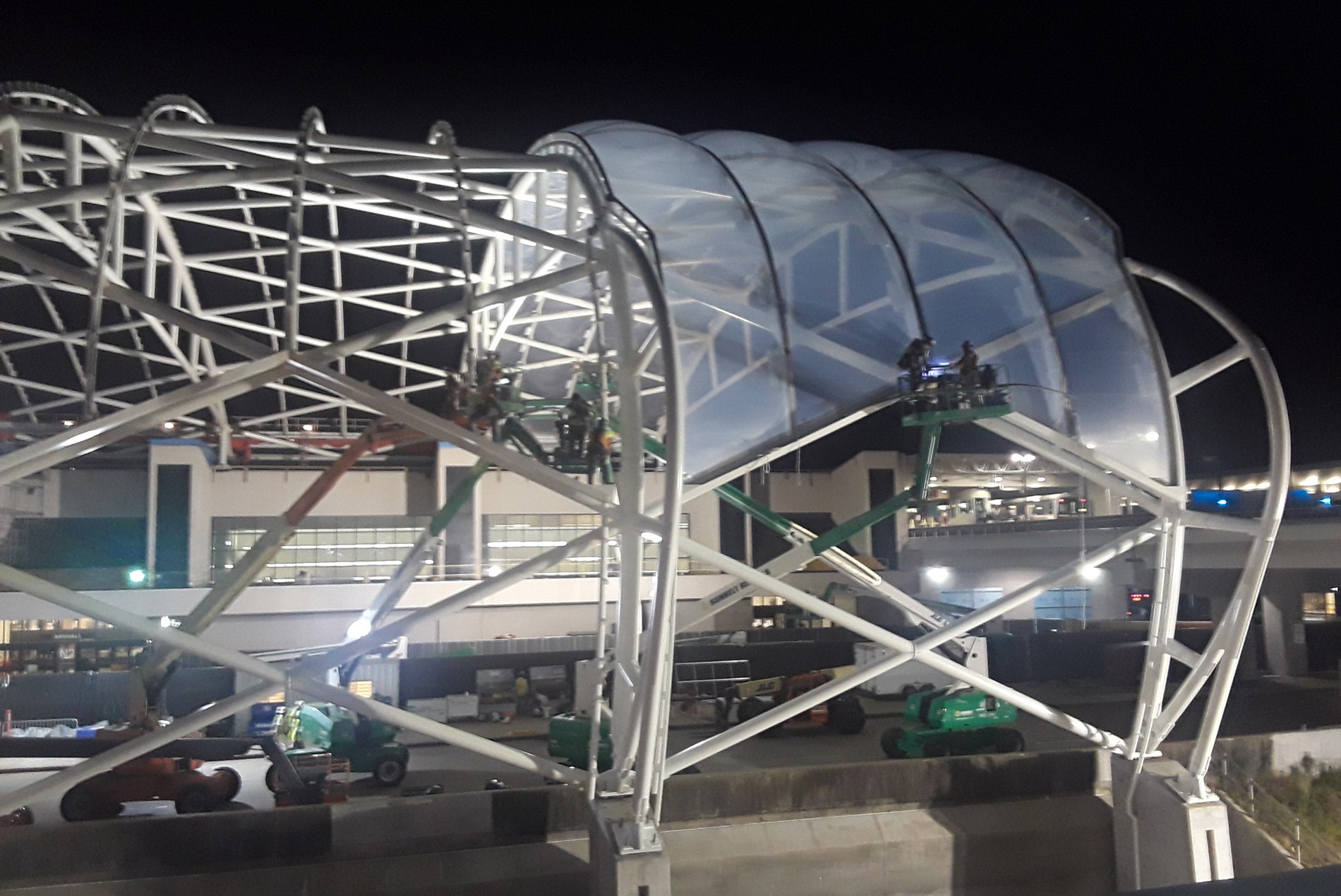
This was also as much a traffic management project as a construction project, coordinated with police, events and airport operations. We built flexibility into the design so that our construction partners could adapt to operations and on-the-ground realities. The key lesson is that the latest visualization technology can help, but understanding how an airport project is built—and maintaining flexibility—is critical to keeping airports operating smoothly.
7. HOK’s STREAM design tool enabled the team to evaluate more than 500 design options in a matter of weeks. How did that change the way you approached design and decision-making, and what did it enable that a traditional process would not?
Breidenthal: We needed to move fast to update the design. After developing dozens of concepts through in-person collaboration and sketching, STREAM allowed us to evaluate hundreds of options quickly, validating cost, weight and performance.
It compressed what would typically take months into weeks or days, giving the client confidence to pivot.
8. As passenger volumes at ATL and other airports continue to grow, how do you see airport terminal design evolving over the next 5–10 years?
Clark: Terminals will become more experience- and technology-driven. Passengers expect seamless navigation and less reliance on physical check-in spaces.
Breidenthal: From an engineering perspective, much of the work involves upgrading aging infrastructure. These are surgeries on existing facilities that require a precise, building-specific approach while maintaining operations. ATL did this successfully with the canopies.
Clark: That also demands a deep understanding of airport operations, including passenger flow, space utilization, baggage, and choreographing it all simultaneously. Airport renovations are like open-heart surgery. Understanding this is key to the work we do.