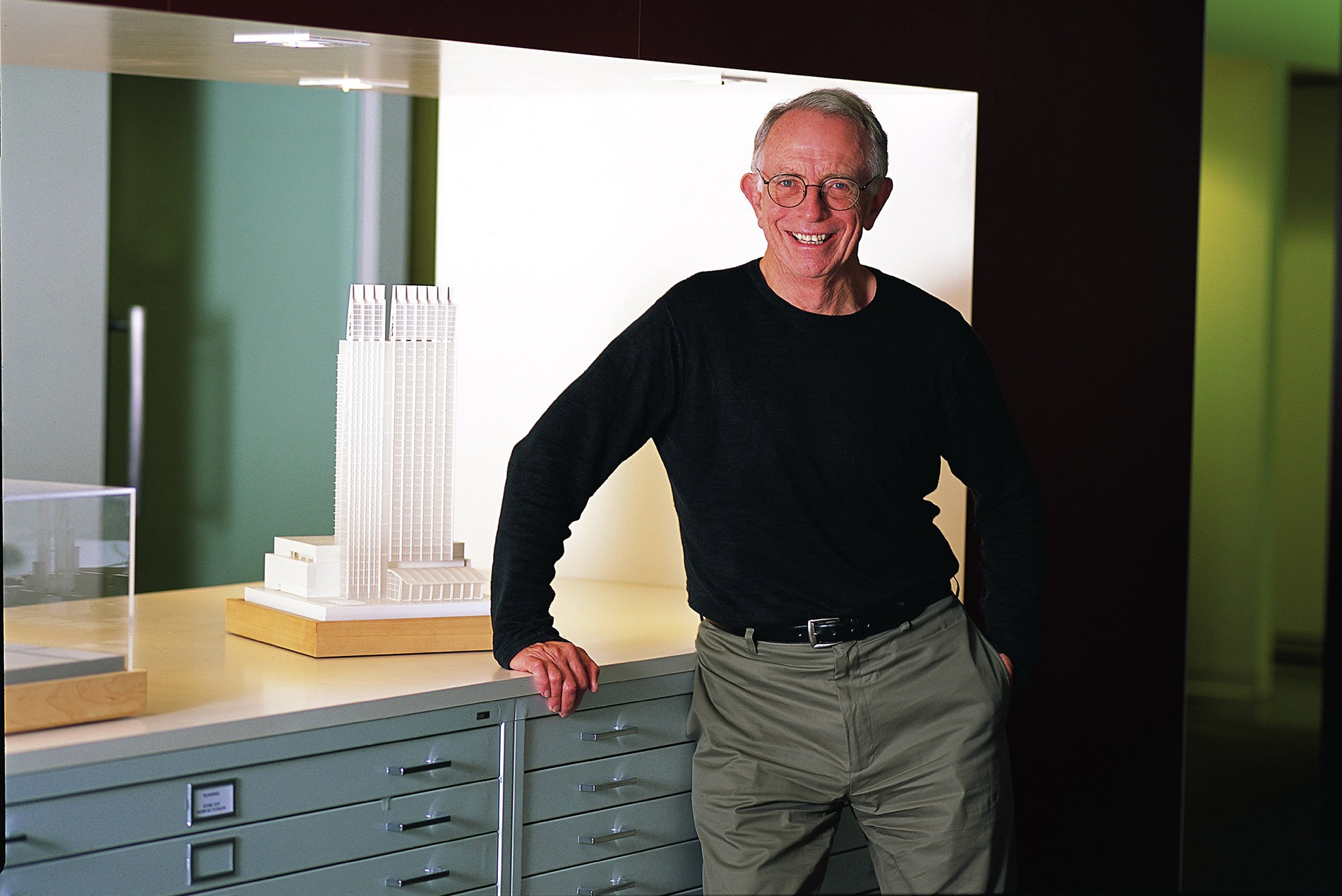
As design principal, president and later chairman of HOK, Valentine believed architecture should help people, not showcase the architect.
Bill Valentine, FAIA, who helped shape HOK into a global design firm and a leader in sustainable design, died on June 25 in Mill Valley, California. He was 88.
Valentine believed that good design was “a simple idea, elegantly executed and inspiring, with social significance and in harmony with the environment.” It was a philosophy he practiced for half a century at HOK, the firm he joined in 1962 and never left.
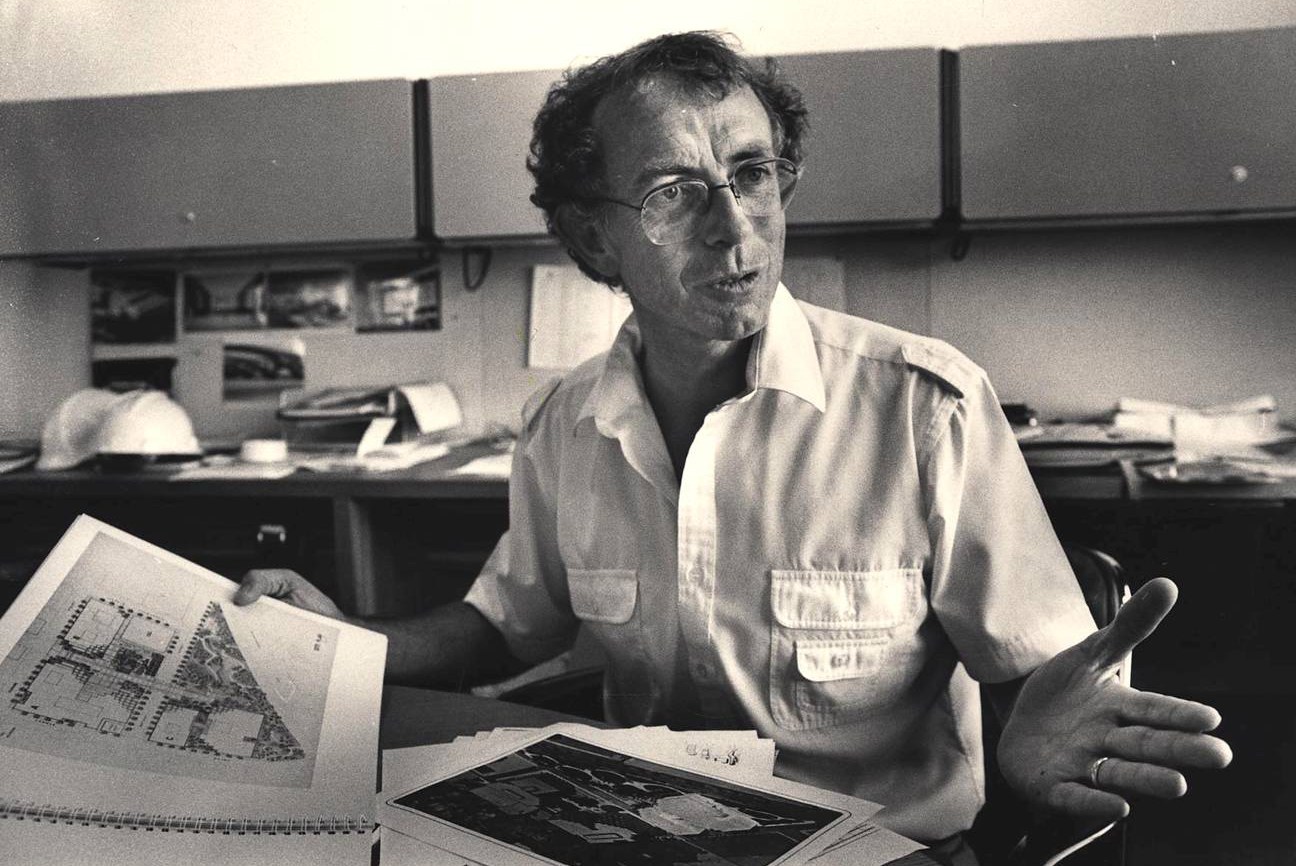
Bill Valentine at his HOK desk in the 1960s, early in a career that would span half a century at the firm.
When Valentine joined HOK, fresh out of Harvard, the firm had 50 employees and a single office in St. Louis. He was immediately drawn to its culture. “What struck me was the earnestness and eagerness of HOK’s people to improve lives through design,” he later recalled.
Valentine’s work crossed building types and borders. In San Francisco, his team designed Levi’s Plaza and the Moscone Convention Center. He designed corporate headquarters for Apple, Microsoft, Adobe, Wellmark Blue Cross and Blue Shield, and Biogen Idec; civic buildings like the Phoenix Municipal Courthouse; and major international projects including King Khalid International Airport in Riyadh.
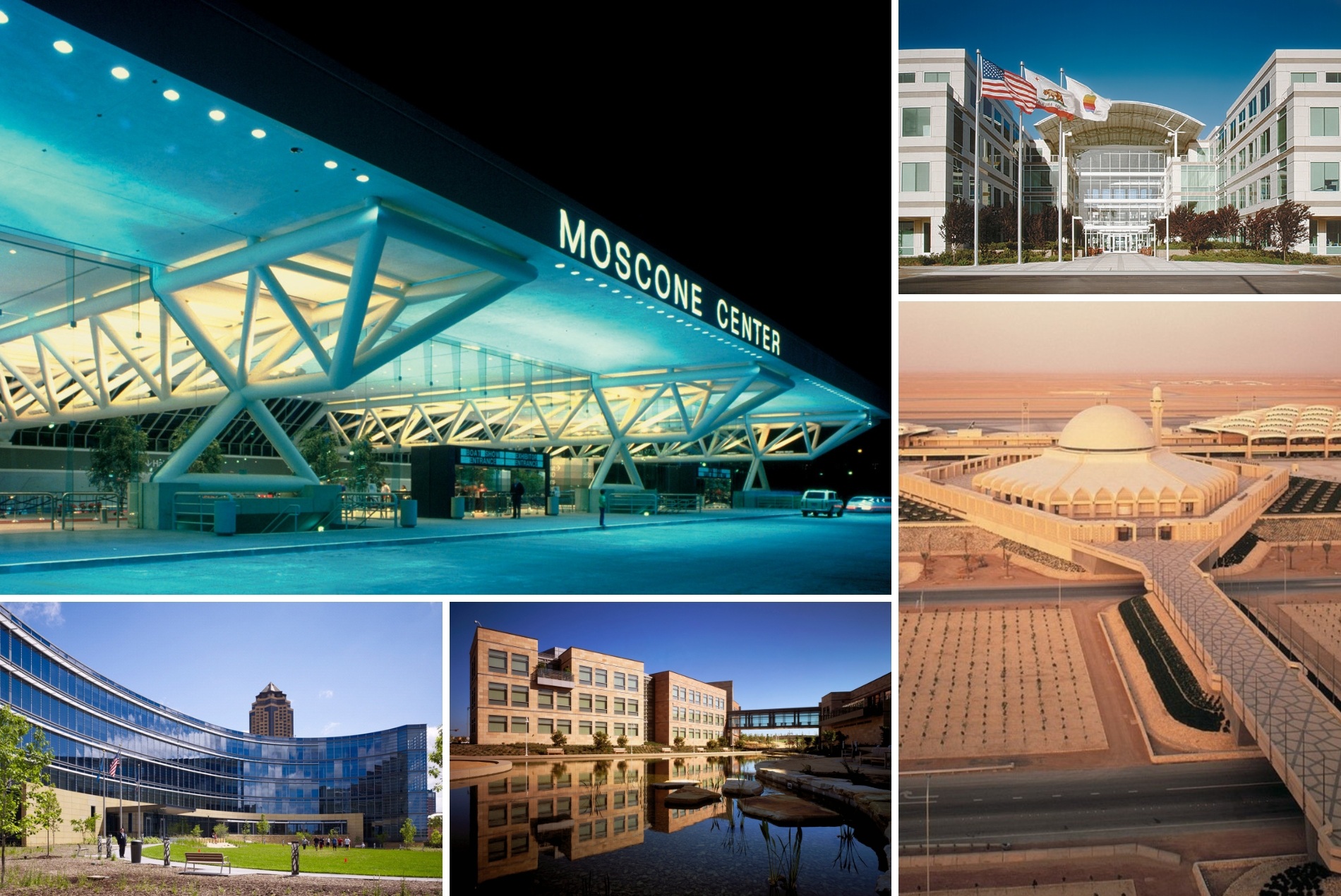
Clockwise from top left: the Moscone Center in San Francisco; Apple’s R&D campus in Cupertino; King Khalid International Airport in Riyadh; the Biogen Idec Research and Development Campus in San Diego; and Wellmark Blue Cross and Blue Shield headquarters in Des Moines.
Valentine’s influence extended well beyond his own projects. He mentored generations of HOK designers, continuing to consult and guide project teams well into his 80s.
“Bill brought a lightness to the work that belied how seriously he took it,” said HOK Co-CEO Eli Hoisington. “He knew how to make everyone feel heard and then gently guide the team toward what he thought was the best design solution without anyone ever feeling pushed. And he never lost the sense that what we do, as important as it is, should be fun. That spirit is part of HOK’s DNA, and Bill is the reason.”
Valentine attributed his design philosophy to the influence of Gyo Obata, HOK’s co-founder and original design principal. “All my ideas about simplicity and helping clients came from Gyo,” Valentine said at his 2012 retirement celebration, held at Levi’s Plaza, one of his most beloved projects.
Obata, in a video tribute played at the celebration, put it simply: “Bill has the kind of personality that’s very cheerful, friendly and open. That makes it easy for clients to talk to him so he can get to the essence of what the solution should be.”
William Valentine was born Sept. 3, 1937, and grew up in Whiteville, a small farming town near the North Carolina coast, working at his father’s tire-recapping shop. He earned his Bachelor of Architecture from North Carolina State University in 1960 and his Master of Architecture from Harvard University in 1962. Years later, he would return to both institutions, lecturing at Harvard’s Graduate School of Design and speaking at NC State’s College of Design.
He joined HOK in St. Louis in 1962, just seven years after Obata, George Hellmuth and George Kassabaum had founded the firm. In 1970, at the request of Obata, Valentine relocated to Northern California to help establish HOK’s San Francisco office—a milestone in the firm’s national expansion that positioned it on the West Coast and produced some of its most celebrated work.
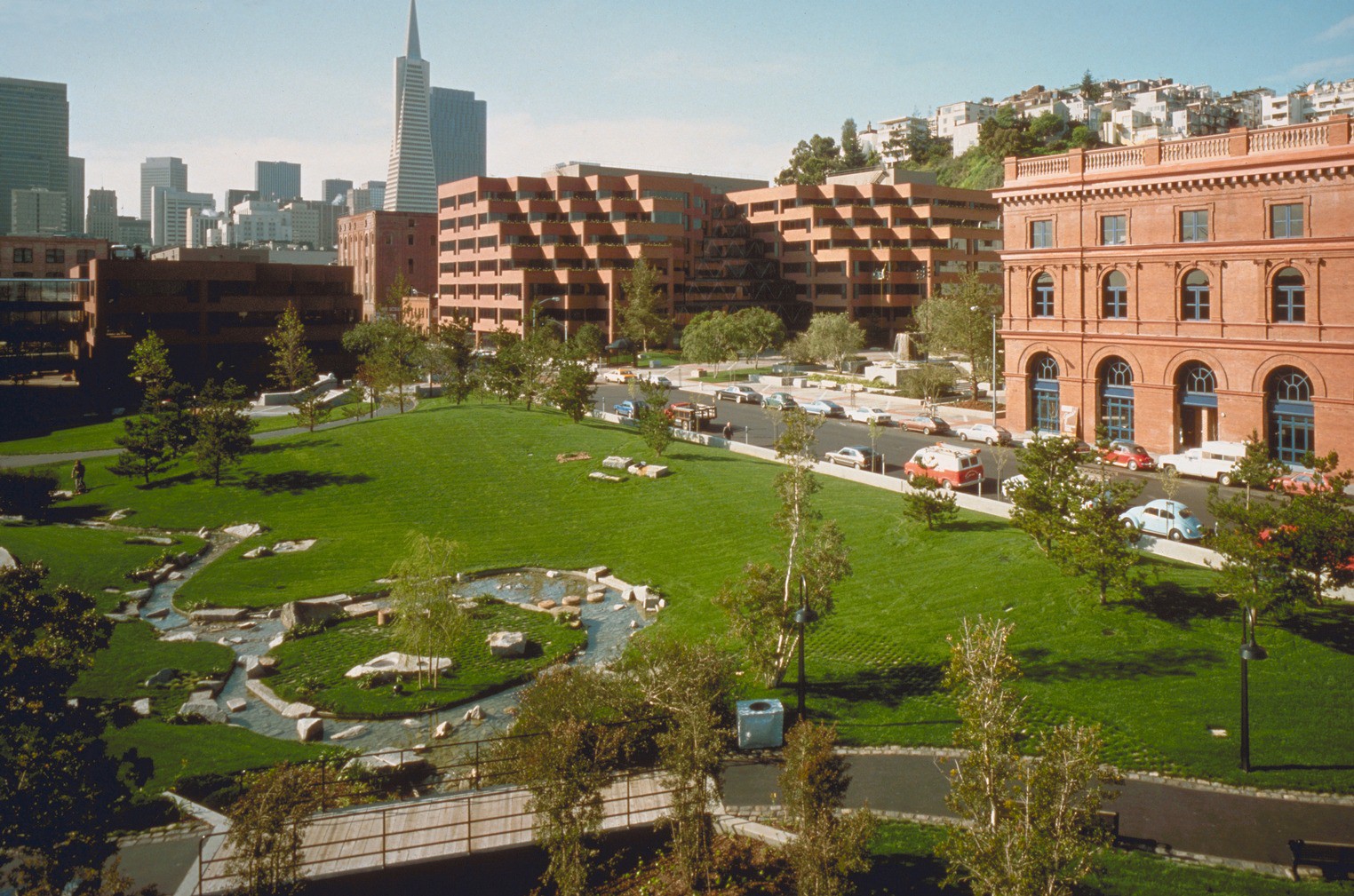
Levi’s Plaza, the Levi Strauss & Co. campus in San Francisco that Valentine’s team completed in 1982. He called it one of his most beloved projects.
Among those San Francisco projects was Levi’s Plaza (above), the corporate campus for Levi Strauss & Co. that Valentine’s team set into a hillside with such care that San Francisco Chronicle architecture critic Allan Temko called it “a gift to the city.” Time magazine named it one of the best designs of 1982. The Moscone Center, completed in 1981, took a similar approach. Rather than simply building a convention hall, Valentine’s team buried much of the structure underground to preserve a public park above.
“Bill was the heart of our San Francisco studio, even in retirement,” said Anton Foss, managing principal of HOK’s San Francisco office. “We’d have lunch three or four times a year, and every time, he’d say, ‘Anton, I just want to know everything.’ He loved this firm. And he softly but very intentionally instilled in all of us that our job is to solve our clients’ problems, not to design a monument to ourselves. That’s the mindset he passed down to generations of HOK designers.”
He served as design principal and president from 2000 to 2005, then chairman until his retirement in 2012. During his tenure, he led the firm’s adoption of sustainable design as a core value, building on work he’d begun in the 1990s. Under Valentine’s leadership, the firm published The HOK Guidebook to Sustainable Design in 2000, alongside the emergence of LEED certification as the industry’s defining standard. It was one of the profession’s earliest practical manuals for green building, and it helped push sustainable design from the margins of the field toward the mainstream, with HOK at the front of that shift.
A Fellow of the American Institute of Architects and a LEED-credentialed professional, Valentine received the “Legend” Award at the 2007 Annual Interiors Awards hosted by Contract magazine. He also received the Corporate Real Estate Executive of the Year award from CoreNet Global’s Northern California Chapter and the Outstanding Business Executive award from the American Public Transportation Association.
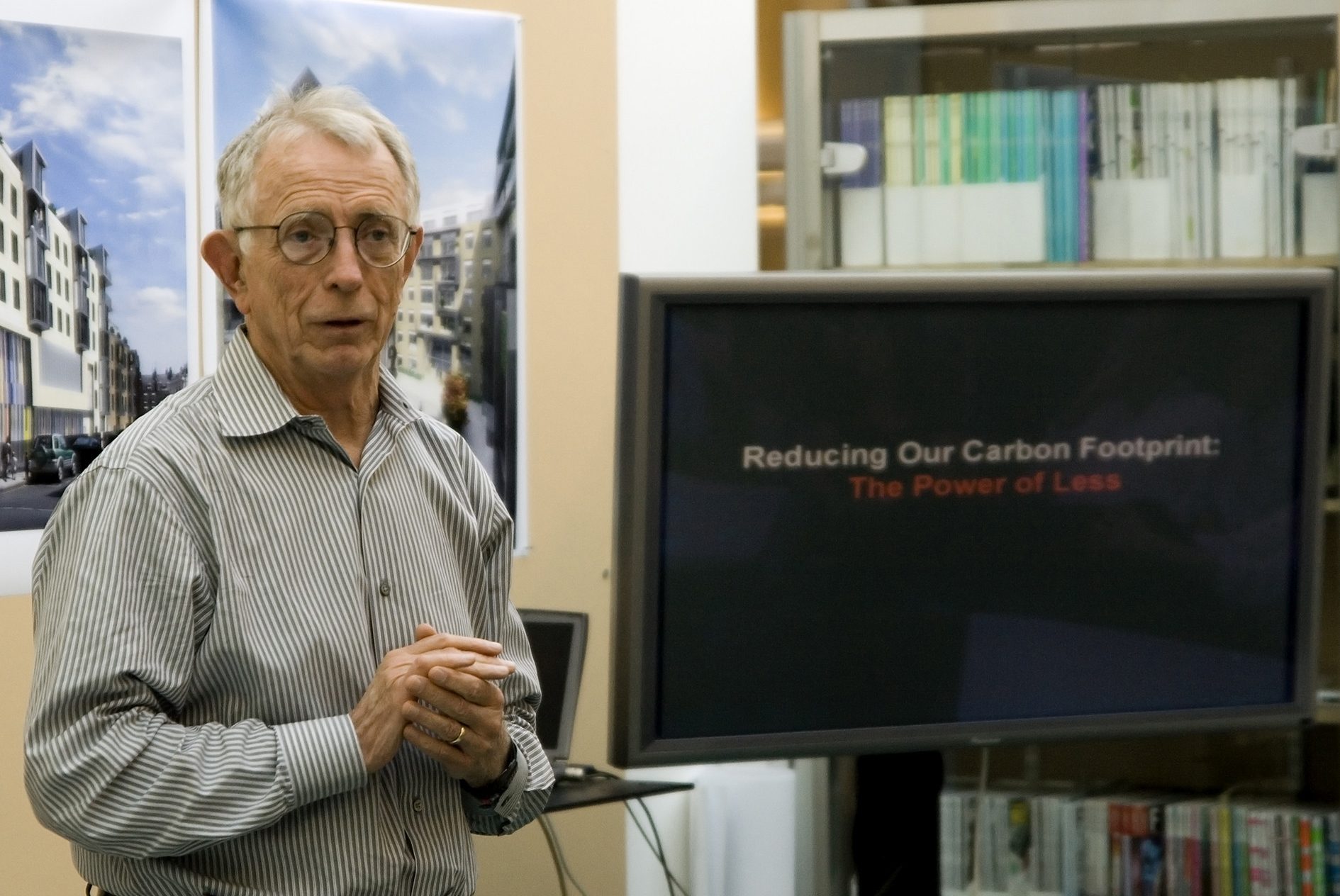
Valentine presenting “The Power of Less” at HOK’s London studio in 2010. “The idea of building less,” he often said, “is the essential concept of green design.”
In the final chapter of his career, Valentine became what he called an “evangelist” for affordable, net-zero carbon design. He argued that the profession’s gold standard should be renovating existing buildings to zero carbon emissions—a shift from a throwaway mentality to one that limits energy and resource use at every level. “The idea of building less is the essential concept of green design,” he said.
He lived this philosophy. Valentine drove a Prius and continuously advocated for simpler, more efficient lifestyles. “There are architects who spend more money on socks in a year than I do for my entire wardrobe,” he once said.
When Gyo Obata died in 2022 at age 99, it was Valentine who provided one of the most memorable tributes, capturing both Obata’s character and, perhaps unwittingly, his own: “Gyo embodied everything that’s honorable about the architectural profession,” he remarked. “Instead of designing for the fashions of the times or to make a personal statement, Gyo designed to improve lives. He was a kind, thoughtful man who developed warm, personal relationships with his colleagues and clients. People believed in him, which is an essential part of turning drawings into buildings.”
Valentine never forgot where he came from. In 2019, he and his wife, Jane—his high school sweetheart whom he married in 1959—donated $250,000 to help fund construction of a new Whiteville High School, their alma mater in the small North Carolina town where he had grown up working in his father’s shop.
Valentine retired from HOK in 2012 after 50 years, though “retired” may overstate the distance he kept. He continued consulting on select projects and mentoring HOK designers into the 2020s. He remained chairman emeritus and lived in Mill Valley, California, just across the Golden Gate Bridge from the San Francisco office where he had spent most of his career. He once said that his morning drive across the bridge never got old: “When I’m driving across the bridge, I can’t wait to get to work and find out what’s going on.”
“If you really want to help, and goodness knows this world needs more help than you can imagine, we’re your place,” Valentine said of HOK. “I believe that in my soul.”
Valentine was preceded in death by his wife, Jane Dorward Valentine, who died in 2022. He is survived by his children, Kayvee, Annie and Will, and six grandchildren.
A celebration of Bill’s life will be held later this summer. Details will be shared by the family.
Visit HOK’s YouTube channel to view a series of video interviews with Bill Valentine.