A panel of architects and green-building experts share what the building sector should know about the recently concluded U.N. Climate Change Conference in Brazil.
How will this year’s United Nation’s Conference of the Parties (COP) influence the built environment? What takeaways do design and construction firms need to know? Those were but two of the questions discussed in a recent HOK Up Next on the impact of COP30.
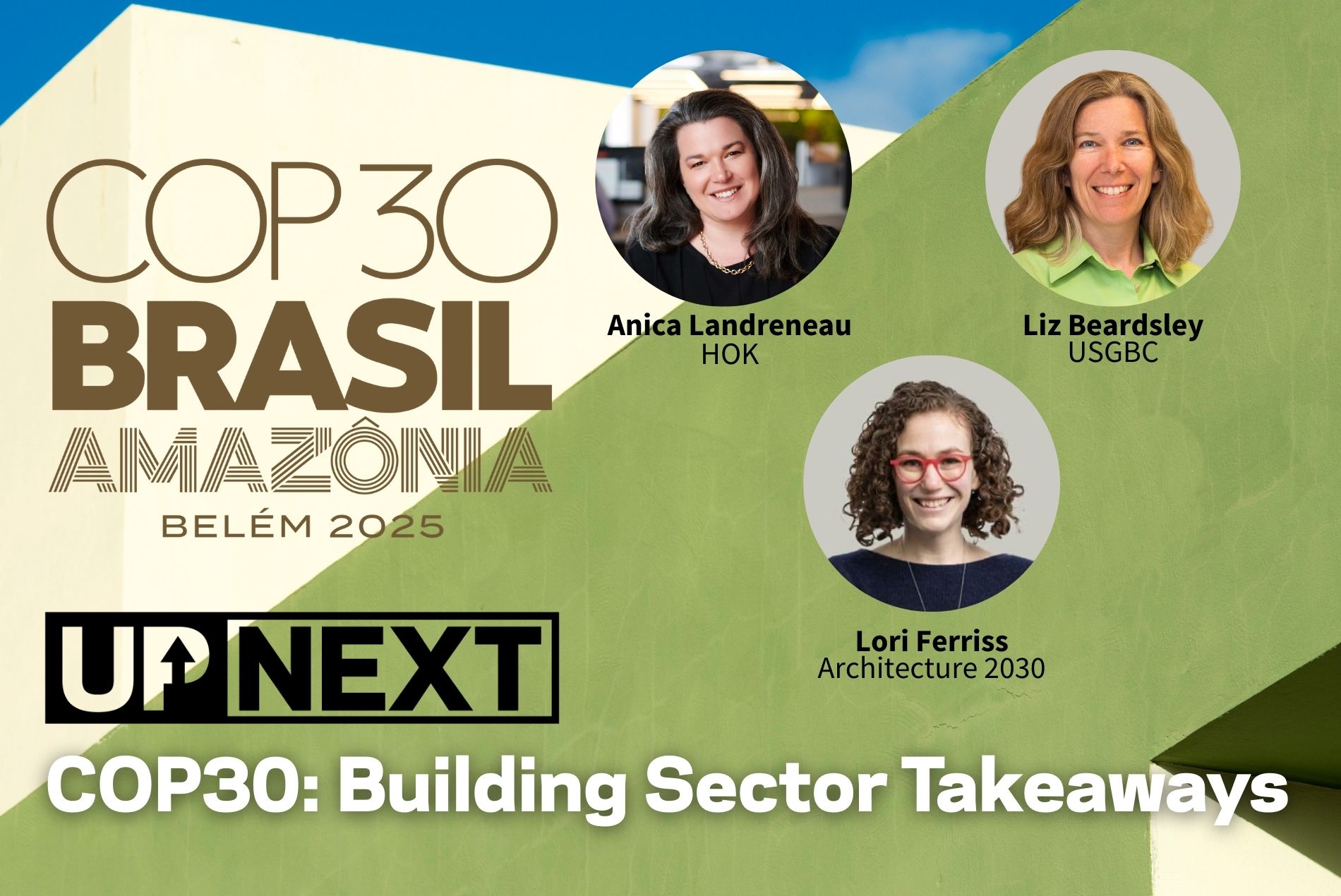
The panel, moderated by HOK Director of Public Relations Stephanie Miller, included three design leaders who attended COP30:
- Lori Ferriss is an architect, structural engineer and preservation specialist who champions building reuse in her role as co-founder of Built Buildings Lab.
- Liz Beardsley serves as senior policy counsel for the U.S. Green Building Council.
- Anica Landreneau is director of Sustainable Design at HOK and one of the authors of the updated LEED v5 green-building certification program.
View the entire panel discussion in the video below and continue on for a list of the key highlights.
Lack of U.S. federal participation = greater voice for others
Much of the pre-conference media focused on the U.S. federal government’s decision to not send delegates to this year’s COP. The U.S. absence opened doors for other actors, said Landreneau.
“Without the U.S., other nations were able to step up and negotiate more on their own terms,” she said. “While we hope that the U.S. isn’t absent every year, it didn’t deter the 194 nations that did participate from exploring opportunities for climate mitigation, resilience and adaptation.”
U.S. regional and local governments also helped fill the void, noted Landreneau, with many cities and states sending delegates, including California, which represents the fourth largest economy in the world.
Shift from goal-setting to implementation
Panelists agreed that COP30 marked a turning point for the global climate community. “This was dubbed the Implementation COP,” said Landreneau. “We have the technology. We have the strategies to do what we need. We now need to scale up implementation, and we need finance.”
One of the most significant developments enabling that shift was the introduction of the Action Agenda, a coordinated framework bringing together national governments, cities, private-sector leaders and NGOs under a shared structure to track and accelerate solutions.
Ferriss called it one of her “most optimistic takeaways,” noting that it “created a place for all of the different solutions that are continuing to drive measurable impact, no matter what happens in terms of the formal commitments.”
Buildings finally enter high-level climate negotiations
Building construction and operations (heating/cooling/lighting) are responsible for nearly 40% of global emissions. Yet the building sector has largely sat on the sidelines at previous COPs. That changed this year with the first ministerial-level meeting of the Intergovernmental Council for Buildings and Climate (ICBC).
The meeting elevated buildings to high-level COP negotiations and called on nations to have greater alignment on building codes and policies to mitigate climate change. This is important for two reasons:
- As Ferriss pointed out, preliminary findings from the Global Status Report for Buildings and Construction (due out in April) show that global building emissions increased 6.5% over the past decade. This is largely due to the continued expansion of the built environment, which last year added 5 billion square meters of new floorspace.
- Half of the world’s new construction is projected to occur in nations that today have few—if any—building energy codes, said Beardsley.
On a more positive note, Landreneau cited a new report on 100 of the world’s largest cities that showed they lowered emissions five times faster than the global average, suggesting that building performance standards in those cities are helping to improve environmental outcomes.
New global frameworks for materials and resilience
COP30 also introduced several new frameworks directly relevant to design and construction professionals.
One was the first Principles for Responsible Timber Construction, which formalizes a coalition between sustainable forestry and the building industry. “We’ve been talking for years about timber because it’s a decarbonized building material and supports responsible and sustainable forestry,” said Landreneau. “This COP created a framework that supports scaling up responsible timber use in construction in a way that aligns with land-use and climate goals.”
Ferriss also highlighted a major milestone: the formal inclusion of cultural heritage in both the Global Goal on Adaptation and the Action Agenda. “Existing and historic buildings bridge both technical and cultural solutions to the climate crisis,” she said. Adapting these buildings for better energy use and resilience not only improves existing places where people work, live and play, it helps strengthen community connections and influences behavior, noted Ferriss.
Growing pressure on global finance and development banks
Another key theme emerging from COP30 was the rising expectation that financial institutions, particularly multinational development banks, play a more active role in funding climate solutions.
“There’s a lot of pressure on finance to do more, especially on adaptation,” said Beardsley. She noted that banks are now being encouraged to require resilience-based risk assessments for building projects, a shift that will influence how future developments are financed and approved.
Helping nations, developers and financial institutions deliver cleaner and healthier buildings will require support from the design industry. “We have to be available to ask for that and show them how it’s possible,” concluded Beardsley.