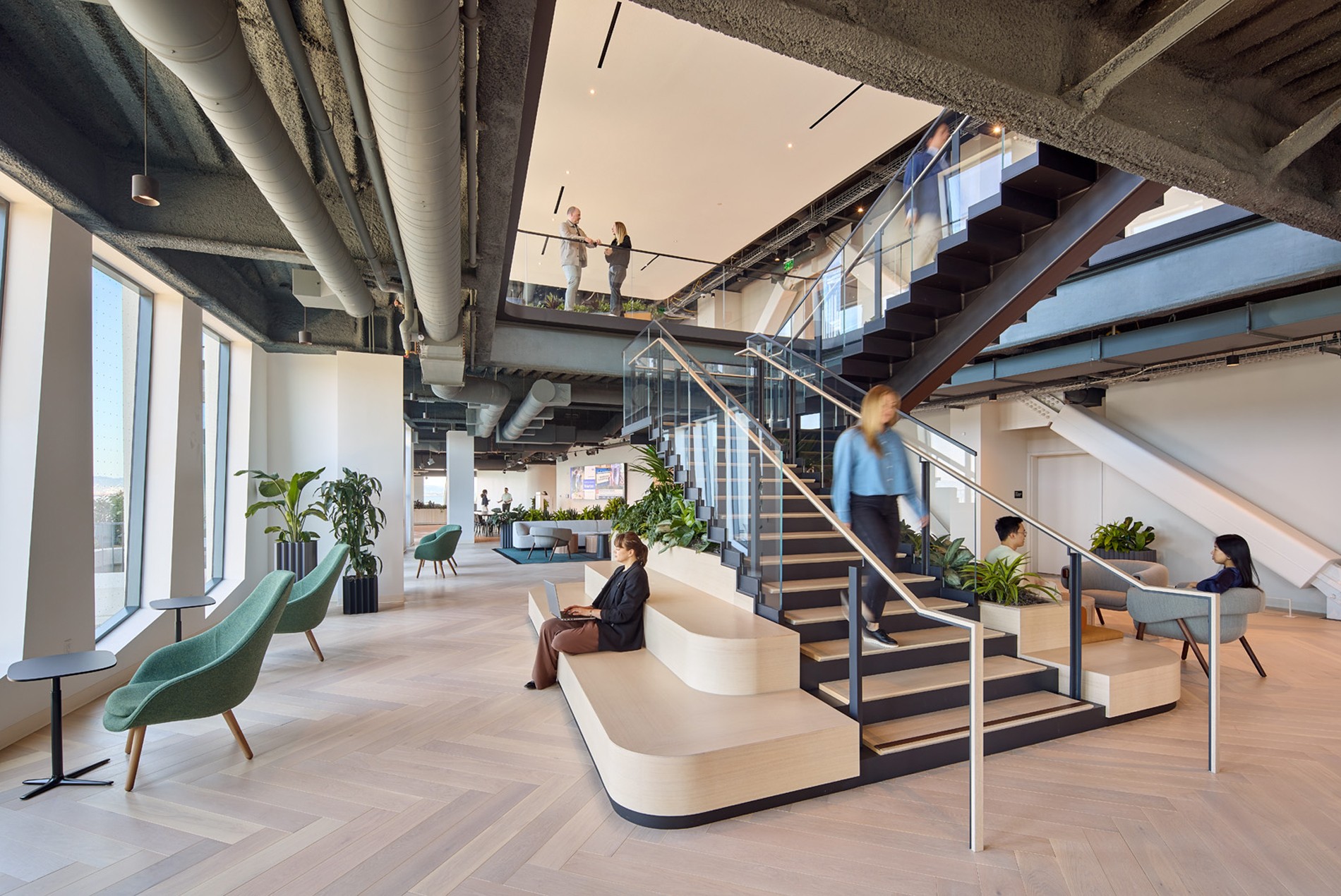
A confidential fintech company’s global headquarters occupies a tower in San Francisco. Inside the 302,900-sq.-ft. headquarters, executive leadership, North American operations and technology teams work under one roof. Our design transforms the office into a vertical campus with neighborhoods, Commons and terraces that create a flexible work environment. City views help people navigate, while terraces offer space for outdoor meetings.
The result is a workplace that draws people back to the office by experience, not mandate.
“The space is beautiful and truly reflects our brand aesthetic with a timeless yet dynamic design,” says the company’s director of global standards and workplace design. “HOK has created a professional, functional environment with a variety of amenity spaces and areas to work that provides choices, and our employees are drawn to that. People are excited to come to the office.”

Mid-pandemic, San Francisco’s commercial market froze. The company signed anyway, taking tenancy in a tower and betting that a headquarters could compete with remote work if it offered what home could not.
The company was looking for innovative solutions to bring executive leadership and North American teams together, compete for Bay Area talent against big-tech neighbors and make the employee commute worthwhile. Our design replaces conventional planning with Neighborhood Choice Environments that feature team zones without assigned seats, supported by a Commons on every floor and built-in hybrid infrastructure. Meeting rooms accommodate both in-person and remote participation.
Instead of including a cafeteria, the company chose distributed pantries and a grab-and-go café on Level 5, deliberately pushing daily foot traffic into the neighborhood’s emerging retail ecosystem. Employees support local businesses at lunch, and the headquarters feeds neighborhood life. A tower works better when its edges dissolve.

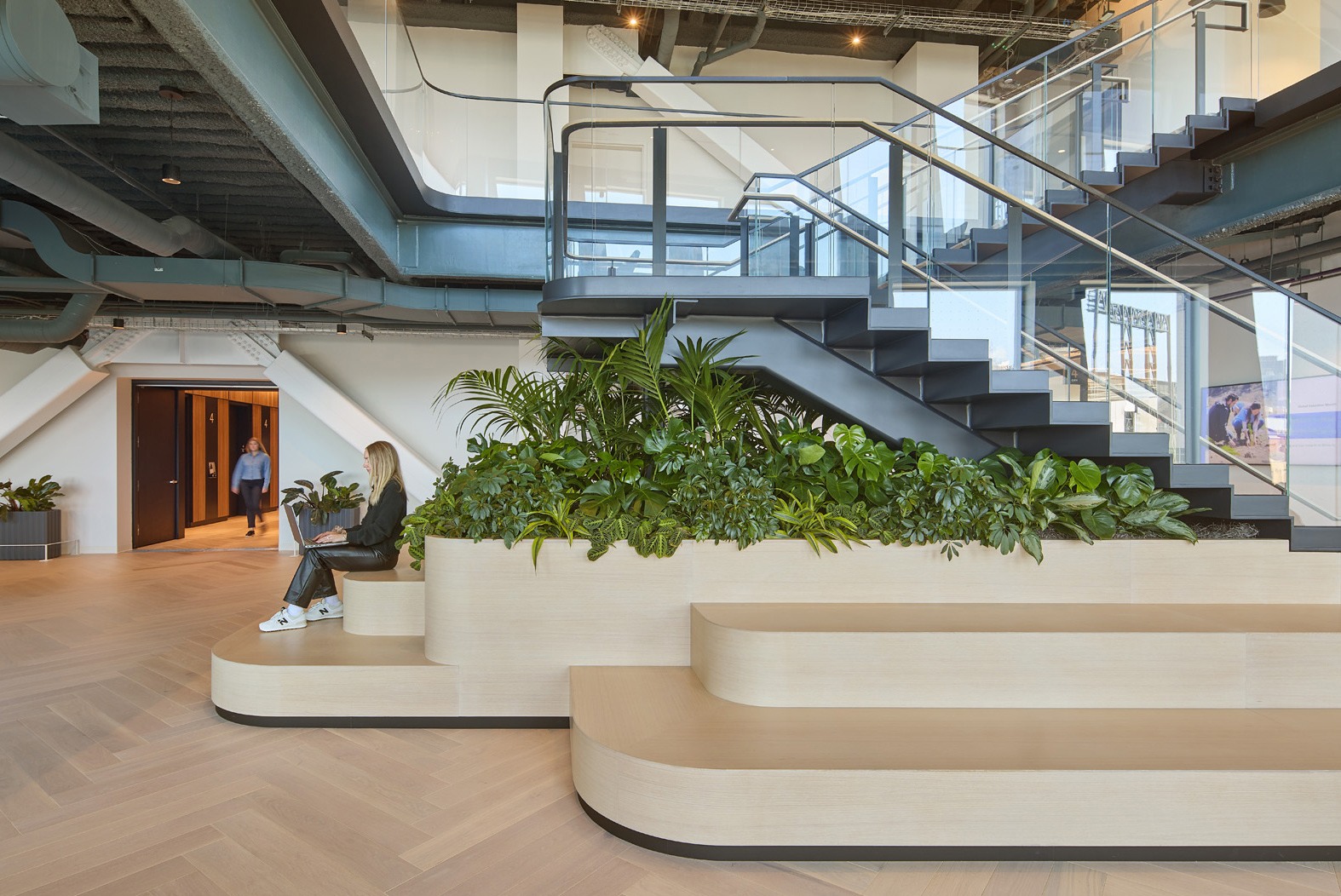
Level 5 serves as the true entrance. Elevators open to daylight, a concierge and a barista, with city views framing arrival.
Visitor processing occurs at street level, so Level 5 concentrates the reception experience. Clear sightlines and intuitive wayfinding lead to the centrally placed stair, which draws people to the Commons and sets the tone for movement between Levels 4 and 5.
This threshold signals openness and ease within the building while introducing the social heart that follows on Level 4.
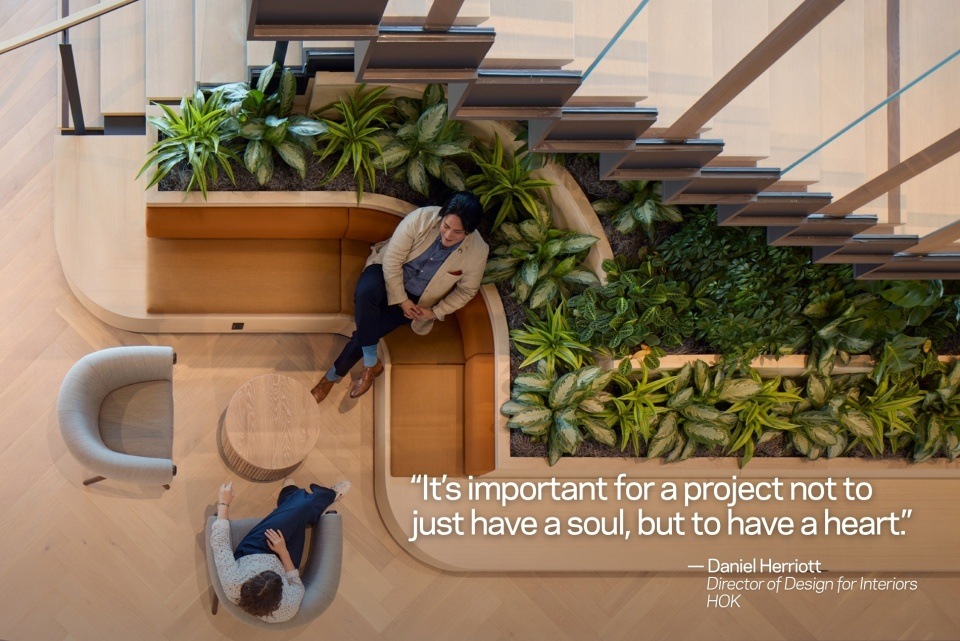
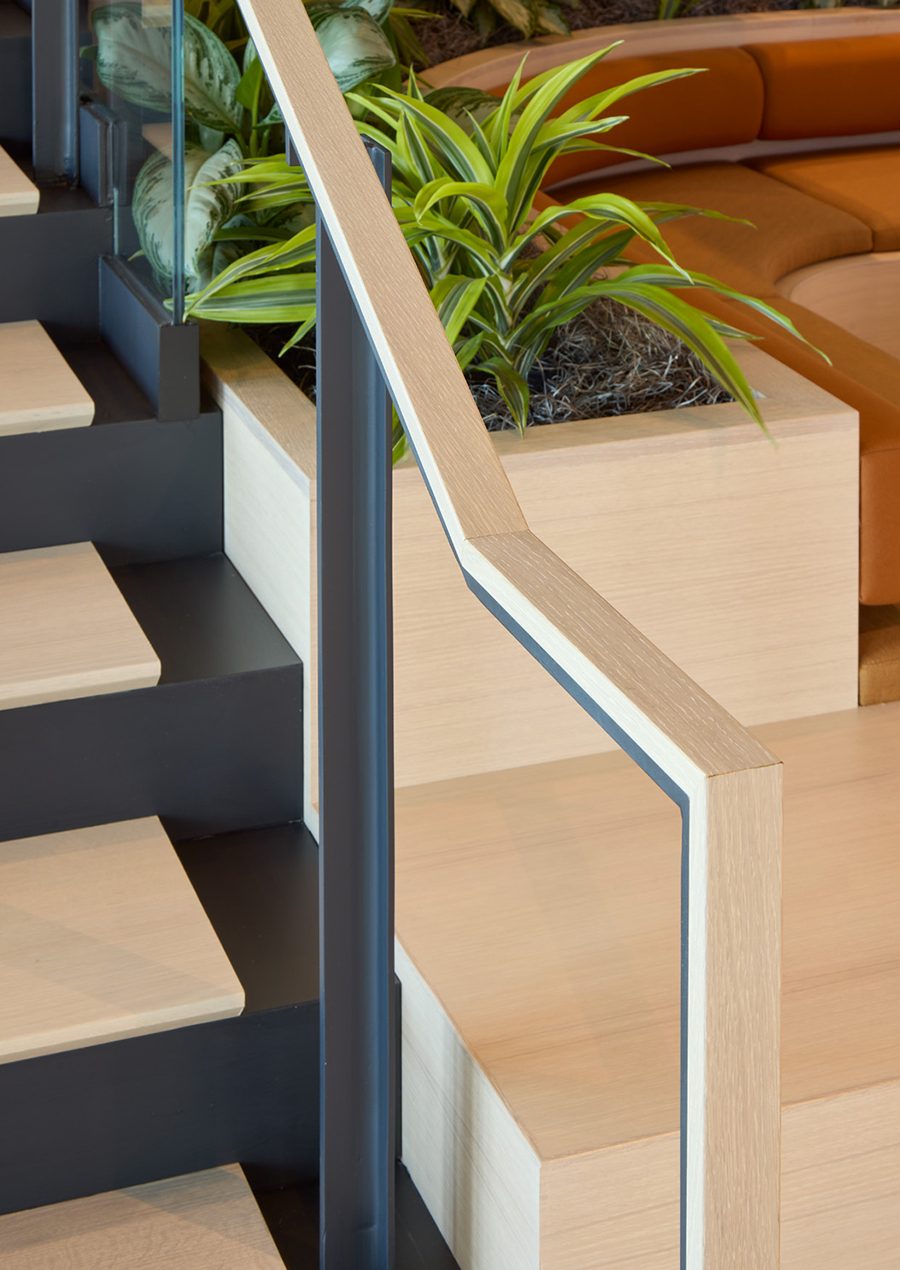
Between Levels 5 and 4, the stairs become a daily ritual and symbol—a sculptural shortcut that makes movement social, visibility natural and connection likely rather than scheduled.
Centrally placed between the elevator banks, adjacent to reception above and the Commons below, the custom stair uses clear proportions and sightlines to invite use and keep orientation intuitive. Architects, designers and builders considered every detail—handrails, materials, biophilia—to transform utility into sculpture.
The stair serves as a physical symbol and social magnet for everybody to come together, seamlessly connecting the two most social floors and fostering a sense of community among employees.
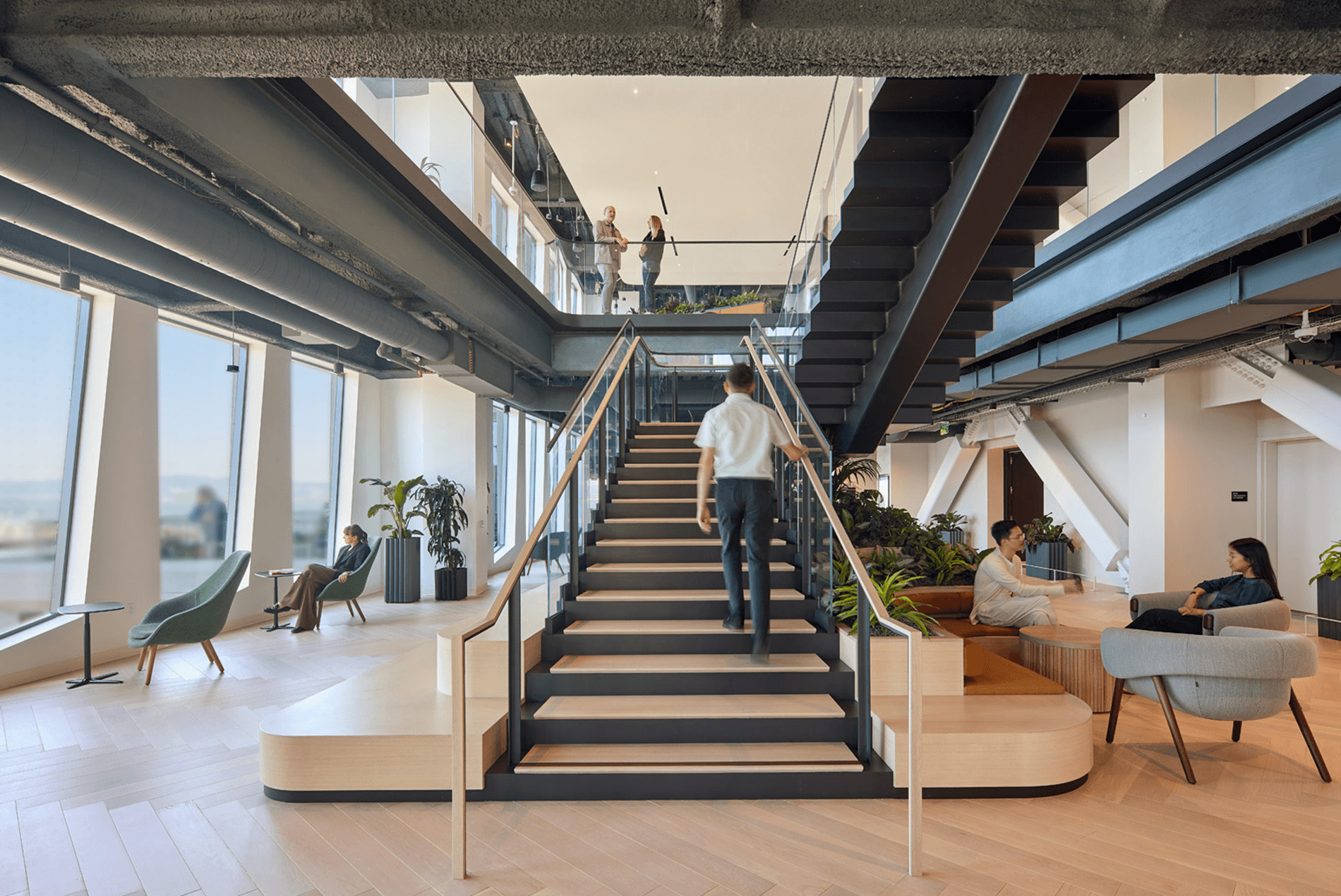

Commons anchor every floor so the best views become everyone’s views. They are open collaboration spaces designed with a flexible, cafe-style vibe and furniture that can be reconfigured for different needs.
The Commons are divided into social and working zones. Social Commons are designed to be vibrant, complete with music and a variety of seating options. Working Commons sit adjacent to project tables and integrated AV, enabling teams to move between zones. Materials and daylight create distinct atmospheres while keeping views open. In the active Commons, hardwood floors and open ceilings are intentionally used to amplify the energy, creating a lively, communal frequency. Pantries on each floor offer places to recharge while extensive daylighting supports visibility and connection to the outdoors.
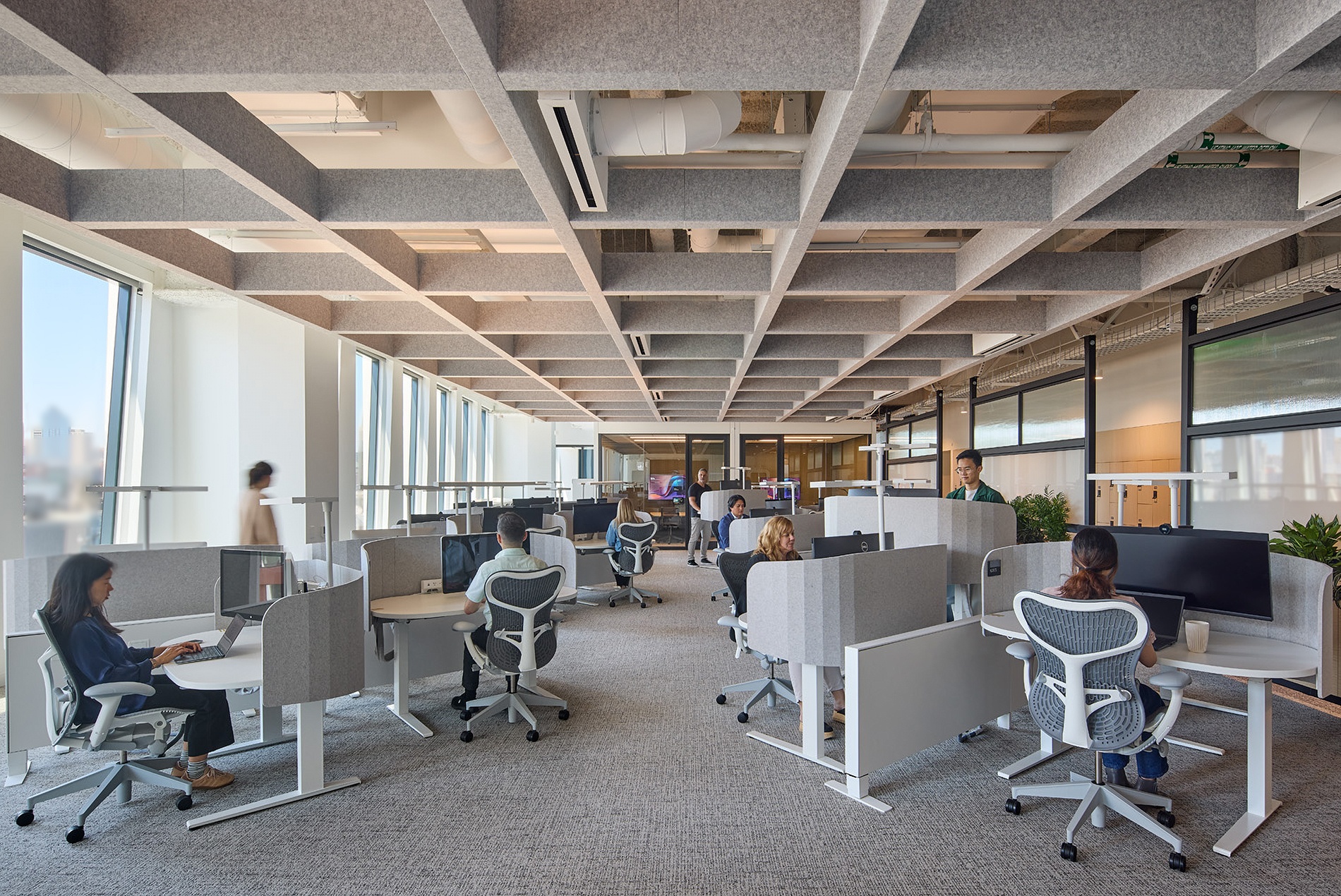
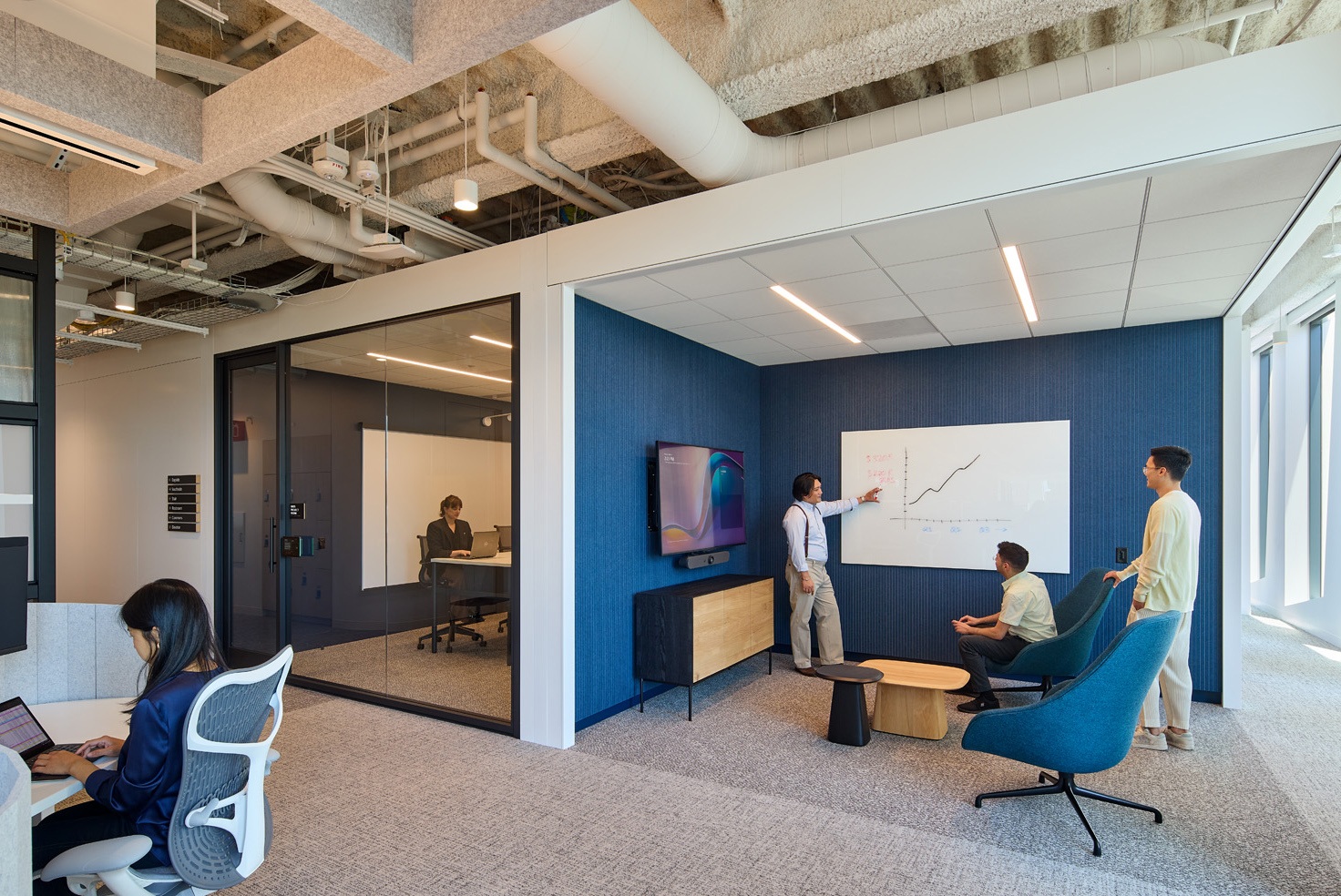
The company traded assigned seating for Neighborhood-based Choice Environments (NCEs), letting teams own zones and individuals claim a spot for the day. The shift from “my” to “our” makes territory fluid and adaptation constant.
Neighborhoods, which each support 32-40 people, have huddle rooms, paired focus booths, a project table, personal lockers and a support zone all within a two-minute walk. A flexible kit of parts—including demountable partitions and monitor-mounted lighting—creates a stable framework that can flex without renovation. Workstations break the grid as four-desk pinwheels that eliminate middle seats. Monitors mount on arms, and lighting mounts to monitor stands. Layouts change, but the neighborhood DNA remains intact.
The company’s people change their work environments at three speeds: a two-minute change when people shift how they use the space, a two-hour change using furniture to reconfigure a setting and a two-day change for moving demountable partitions. Booking and presence tools show who’s in and what’s free, letting teams reconfigure without changing floors or losing momentum.
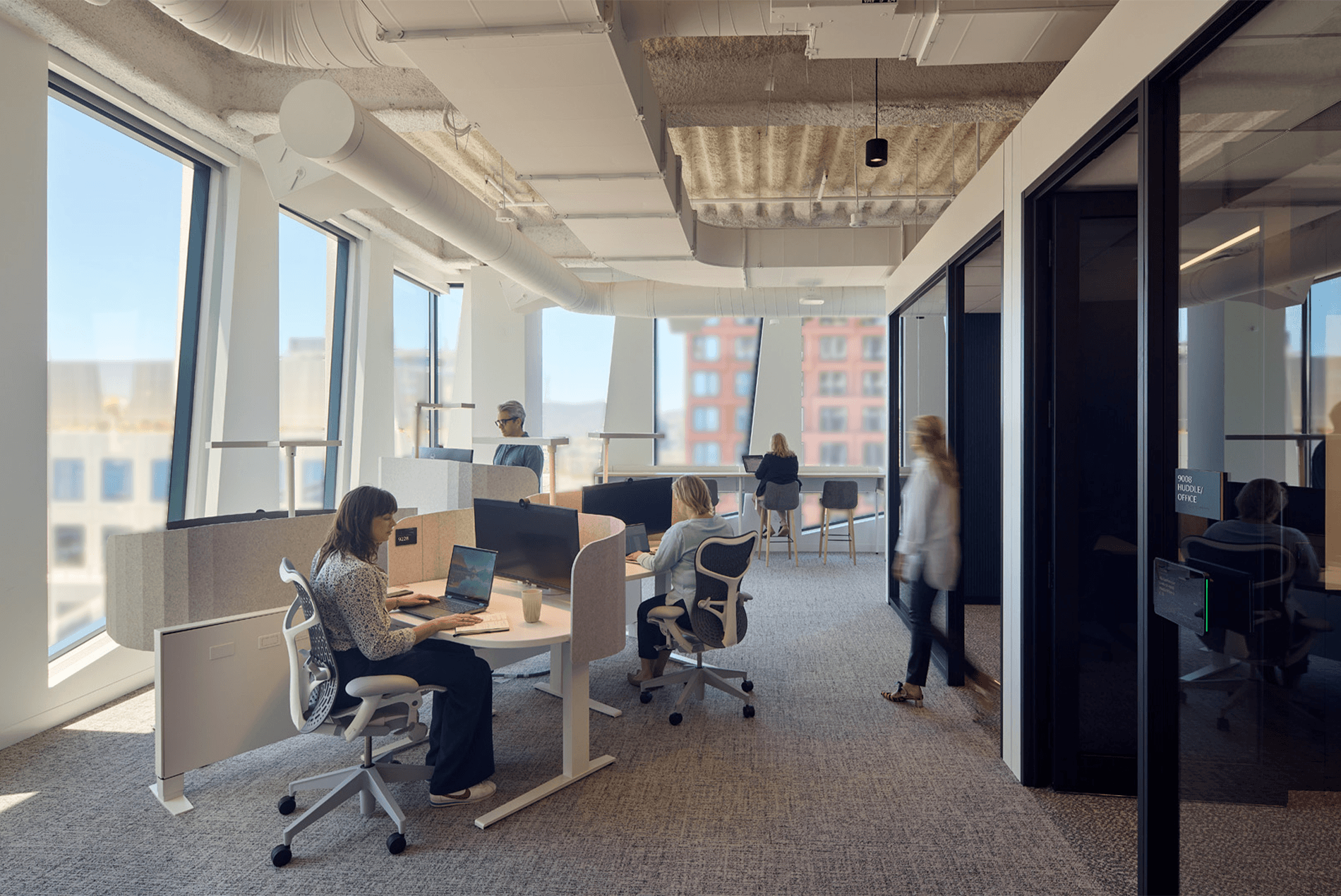
Orientation starts with the view. Each floor is divided into three zones named for local landmarks visible through the glass. Step off the elevator and location is clear before any sign comes into play.
Rather than relying on signage, the plan preserves an open perimeter and maximizes natural light so the horizon remains legible and the views do most of the work. A muted, nature-based palette keeps attention on the landscape and helps wayfinding feel intuitive rather than instructional.
Subtle cues do the rest. Natural materials and live plantings appear throughout, and customized signage supports the logic established by the views.
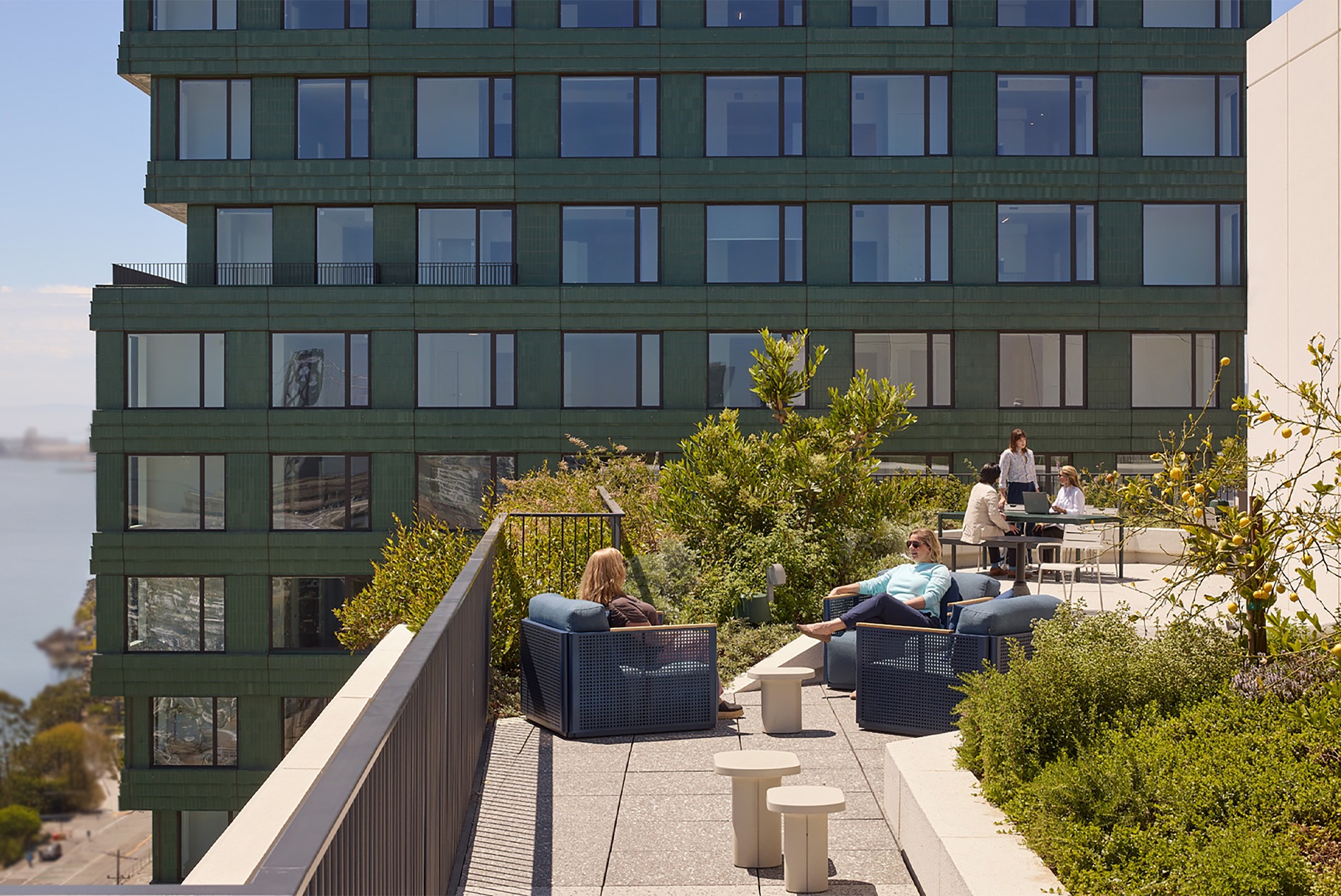
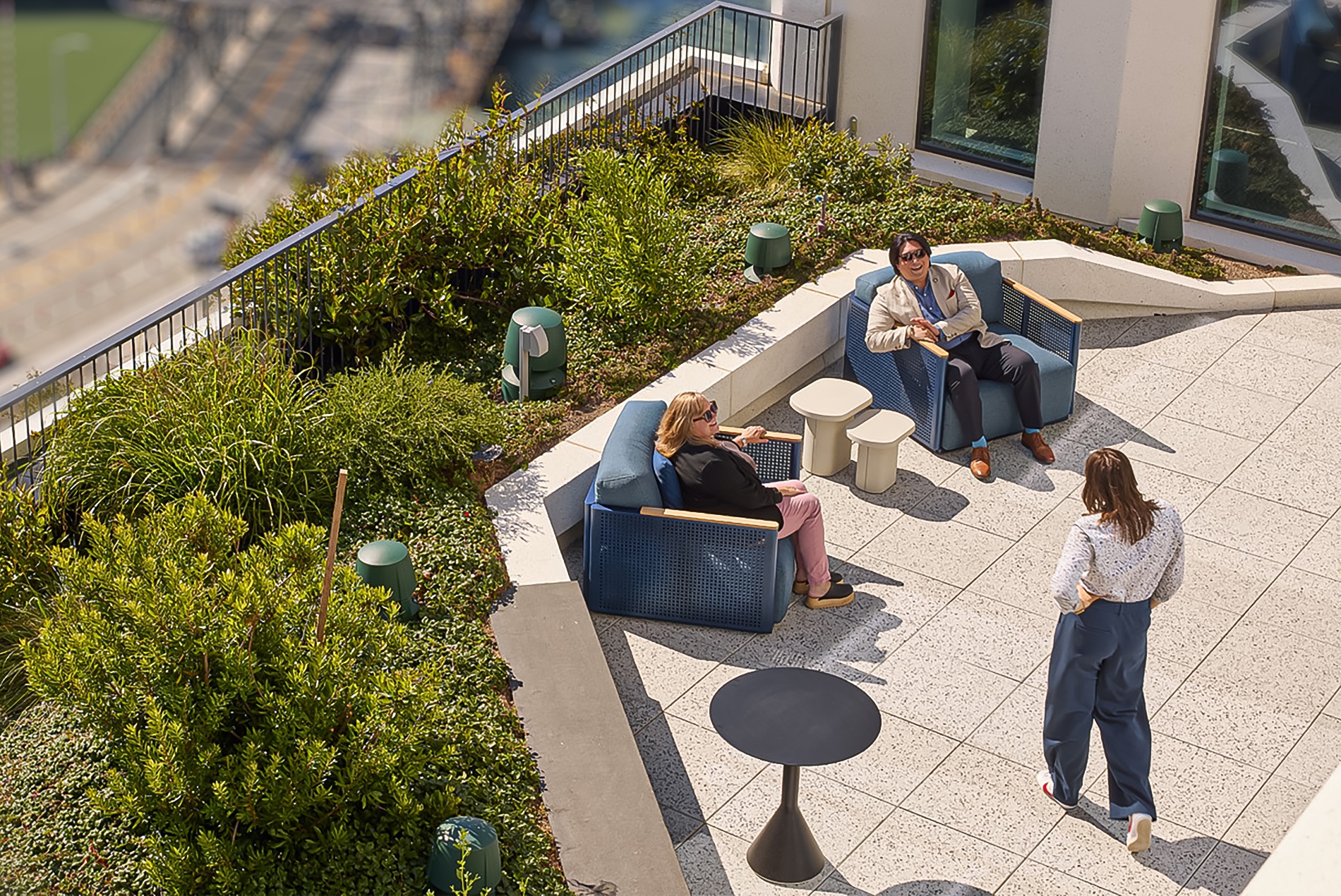
Work moves outside across terraces that step up two faces of the building, turning the perimeter into active workspaces and event areas. Small groups gather for quick conversations and all-hands move outdoors when the weather allows. The views are part of the experience.
Outdoor work is supported with Wi-Fi and planting that shapes comfortable edges. Casual furnishings accommodate everyday use and impromptu gatherings, and the terraces’ placement maintains direct relationships to interior spaces and the Bay and ballpark beyond.
As extensions of the workplace, the terraces add choice without adding complexity. They enable meetings in fresh air, host internal and external events and keep the building’s connection to its setting in constant view.

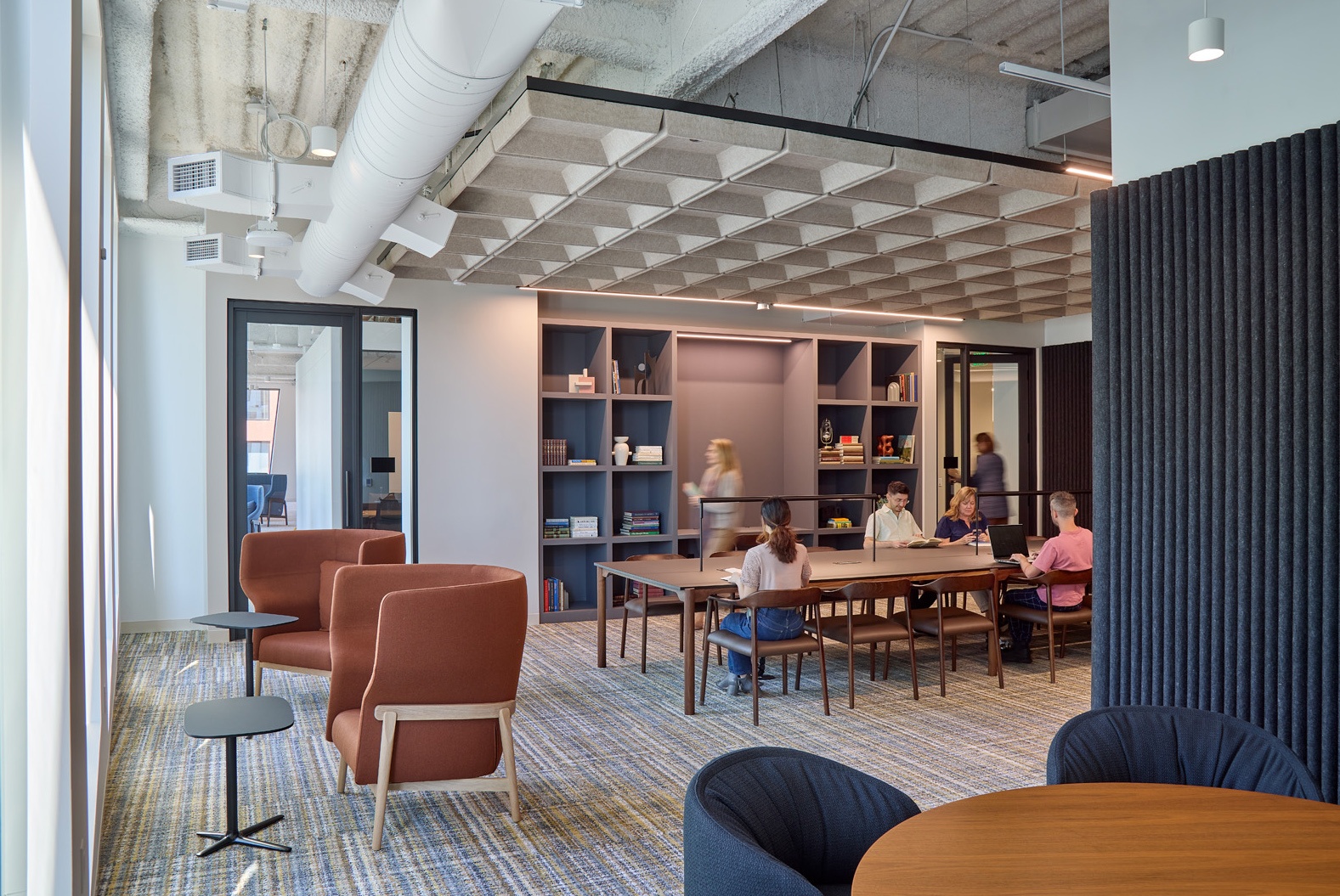
Choice drives wellness. the company’s people select environments that fit their task and temperament—silent libraries for deep focus, phone booths for calls and active Commons when stimulation helps the work. Desk-level lighting travels with the workstation and the building offers options so everyone can find their preferred setting.
Sound shapes behavior through a clear gradient. Noise steps down from the active, music-enabled Commons to quiet work zones and then to the libraries. Materials support this transition. Wood floors signal the energetic nature of the Commons while quieter zones use softer finishes and acoustic panels to absorb sound.
Neuroinclusion goes beyond accommodation. Settings range from enclosed to exposed and from calm to energetic, allowing people to adjust their environment without leaving the neighborhood. Movement is encouraged, with individuals able to choose stairs for short trips and to use terraces and daylit edges.
The headquarters demonstrates that choice, clarity and connection can change office behavior. Since opening, attendance has surpassed pre-pandemic levels—proof that the place itself can bring people back.

A confidential fintech company’s global headquarters occupies a tower in San Francisco. Inside the 302,900-sq.-ft. headquarters, executive leadership, North American operations and technology teams work under one roof. Our design transforms the office into a vertical campus with neighborhoods, Commons and terraces that create a flexible work environment. City views help people navigate, while terraces offer space for outdoor meetings.
The result is a workplace that draws people back to the office by experience, not mandate.
“The space is beautiful and truly reflects our brand aesthetic with a timeless yet dynamic design,” says the company’s director of global standards and workplace design. “HOK has created a professional, functional environment with a variety of amenity spaces and areas to work that provides choices, and our employees are drawn to that. People are excited to come to the office.”
Mid-pandemic, San Francisco’s commercial market froze. The company signed anyway, taking tenancy in a tower and betting that a headquarters could compete with remote work if it offered what home could not.
The company was looking for innovative solutions to bring executive leadership and North American teams together, compete for Bay Area talent against big-tech neighbors and make the employee commute worthwhile. Our design replaces conventional planning with Neighborhood Choice Environments that feature team zones without assigned seats, supported by a Commons on every floor and built-in hybrid infrastructure. Meeting rooms accommodate both in-person and remote participation.
Instead of including a cafeteria, the company chose distributed pantries and a grab-and-go café on Level 5, deliberately pushing daily foot traffic into the neighborhood’s emerging retail ecosystem. Employees support local businesses at lunch, and the headquarters feeds neighborhood life. A tower works better when its edges dissolve.
Level 5 serves as the true entrance. Elevators open to daylight, a concierge and a barista, with city views framing arrival.
Visitor processing occurs at street level, so Level 5 concentrates the reception experience. Clear sightlines and intuitive wayfinding lead to the centrally placed stair, which draws people to the Commons and sets the tone for movement between Levels 4 and 5.
This threshold signals openness and ease within the building while introducing the social heart that follows on Level 4.
Between Levels 5 and 4, the stairs become a daily ritual and symbol—a sculptural shortcut that makes movement social, visibility natural and connection likely rather than scheduled.
Centrally placed between the elevator banks, adjacent to reception above and the Commons below, the custom stair uses clear proportions and sightlines to invite use and keep orientation intuitive. Architects, designers and builders considered every detail—handrails, materials, biophilia—to transform utility into sculpture.
The stair serves as a physical symbol and social magnet for everybody to come together, seamlessly connecting the two most social floors and fostering a sense of community among employees.
Commons anchor every floor so the best views become everyone’s views. They are open collaboration spaces designed with a flexible, cafe-style vibe and furniture that can be reconfigured for different needs.
The Commons are divided into social and working zones. Social Commons are designed to be vibrant, complete with music and a variety of seating options. Working Commons sit adjacent to project tables and integrated AV, enabling teams to move between zones. Materials and daylight create distinct atmospheres while keeping views open. In the active Commons, hardwood floors and open ceilings are intentionally used to amplify the energy, creating a lively, communal frequency. Pantries on each floor offer places to recharge while extensive daylighting supports visibility and connection to the outdoors.
The company traded assigned seating for Neighborhood-based Choice Environments (NCEs), letting teams own zones and individuals claim a spot for the day. The shift from “my” to “our” makes territory fluid and adaptation constant.
Neighborhoods, which each support 32-40 people, have huddle rooms, paired focus booths, a project table, personal lockers and a support zone all within a two-minute walk. A flexible kit of parts—including demountable partitions and monitor-mounted lighting—creates a stable framework that can flex without renovation. Workstations break the grid as four-desk pinwheels that eliminate middle seats. Monitors mount on arms, and lighting mounts to monitor stands. Layouts change, but the neighborhood DNA remains intact.
The company’s people change their work environments at three speeds: a two-minute change when people shift how they use the space, a two-hour change using furniture to reconfigure a setting and a two-day change for moving demountable partitions. Booking and presence tools show who’s in and what’s free, letting teams reconfigure without changing floors or losing momentum.
Orientation starts with the view. Each floor is divided into three zones named for local landmarks visible through the glass. Step off the elevator and location is clear before any sign comes into play.
Rather than relying on signage, the plan preserves an open perimeter and maximizes natural light so the horizon remains legible and the views do most of the work. A muted, nature-based palette keeps attention on the landscape and helps wayfinding feel intuitive rather than instructional.
Subtle cues do the rest. Natural materials and live plantings appear throughout, and customized signage supports the logic established by the views.
Work moves outside across terraces that step up two faces of the building, turning the perimeter into active workspaces and event areas. Small groups gather for quick conversations and all-hands move outdoors when the weather allows. The views are part of the experience.
Outdoor work is supported with Wi-Fi and planting that shapes comfortable edges. Casual furnishings accommodate everyday use and impromptu gatherings, and the terraces’ placement maintains direct relationships to interior spaces and the Bay and ballpark beyond.
As extensions of the workplace, the terraces add choice without adding complexity. They enable meetings in fresh air, host internal and external events and keep the building’s connection to its setting in constant view.
Choice drives wellness. the company’s people select environments that fit their task and temperament—silent libraries for deep focus, phone booths for calls and active Commons when stimulation helps the work. Desk-level lighting travels with the workstation and the building offers options so everyone can find their preferred setting.
Sound shapes behavior through a clear gradient. Noise steps down from the active, music-enabled Commons to quiet work zones and then to the libraries. Materials support this transition. Wood floors signal the energetic nature of the Commons while quieter zones use softer finishes and acoustic panels to absorb sound.
Neuroinclusion goes beyond accommodation. Settings range from enclosed to exposed and from calm to energetic, allowing people to adjust their environment without leaving the neighborhood. Movement is encouraged, with individuals able to choose stairs for short trips and to use terraces and daylit edges.
The headquarters demonstrates that choice, clarity and connection can change office behavior. Since opening, attendance has surpassed pre-pandemic levels—proof that the place itself can bring people back.