
Before closing in 2015, the city’s blue-clad power plant—nicknamed “Big Blue” since it opened in the early 1960s—provided energy to Vero Beach for over 60 years. Now, its planned rebirth as a 20-acre public destination will be a new source of energy for the community. The site’s second life as a hyper-mixed-use development returns the largest and most economically valuable publicly owned waterfront property in Florida to the public.
The project’s core promise is to provide public access to the Indian River Lagoon, a shallow water estuary on Florida’s east coast. In a coastline dominated by privately controlled beach frontage, this development will restore everyday public access to a significant piece of waterfront.
Big Blue once divided the city from the lagoon. The plan creates a connected public realm that leads people from the streets of Vero Beach through the reimagined plant to the water. Anchoring the experience is the adaptive reuse of the entire power plant, which creates a new gateway, along with a Grand Promenade that connects the city to the water.
These four principles guide the project:
- Celebrate and elevate Vero Beach’s community and culture on the water.
- Create an environment that’s friendly to all life.
- Advance sustainability and resilience to thrive in the face of change.
- Connect and complement downtown, beaches, parks and shopping.
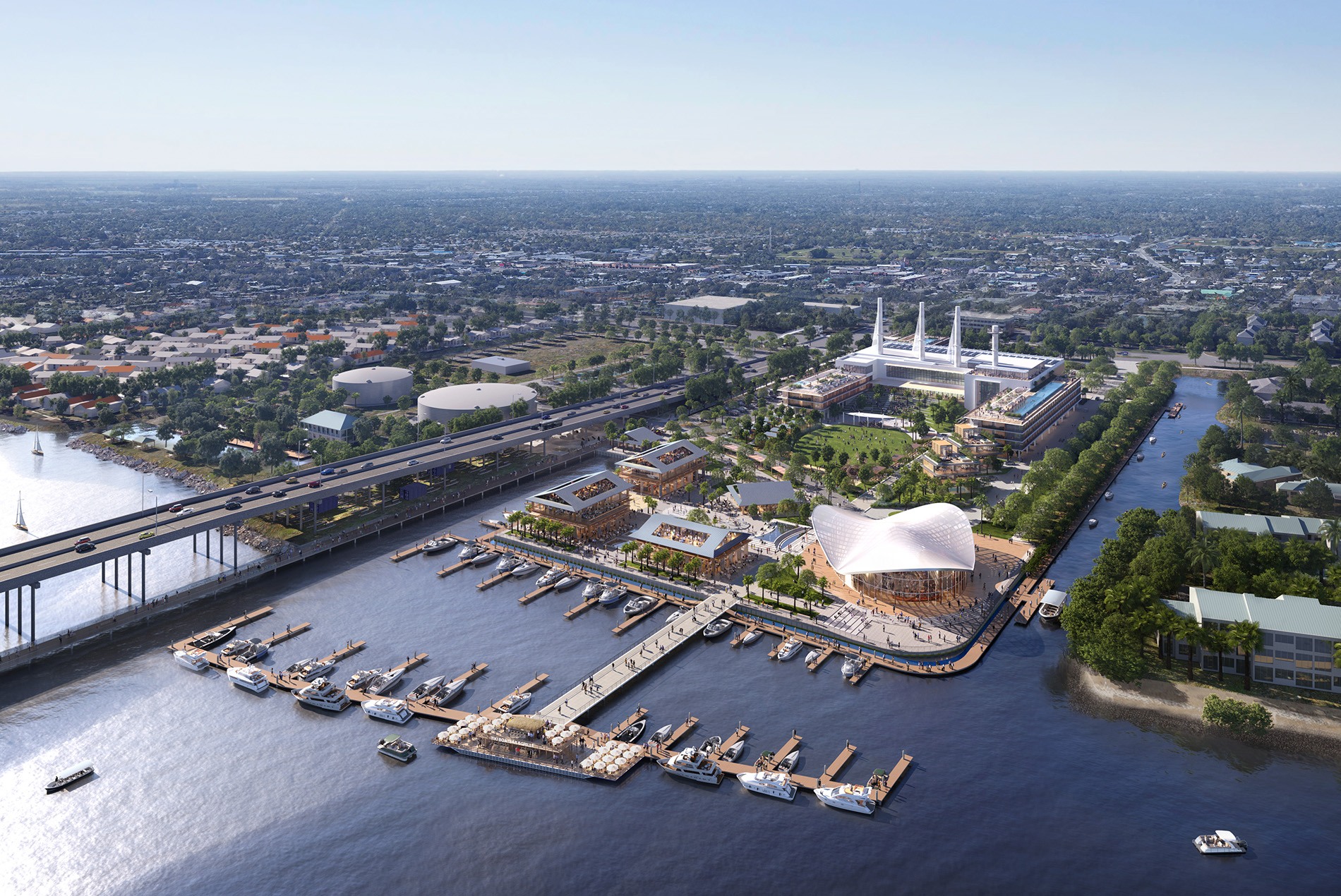
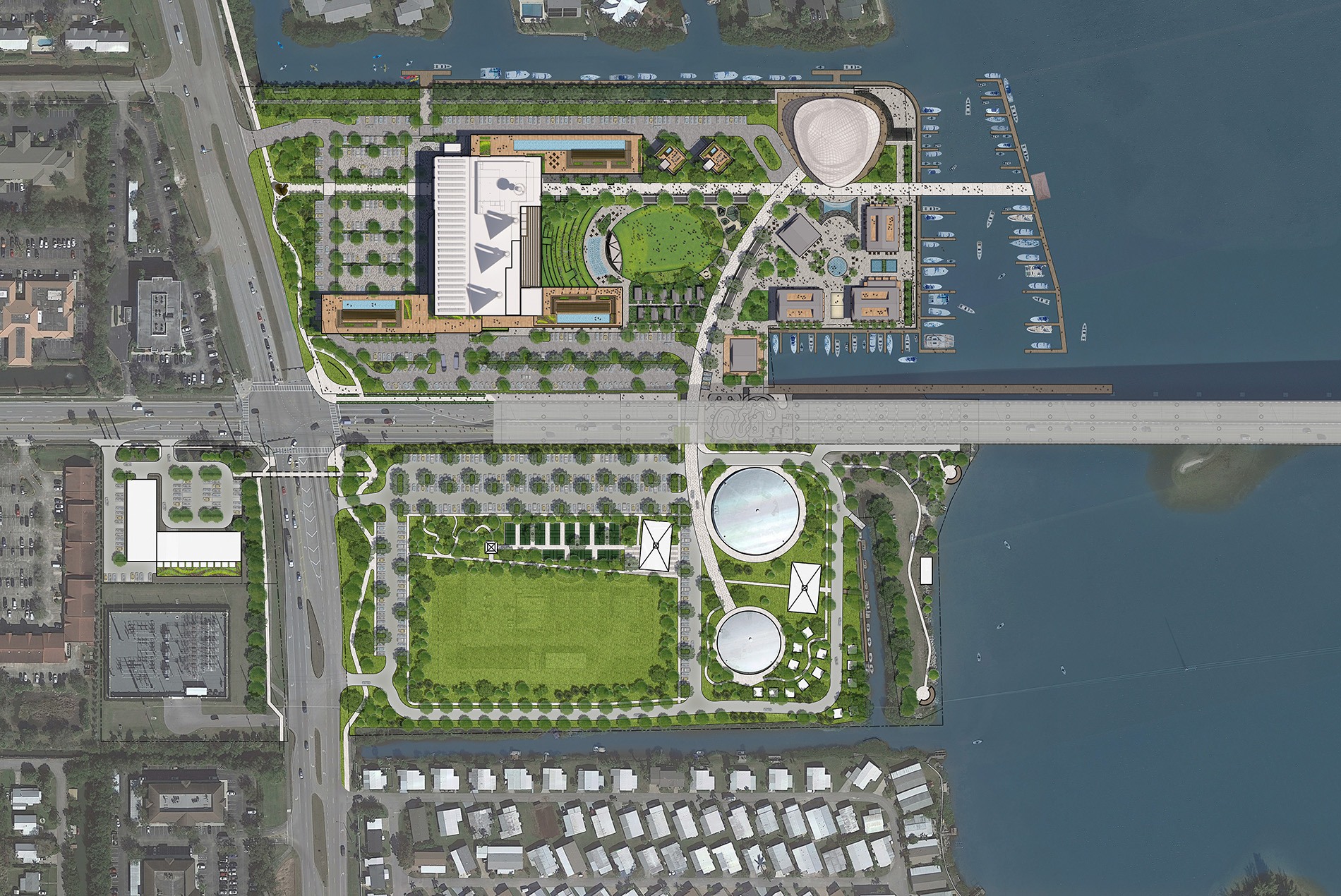
The master plan integrates these principles across a 347,000-sq.-ft, hyper-mixed-use development. Key program elements include the adaptive reuse of Big Blue housing a Great Hall food court, grocer, galleries and innovative officing; two hotels; a 400-seat Event Center; a Waterfront Village with an 84-slip marina and floating tiki bar; a community park with amphitheater; and recreational amenities ranging from a fishing pier to a pirate ship playground. A Grand Promenade, linking downtown to the lagoon, connects all these program elements.

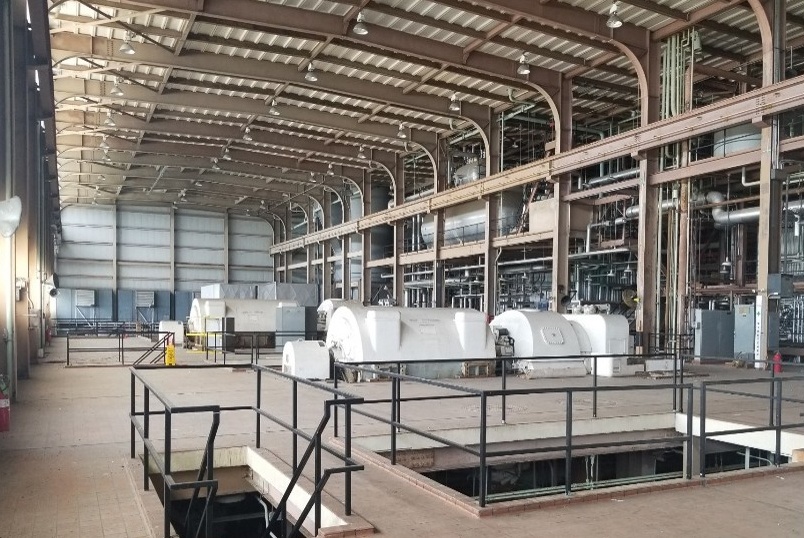
For decades the plant acted as a barrier between the city and the lagoon. Our plan enables it to work as the gateway to a continuous public realm. A new piazza at the entry forecourt, designed for farmers’ markets and art fairs, turns former back-of-house edges into the city’s front door.
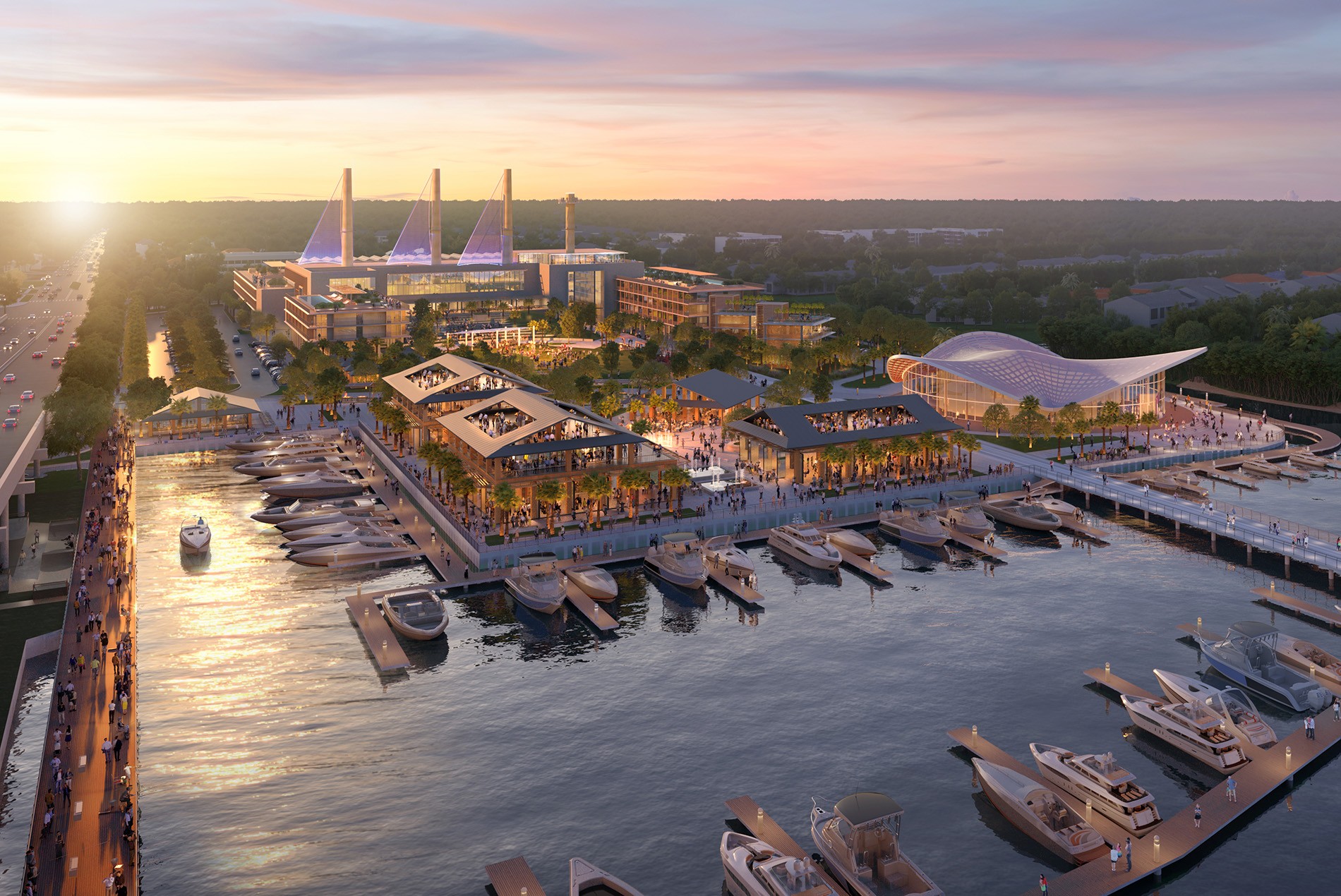
Keeping the entire structure preserves community memory, retains the three iconic smokestacks and creates volume for public gathering. The stacks become civic markers with LED sails visible along the coast, and the smaller stack adds an overlook that turns infrastructure into a destination.
The Great Hall anchors daily life with a food court and boutique grocer. The industrial character stays intact. Clearing decades of equipment and catwalks through what the team calls “white glove demolition” becomes careful subtraction rather than erasure, while preserving compelling and teachable legacy elements. A retained bridge crane becomes an interpretive feature with kinetic “jellyfish” lighting moving through the space—a playful nod to the lagoon’s marine ecology.


A Grand Promenade links the new festival plaza at the Indian River Boulevard entry—passing through Big Blue—to the marina on the lagoon. The plaza can accommodate weekly farmers’ markets and art fairs and is enclosed by new hotel frontage, creating a true public square.
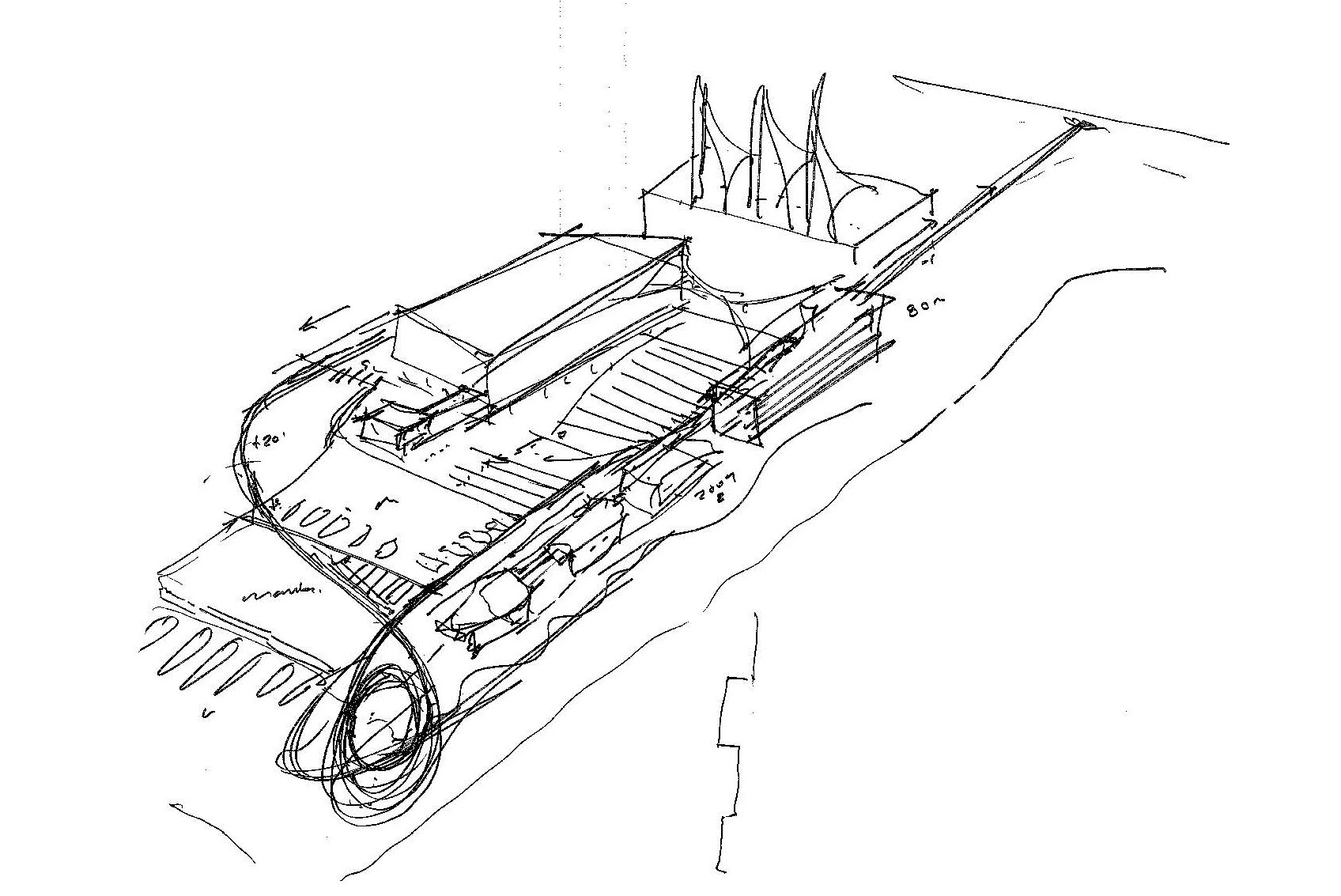
The promenade tracks the cross-section of the plant, then opens to the water through a preserved view corridor. A shaded walk under live oaks follows the north canal. Celebrated intersections tie paths into the spine. A fishing pier is included as a new amenity.
An arcing pathway continues beneath the highway bridge to the adjacent water treatment facility, where illuminated water tanks serve as landmarks for future-phase connections. Event and overflow parking is shifted to the treatment-plant site so the main pathway remains for people. The promenade helps connect various public spaces, including a community park with a landscaped amphitheater suitable for events.
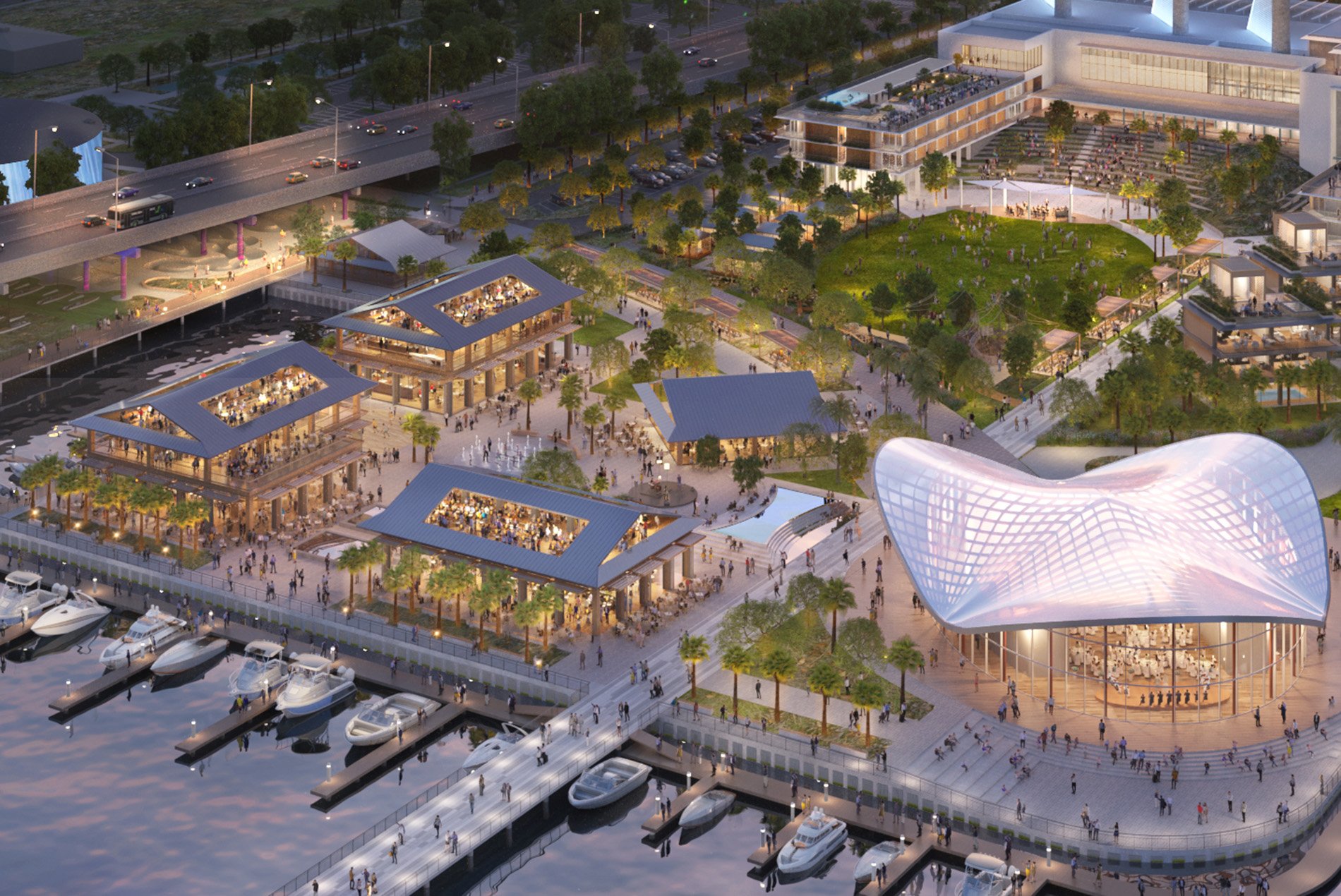

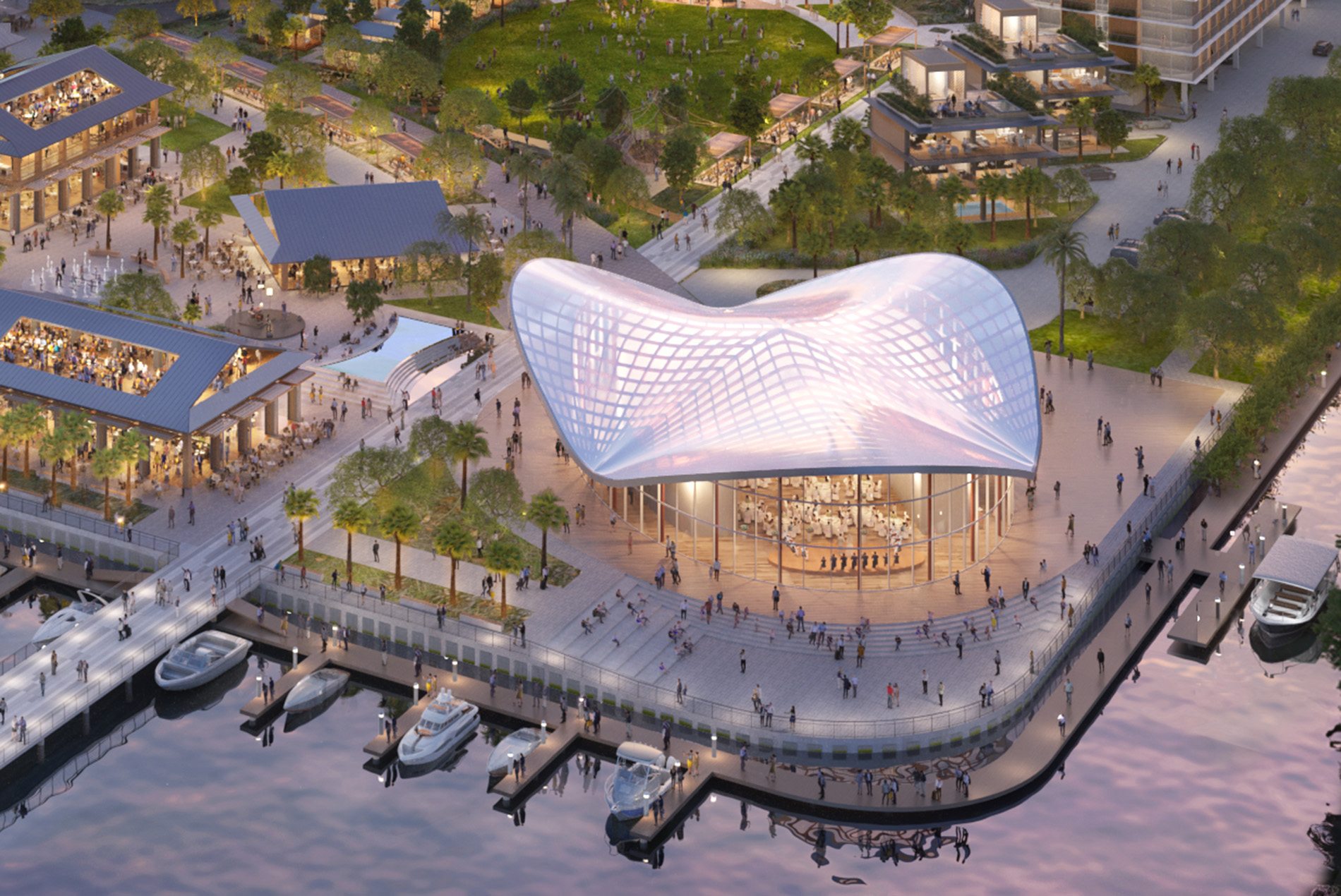
The Event Center anchors the lagoon edge with a 400-seat, outward-looking hall. Lobbies open to terraces, bringing performances and gatherings to the water’s edge. A sculptural roof is visible from the promenade and from boats on the lagoon, with a lightweight, translucent enclosure planned over a warm mass-timber structure. The form’s design references an undulating stingray, a rippling beach hat or a billowing sail.
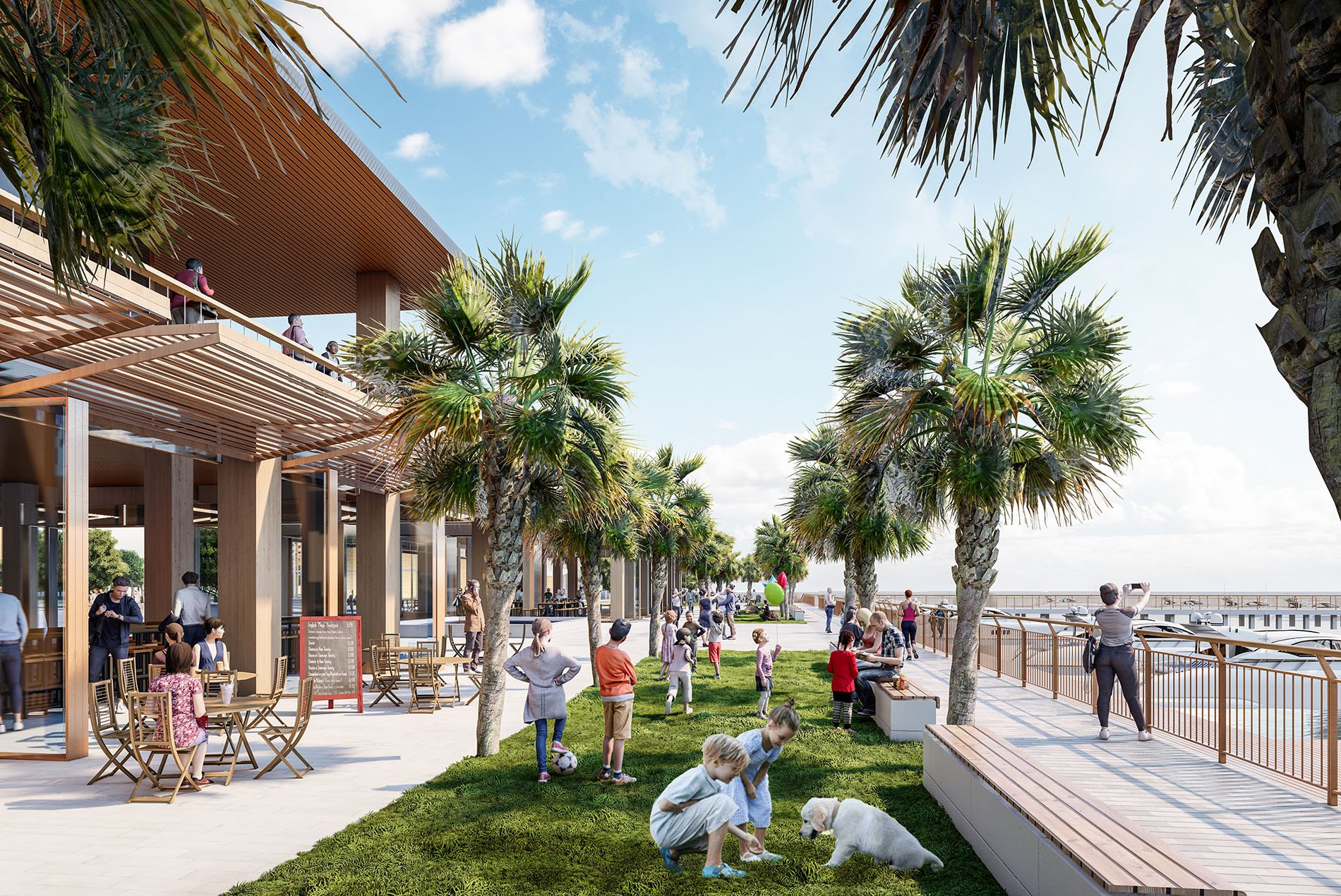
The Waterfront Village gathers four low-rise buildings along two axes, centered on a public square and three plazas. Ground floors open with operable glass to form shaded outdoor rooms, and integrated wooden shutters provide storm protection. The design and tenant strategy support local businesses and amenities that complement surrounding neighborhoods. The village fronts the promenade, with the marina located to avoid conflict with the mangrove protection zone.
Key amenities are designed as destinations. A floating tiki bar is a focal point for the marina, while a natural play park and a beach volleyball court anchor everyday public spaces.
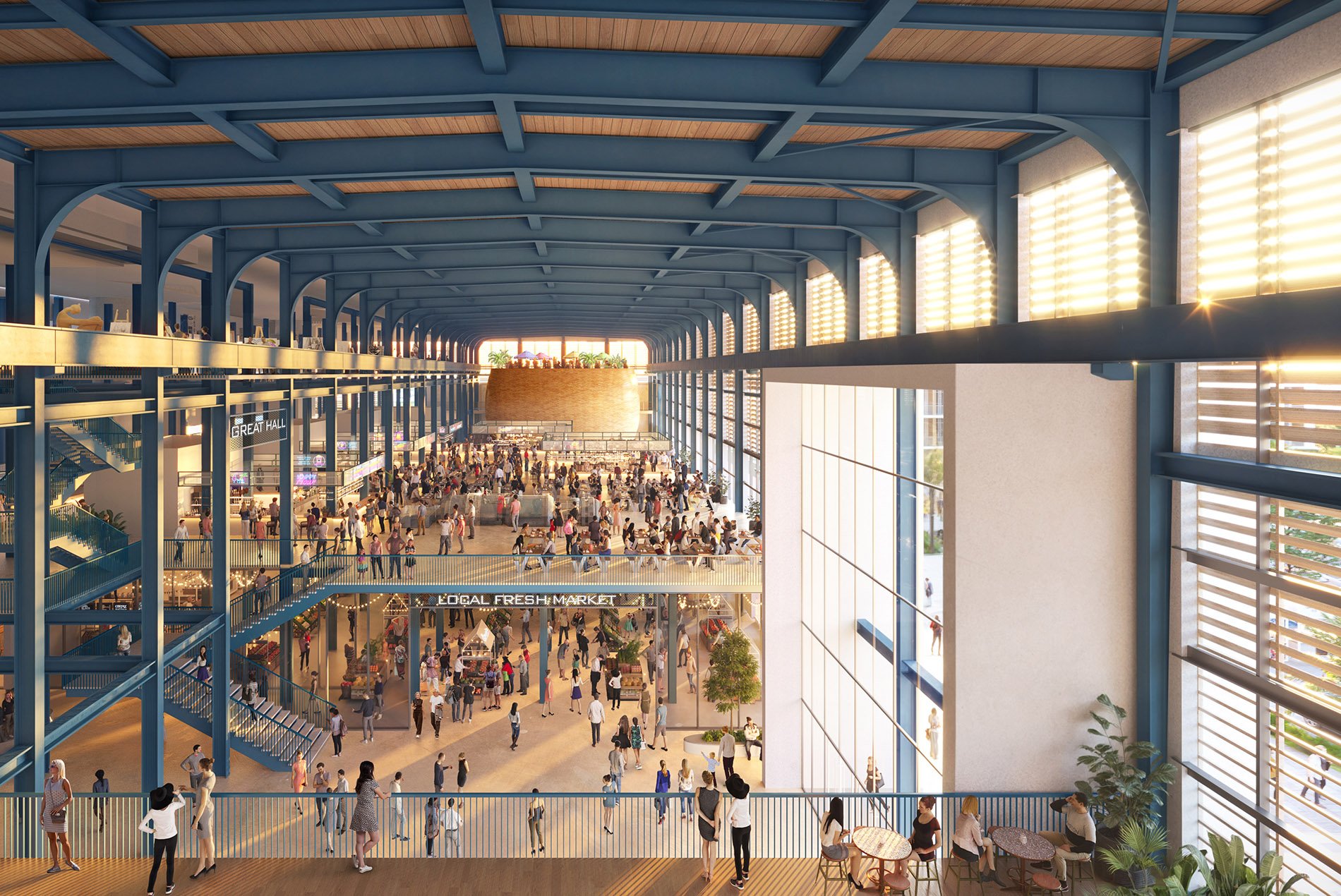
This place will be active every day, not just on performance nights. The Great Hall, with its food court and grocer, anchors this daily rhythm, while regular civic events like farmers’ markets keep the waterfront vibrant from early errands to late walks.
Physical spaces and programming are layered to ensure the site is active throughout the week and year. Diverse programs allow families to move between play areas and the square, while anglers share space with joggers and boaters tie up at the marina. On show nights, the Event Center increases the crowd, while the village holds people before and after performances. Much of this experience costs little or nothing—strolling, picnicking or watching boats—making the waterfront equitable and accessible to everyone.
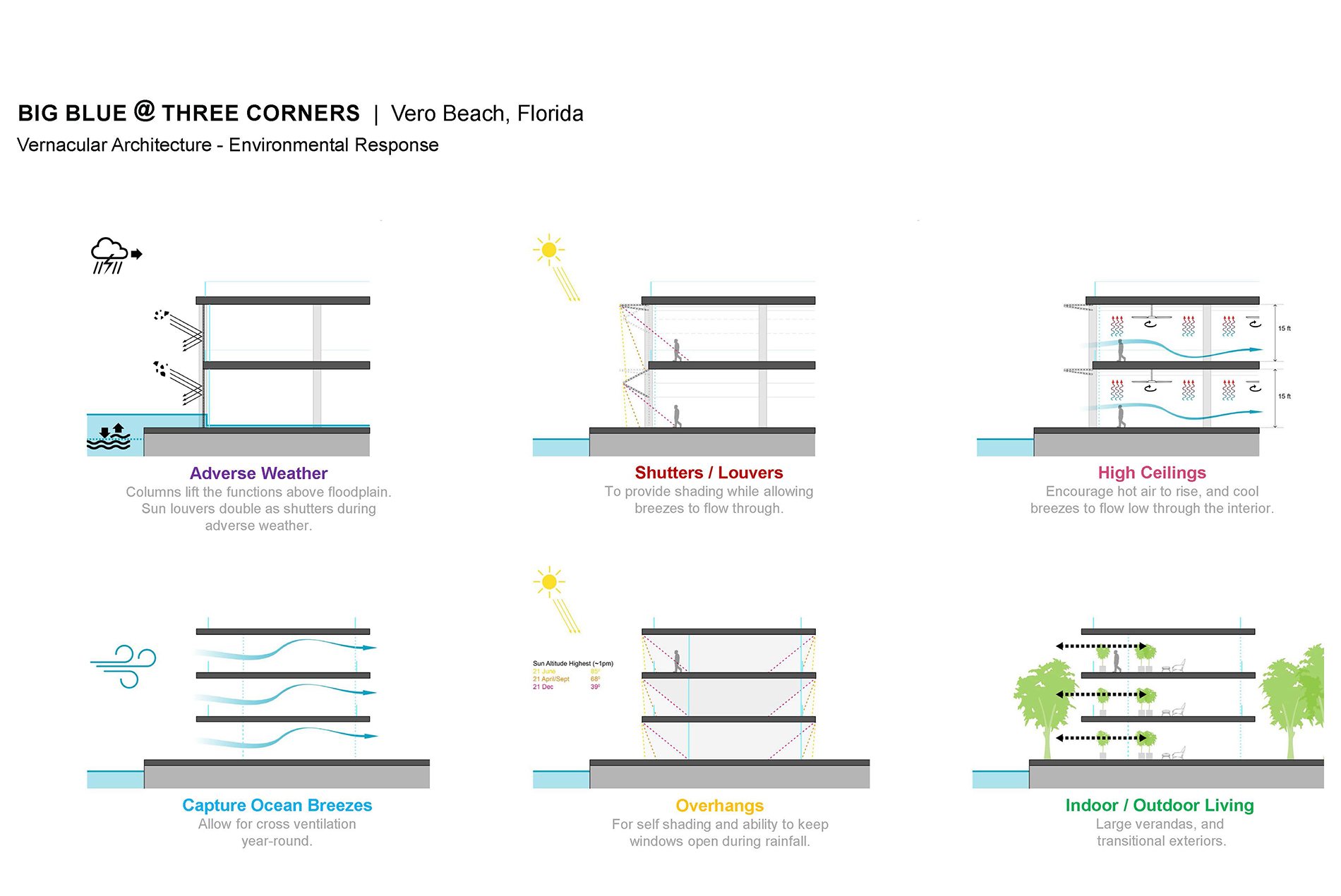
The design is tailored for seasonal patterns and resilience. Deep shade and climate-responsive architecture suit both winter and summer conditions. After a storm, the resilient design allows the district to reopen quickly so street life can resume.

The design reconciles Florida’s coastal climate with Big Blue’s industrial presence to create complementary design aesthetics for the district. Our solution keeps the scale human. One-story pavilions rise to four-story hotels, enhancing the plant rather than competing with it. Deep overhangs cast shade, and high ceilings let hot air lift away.
Light-colored, pitched metal roofs are sculpted to create functional terraces. This satisfies the community’s preference for a traditional hip roof silhouette while opening up the buildings to views and breezes. Warm timber set against bright white softens the industrial backdrop. Operable shutters bring shade on clear days and protect glass when storms approach.
Together, these moves give the waterfront a clear, local character—born from climate sense and the honest presence of the old plant.
The waterfront will be rebuilt to support life first. Mangrove protection zones are enhanced along the north canal. New 3D-printed living seawalls replace hard edges, creating microhabitat, improving water quality and calming waves. This will be one of the largest uses of the technology in Florida. Native plantings, shade trees and a series of rain gardens and detention basins clean stormwater before it reaches the lagoon.
Our plan reduces flood risk for buildings and the site. Elevated ground levels strengthen resilience against sea level rise and storm surges. Vital mechanical and electrical systems sit above the 500-year flood zone. Floodgates will protect the development during storms.
Resilience also means community continuity. With hotel rooms, a grocer and large interior gathering areas, the site can serve as a community resilience hub during natural disasters. On-site photovoltaics will continue Big Blue’s original legacy of providing energy to Vero Beach.

The project’s impact begins with adaptive reuse, turning an industrial asset into public value. Keeping Big Blue’s concrete and steel preserves embodied carbon and avoids the emissions of large-scale demolition and new construction. On the water, the restorative design adds vital habitat and improves the lagoon’s water quality through mangrove protection, 3D-printed living seawalls and native shade landscapes.
Our design prioritizes community access and mobility. Shaded, continuous promenades encourage pedestrian and bicycle traffic, connecting Vero Beach’s urban fabric directly to the water. Parking is kept off the main spine and largely at grade. At the downtown edge, connections to public transit, including local GoLine and water taxi stops, are part of the site plan.
The hyper-mixed-use program fuels regional economic growth. Pairing essential amenities like a grocer and business services with major draws like the Event Center and hotels creates a steady revenue stream and ensures the site is continuously activated.
The City of Vero Beach invited development teams to respond to an RFP for reimagining Three Corners. Through a multi-stage selection process, the public communicated that they wanted more than new buildings. They asked for everyday access to the water, a plan that felt like Vero Beach and a place for families and visitors. Our vision for a highly accessible, hyper-mixed-use waterfront resonated with the community.
Public support for the first-round design opened the door to a more refined second proposal. This allowed us to translate extensive community feedback into meaningful design moves. The plan evolved significantly: the Event Center moved from an island concept to the mainland, and a proposed parking structure became a public piazza, transforming the arrival experience.
The result was a plan that was more compact and aligned with cost expectations. The team’s internal design review confirmed what the community sensed: the editing had strengthened the design. By listening intently and revising the scheme, our team delivered a refined vision that earned overwhelming community backing and proved that thoughtful critique leads to better architecture.

Before closing in 2015, the city’s blue-clad power plant—nicknamed “Big Blue” since it opened in the early 1960s—provided energy to Vero Beach for over 60 years. Now, its planned rebirth as a 20-acre public destination will be a new source of energy for the community. The site’s second life as a hyper-mixed-use development returns the largest and most economically valuable publicly owned waterfront property in Florida to the public.
The project’s core promise is to provide public access to the Indian River Lagoon, a shallow water estuary on Florida’s east coast. In a coastline dominated by privately controlled beach frontage, this development will restore everyday public access to a significant piece of waterfront.
Big Blue once divided the city from the lagoon. The plan creates a connected public realm that leads people from the streets of Vero Beach through the reimagined plant to the water. Anchoring the experience is the adaptive reuse of the entire power plant, which creates a new gateway, along with a Grand Promenade that connects the city to the water.
These four principles guide the project:
- Celebrate and elevate Vero Beach’s community and culture on the water.
- Create an environment that’s friendly to all life.
- Advance sustainability and resilience to thrive in the face of change.
- Connect and complement downtown, beaches, parks and shopping.
The master plan integrates these principles across a 347,000-sq.-ft, hyper-mixed-use development. Key program elements include the adaptive reuse of Big Blue housing a Great Hall food court, grocer, galleries and innovative officing; two hotels; a 400-seat Event Center; a Waterfront Village with an 84-slip marina and floating tiki bar; a community park with amphitheater; and recreational amenities ranging from a fishing pier to a pirate ship playground. A Grand Promenade, linking downtown to the lagoon, connects all these program elements.
For decades the plant acted as a barrier between the city and the lagoon. Our plan enables it to work as the gateway to a continuous public realm. A new piazza at the entry forecourt, designed for farmers’ markets and art fairs, turns former back-of-house edges into the city’s front door.
Keeping the entire structure preserves community memory, retains the three iconic smokestacks and creates volume for public gathering. The stacks become civic markers with LED sails visible along the coast, and the smaller stack adds an overlook that turns infrastructure into a destination.
The Great Hall anchors daily life with a food court and boutique grocer. The industrial character stays intact. Clearing decades of equipment and catwalks through what the team calls “white glove demolition” becomes careful subtraction rather than erasure, while preserving compelling and teachable legacy elements. A retained bridge crane becomes an interpretive feature with kinetic “jellyfish” lighting moving through the space—a playful nod to the lagoon’s marine ecology.
A Grand Promenade links the new festival plaza at the Indian River Boulevard entry—passing through Big Blue—to the marina on the lagoon. The plaza can accommodate weekly farmers’ markets and art fairs and is enclosed by new hotel frontage, creating a true public square.
The promenade tracks the cross-section of the plant, then opens to the water through a preserved view corridor. A shaded walk under live oaks follows the north canal. Celebrated intersections tie paths into the spine. A fishing pier is included as a new amenity.
An arcing pathway continues beneath the highway bridge to the adjacent water treatment facility, where illuminated water tanks serve as landmarks for future-phase connections. Event and overflow parking is shifted to the treatment-plant site so the main pathway remains for people. The promenade helps connect various public spaces, including a community park with a landscaped amphitheater suitable for events.
The Event Center anchors the lagoon edge with a 400-seat, outward-looking hall. Lobbies open to terraces, bringing performances and gatherings to the water’s edge. A sculptural roof is visible from the promenade and from boats on the lagoon, with a lightweight, translucent enclosure planned over a warm mass-timber structure. The form’s design references an undulating stingray, a rippling beach hat or a billowing sail.
The Waterfront Village gathers four low-rise buildings along two axes, centered on a public square and three plazas. Ground floors open with operable glass to form shaded outdoor rooms, and integrated wooden shutters provide storm protection. The design and tenant strategy support local businesses and amenities that complement surrounding neighborhoods. The village fronts the promenade, with the marina located to avoid conflict with the mangrove protection zone.
Key amenities are designed as destinations. A floating tiki bar is a focal point for the marina, while a natural play park and a beach volleyball court anchor everyday public spaces.
This place will be active every day, not just on performance nights. The Great Hall, with its food court and grocer, anchors this daily rhythm, while regular civic events like farmers’ markets keep the waterfront vibrant from early errands to late walks.
Physical spaces and programming are layered to ensure the site is active throughout the week and year. Diverse programs allow families to move between play areas and the square, while anglers share space with joggers and boaters tie up at the marina. On show nights, the Event Center increases the crowd, while the village holds people before and after performances. Much of this experience costs little or nothing—strolling, picnicking or watching boats—making the waterfront equitable and accessible to everyone.
The design is tailored for seasonal patterns and resilience. Deep shade and climate-responsive architecture suit both winter and summer conditions. After a storm, the resilient design allows the district to reopen quickly so street life can resume.
The design reconciles Florida’s coastal climate with Big Blue’s industrial presence to create complementary design aesthetics for the district. Our solution keeps the scale human. One-story pavilions rise to four-story hotels, enhancing the plant rather than competing with it. Deep overhangs cast shade, and high ceilings let hot air lift away.
Light-colored, pitched metal roofs are sculpted to create functional terraces. This satisfies the community’s preference for a traditional hip roof silhouette while opening up the buildings to views and breezes. Warm timber set against bright white softens the industrial backdrop. Operable shutters bring shade on clear days and protect glass when storms approach.
Together, these moves give the waterfront a clear, local character—born from climate sense and the honest presence of the old plant.
The waterfront will be rebuilt to support life first. Mangrove protection zones are enhanced along the north canal. New 3D-printed living seawalls replace hard edges, creating microhabitat, improving water quality and calming waves. This will be one of the largest uses of the technology in Florida. Native plantings, shade trees and a series of rain gardens and detention basins clean stormwater before it reaches the lagoon.
Our plan reduces flood risk for buildings and the site. Elevated ground levels strengthen resilience against sea level rise and storm surges. Vital mechanical and electrical systems sit above the 500-year flood zone. Floodgates will protect the development during storms.
Resilience also means community continuity. With hotel rooms, a grocer and large interior gathering areas, the site can serve as a community resilience hub during natural disasters. On-site photovoltaics will continue Big Blue’s original legacy of providing energy to Vero Beach.
The project’s impact begins with adaptive reuse, turning an industrial asset into public value. Keeping Big Blue’s concrete and steel preserves embodied carbon and avoids the emissions of large-scale demolition and new construction. On the water, the restorative design adds vital habitat and improves the lagoon’s water quality through mangrove protection, 3D-printed living seawalls and native shade landscapes.
Our design prioritizes community access and mobility. Shaded, continuous promenades encourage pedestrian and bicycle traffic, connecting Vero Beach’s urban fabric directly to the water. Parking is kept off the main spine and largely at grade. At the downtown edge, connections to public transit, including local GoLine and water taxi stops, are part of the site plan.
The hyper-mixed-use program fuels regional economic growth. Pairing essential amenities like a grocer and business services with major draws like the Event Center and hotels creates a steady revenue stream and ensures the site is continuously activated.
The City of Vero Beach invited development teams to respond to an RFP for reimagining Three Corners. Through a multi-stage selection process, the public communicated that they wanted more than new buildings. They asked for everyday access to the water, a plan that felt like Vero Beach and a place for families and visitors. Our vision for a highly accessible, hyper-mixed-use waterfront resonated with the community.
Public support for the first-round design opened the door to a more refined second proposal. This allowed us to translate extensive community feedback into meaningful design moves. The plan evolved significantly: the Event Center moved from an island concept to the mainland, and a proposed parking structure became a public piazza, transforming the arrival experience.
The result was a plan that was more compact and aligned with cost expectations. The team’s internal design review confirmed what the community sensed: the editing had strengthened the design. By listening intently and revising the scheme, our team delivered a refined vision that earned overwhelming community backing and proved that thoughtful critique leads to better architecture.